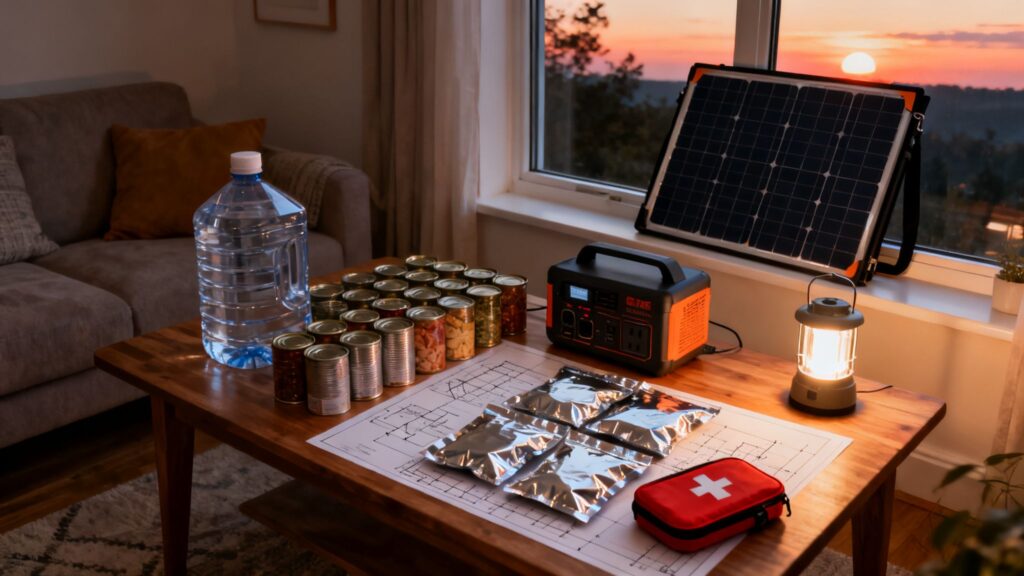
When it comes to preparing for a long-term power outage, the first thing people think of is flashlights and batteries. That’s a start, but we need to think bigger. A lot bigger.
This isn’t about just getting through a few hours of inconvenience. It’s about building a solid, layered plan to sustain your family when the modern world grinds to a halt for days, or even weeks. It’s about securing the absolute essentials—water, food, and medical supplies—before the lights go out.
Beyond Flickering Lights: The Reality of a Grid-Down Scenario
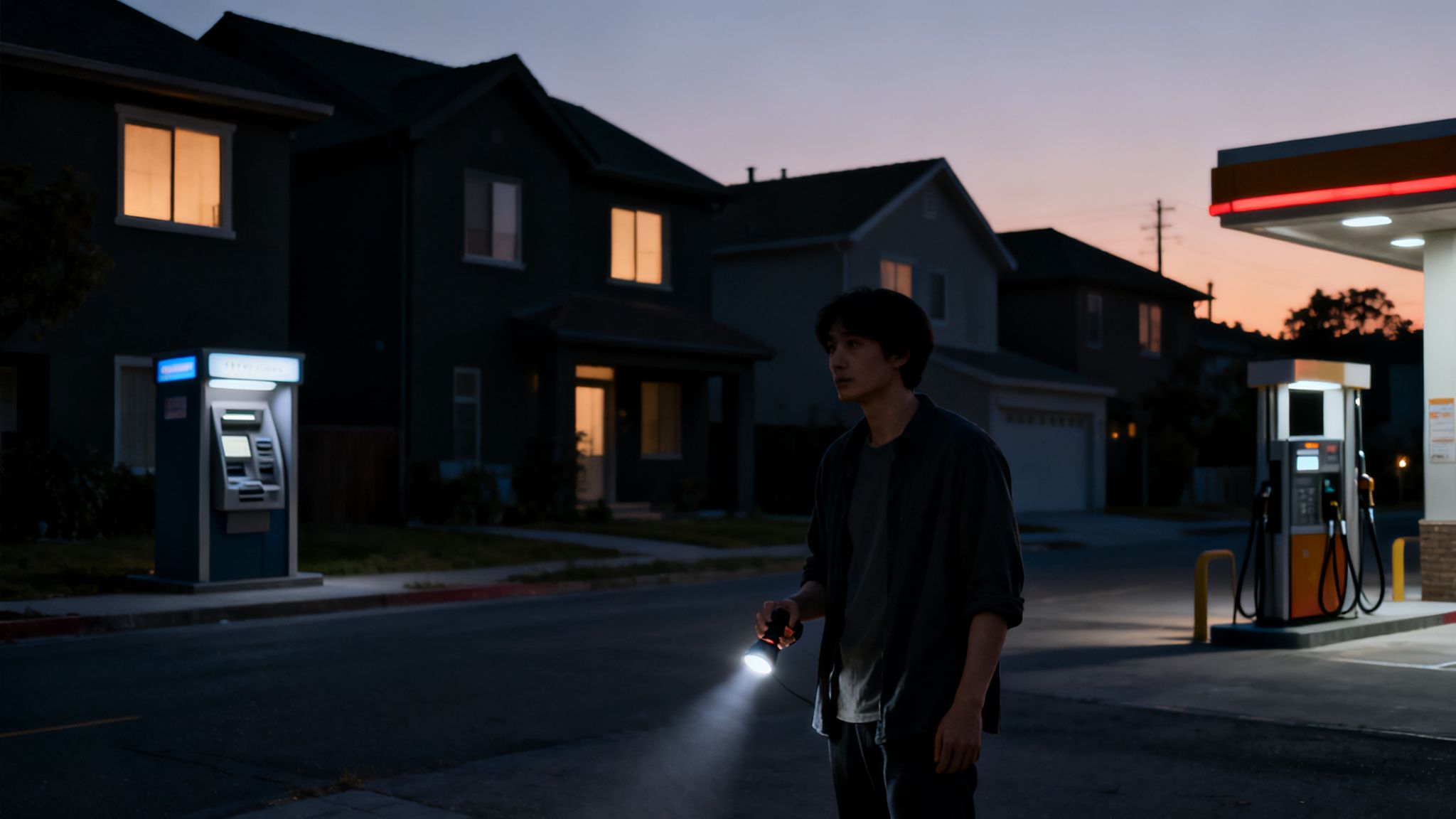
Let’s be clear: a prolonged, grid-down event is a different beast entirely. It’s a cascading failure that unravels the very fabric of modern life. The systems we take for granted every single day simply stop.
Forget about losing your Wi-Fi for a bit. We’re talking about ATMs going dark and credit card systems crashing. Gas pumps won’t work. The supply chain that stocks grocery store shelves will snap. Communication lines will go silent.
The Ripple Effect of a Widespread Blackout
This isn’t some far-fetched scenario. We’ve seen it happen. During Hurricane Irma in September 2017, a staggering 7.6 million customers lost power at the storm’s peak. It took up to two weeks to get everyone back online. Two weeks without refrigeration, lights, or basic communication. Imagine that.
If you’re just getting started, our complete guide on preparing for power outages covers the fundamental steps every household should take.
Understanding this ripple effect is the critical “why” behind any serious prep plan. It forces a shift in mindset—from passively waiting out a blackout to actively creating a self-sufficient household when all outside support is gone. If you’re wondering what could cause such a widespread failure, it’s worth taking some time to understand the effects of an EMP attack on our infrastructure.
The Five Pillars of Survival
To build a plan that actually works, you have to focus on what truly matters. We’ve structured this guide around five core pillars that form the foundation of any effective strategy for a long-term power outage.
- Water and Food: How to secure a safe, reliable supply of drinking water and non-perishable food.
- Power and Energy: Creating a personal, off-grid energy plan to run your most critical devices.
- Shelter and Sanitation: Keeping your home safe, climate-controlled, and hygienic when public utilities fail.
- Communication and Information: How to stay informed and in touch when normal channels are down.
- Security and Community: Protecting your home and working with your neighbors for mutual support.
By tackling these five areas, you’re not just stocking up on supplies. You’re building a robust framework that turns a potential catastrophe into a manageable challenge.
This approach gives you a clear roadmap, guiding you through real, actionable steps to build a plan you can count on.
Building Your Lifeline: Food and Water Security
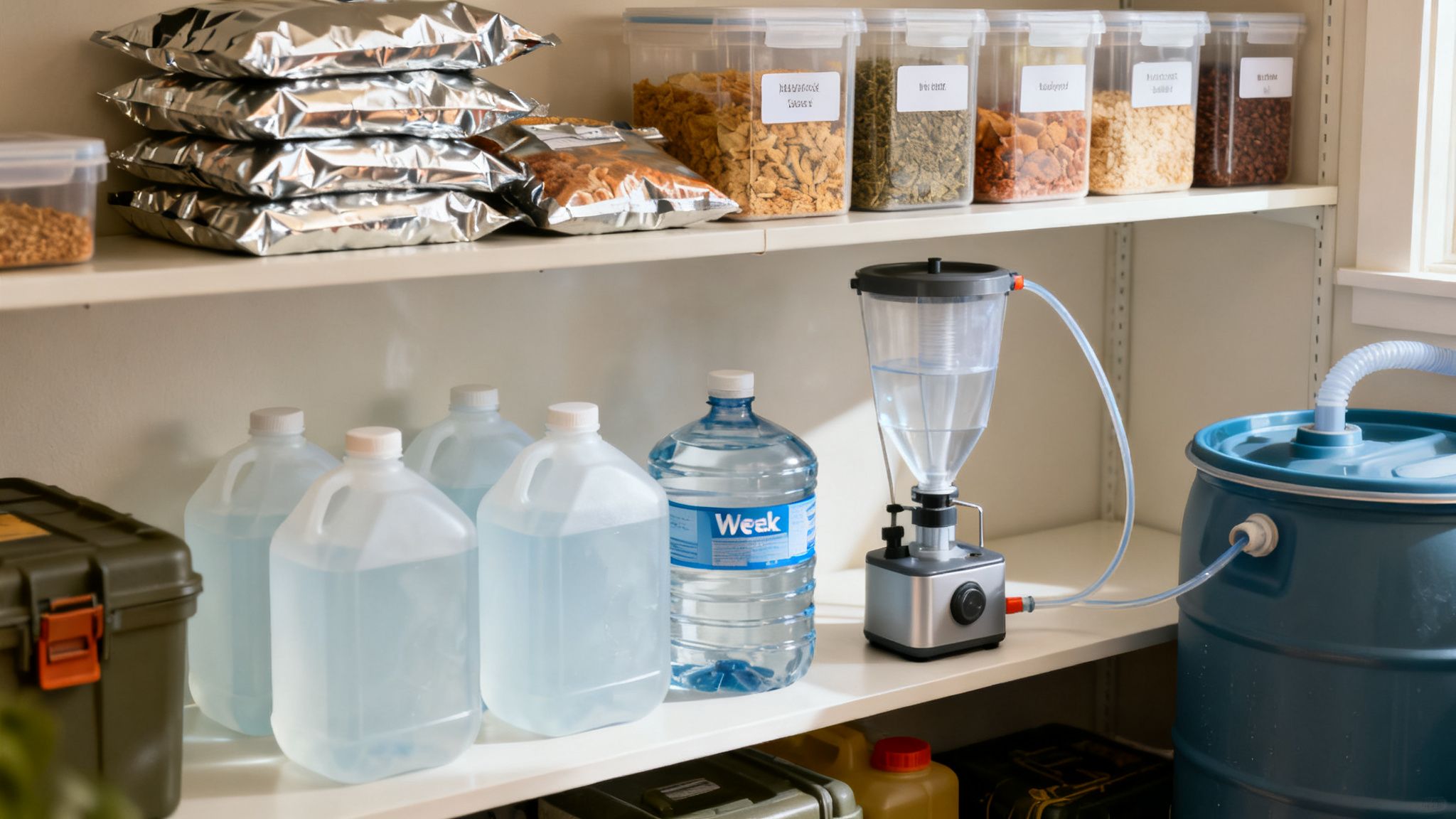
When the lights go out and stay out, the modern world melts away fast. Suddenly, it all boils down to two things: water and food. These are the absolute cornerstones of survival, the non-negotiables that will see you through a crisis. Your first and most important goal is to create a solid, layered strategy for both.
Thinking this is overkill? The data tells a different story. Between 2000 and 2023, the U.S. was hit with 1,755 major weather-related power outages, which accounted for a staggering 80% of all significant blackouts. With states like Texas seeing 210 major outages and Michigan 157, these aren’t just once-in-a-lifetime events anymore. The numbers are clear: you need a real plan, and it starts with what’s in your pantry. You can dig into the specifics in this detailed report on weather-related power outages.
Your Multi-Layered Water Strategy
For a serious outage, your water plan needs to be much more robust than just a few cases of bottled water from the store. You have to think in layers of security, from what you can grab immediately to sources you can rely on for the long haul.
Your first layer is having at least a two-week supply of clean, stored water ready to go. The rule of thumb is one gallon per person, per day—that covers drinking and basic hygiene. For my family of four, that means having 56 gallons stored and accessible at all times in stackable containers like the WaterBrick.
Beyond that initial supply, you need a reliable way to purify water from other sources. This is where a high-quality, gravity-fed filter becomes a game-changer. A system like a Big Berkey Water Filter can process thousands of gallons from a rain barrel, a nearby creek, or even a swimming pool, stripping out bacteria, viruses, and other nasty stuff without needing a single watt of electricity.
Pro-Tip: Don’t skip the low-tech backups. Keep a bottle of water purification tablets like Potable Aqua and some plain, unscented liquid bleach on hand. You can treat an entire gallon of water with just eight drops of bleach, making it an incredibly efficient and space-saving last resort for your emergency kit.
A comprehensive disaster supply kit should include all these water purification options alongside your other emergency essentials.
Building a Resilient Long-Term Pantry
Your food plan should look a lot like your water plan—built in layers. Start with immediate needs and work your way out to long-term sustainability.
- 72-Hour Kit: This is your grab-and-go bag. Fill it with no-cook, high-energy foods like Clif Bars, nuts, jerky, and dried fruit. This is what buys you time to figure out what’s going on without your stomach growling.
- Two-Week Supply: Now, expand that with pantry items that need little to no cooking. Think canned soups and chili, peanut butter, crackers, and canned fish. And for goodness sake, don’t forget a manual can opener like the Swing-A-Way. It’s the one tool everyone seems to forget.
- 30+ Day Bulk Staples: For real peace of mind, this is where you build your foundation. Bulk staples are the calorie workhorses that will keep you going when the grocery store is a distant memory. We’re talking big bags of rice, beans, pasta, oats, flour, and sugar.
The secret to making these supplies last isn’t just buying them; it’s storing them correctly. Packing things like rice and beans into mylar bags with oxygen absorbers can give them a shelf life of 20-30 years by protecting them from oxygen, moisture, and pests. Our guide on how to store food for the long term walks you through the entire process.
To give you a starting point, here is a basic breakdown of what one person would need for a month.
Long-Term Pantry Staples Per Person for 30 Days
| Food Item | Quantity Per Adult | Primary Use | Storage Method |
|---|---|---|---|
| Rice (White) | 20 lbs | Calorie-dense base for meals | Mylar bags with oxygen absorbers |
| Beans (Pinto/Black) | 10 lbs | Protein, fiber, versatile | Mylar bags with oxygen absorbers |
| Rolled Oats | 10 lbs | Breakfast, filler, baking | Original container or food-grade bucket |
| Pasta | 5 lbs | Quick carbohydrate source | Original packaging, stored in bins |
| Flour | 10 lbs | Baking, thickening sauces | Airtight container or mylar bags |
| Sugar/Honey | 5 lbs | Sweetener, calories, preserving | Airtight container |
| Powdered Milk | 5 lbs | Dairy, calcium, cooking | Airtight container or mylar bags |
| Cooking Oil | 1 gallon | Fats, cooking, calories | Cool, dark place in original bottle |
| Salt | 5 lbs | Flavor, food preservation | Airtight container |
This table provides a solid foundation. You’ll want to supplement it with canned goods, spices, and comfort items to round out your meals and keep morale high.
Essential Off-Grid Cooking Solutions
Stockpiling food is only half the equation. You absolutely need a way to cook it when your electric stove is just a fancy countertop. A reliable off-grid cooking method is critical not just for nutrition, but for safety and morale. A hot meal can make all the difference on a cold night.
Off-Grid Cooking Method Comparison
| Cooking Method | Fuel Source | Best For | Key Consideration |
|---|---|---|---|
| Propane Stove | Propane canisters | Quick, reliable meals; boiling water | Requires a stockpile of fuel canisters. |
| Solar Oven | Sunlight | Baking, slow-cooking on clear days | Completely weather-dependent and requires patience. |
| Rocket Stove | Twigs, small wood | Efficient boiling and frying with minimal fuel | Produces smoke; must be used in a ventilated area. |
So, which one is right for you? It really depends on your location and what you have access to. For most people, a simple propane camp stove like a Coleman Classic is an excellent, no-fuss starting point. But if you want a truly sustainable, long-term solution, a rocket stove that can burn whatever sticks and twigs you can find is tough to beat. The best strategy is having more than one option, so you’re ready for anything.
Creating Your Own Power Grid
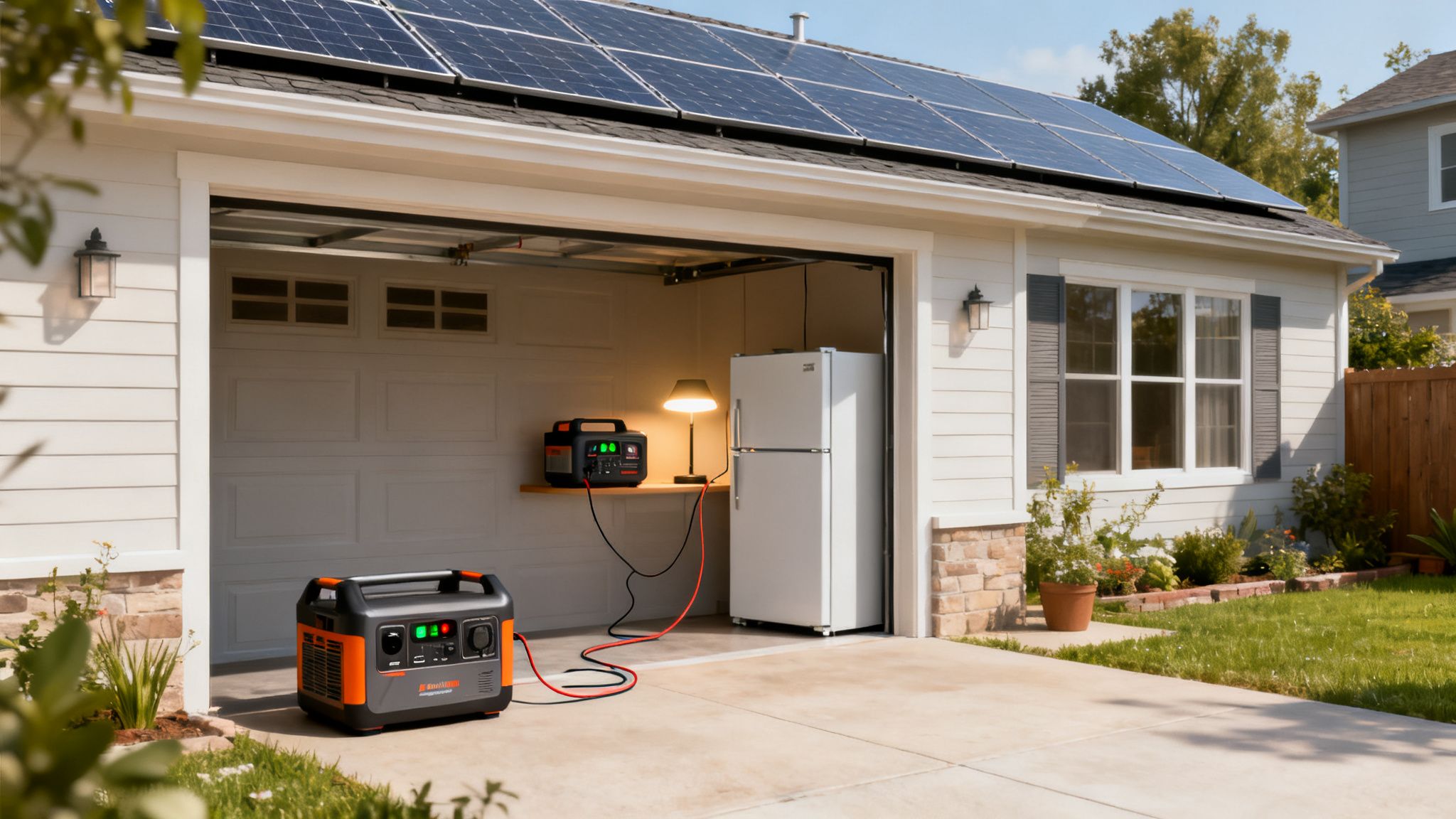
With food and water squared away, let’s talk about power. When the grid goes down for good, you’re the one in charge of keeping the lights on. It’s a big responsibility, but you don’t need to power your whole life—just the essentials. A smart, layered approach is all it takes to keep things running.
Before diving into specific equipment, make sure you understand the basics of preparing for a power outage to build a solid foundation.
Before you even think about buying a generator, you need to figure out what actually needs power. This is what we call a personal energy audit, and it’s all about separating the absolute necessities from the nice-to-haves. Your goal is to create a simple, tiered list of your power priorities.
A CPAP machine for a family member? That’s a Tier 1, non-negotiable item. The refrigerator and freezer are Tier 2—critical for saving hundreds of dollars in food, but you have a little wiggle room. Your TV, Wi-Fi router, and game console are all Tier 3. They’re pure luxuries when you’re managing a finite power supply.
Understanding Your Power Needs
This is where the rubber meets the road. Grab a notepad and walk through your house, listing every device you can’t live without. Look for the small label on the device itself or on its power cord—you’re looking for its wattage (W). That number is the key to matching your needs with the right equipment.
Here’s how I’d break it down:
- Medical Gear: Start here. Any life-sustaining equipment like a CPAP, oxygen concentrator, or nebulizer is your top priority.
- Refrigeration: Your fridge and freezer are probably the biggest energy hogs on your list. Keeping them running prevents massive food spoilage.
- Communications: This means keeping phones, a laptop, and your emergency radios charged and ready. Information is critical.
- Lighting: You don’t need to light up the whole house, but a few high-efficiency LED lights are crucial for safety and morale after dark.
- Small Appliances: Maybe a coffee maker or a small electric kettle is a non-negotiable morale booster for you. If so, add it to the list.
Once you’ve got this list and the wattage for each item, you’ll have a realistic picture of your power budget.
Gas Generators vs. Portable Power Stations
For most people, backup power comes down to two main choices: a traditional gas-powered generator or a modern portable power station. They both generate electricity, but they get there in completely different ways. Your living situation and what you need to power will determine which is right for you.
A gas generator is a workhorse. It can handle the big stuff—refrigerators, freezers, even a well pump. Brands like Honda and Generac are known for their reliability. But the trade-offs are significant. They’re incredibly loud, spew deadly carbon monoxide, and demand a steady supply of gasoline, which can be hard to find in a crisis. They must be run outside, a minimum of 20 feet away from your house, and you absolutely need carbon monoxide detectors inside.
Portable power stations, often called solar generators, are basically massive, intelligent batteries. You’ve probably seen brands like Jackery or Goal Zero. They’re silent, produce zero fumes, and are completely safe to use indoors. This makes them the only realistic option for anyone in an apartment or condo. They excel at running electronics, lights, and smaller medical devices. We do a deep dive into all the options in our guide to portable power sources available.
Key Takeaway: Pay attention to the specs, not just the brand. Watt-hours (Wh) tell you the battery’s capacity—think of it as the size of the gas tank. Inverter capacity (W) tells you the maximum power it can dish out at once. A 1000Wh station with a 1000W inverter can’t run a 1500W space heater, not even for a second.
This chart breaks down the core differences:
| Feature | Gas Generator | Portable Power Station |
|---|---|---|
| Best Use Case | Powering large appliances, entire home circuits | Powering electronics, small appliances, medical gear |
| Indoor/Outdoor Use | Outdoor only due to carbon monoxide risk | Safe for indoor use |
| Noise Level | Very loud (like a lawnmower) | Silent or near-silent operation |
| Fuel/Recharging | Requires gasoline/propane; fuel can degrade | Recharges from wall outlet, car, or solar panels |
| Primary Drawback | Fuel storage, noise, fumes, maintenance | Limited output for high-draw appliances |
Honestly, the smartest setup is often a hybrid one. Use a gas generator for short periods to run the heavy-draw appliances like the freezer, then rely on a portable power station for quiet, efficient, indoor power for everything else.
The Importance of Low-Tech Lighting
While big-ticket power solutions are important, don’t forget the simple stuff. Your power plan needs layers of redundancy, and nothing is more fundamental than light. A generator can fail, but a good headlamp is almost foolproof.
Forget those old, clunky flashlights that burn through D-cell batteries. Modern LED technology is cheap, efficient, and reliable.
- LED Headlamps: This is the single most important lighting tool you can own. A dependable model like the Petzl TIKKA leaves your hands free to cook, make repairs, or read a book. Get one for every person in your family.
- LED Lanterns: A quality lantern can light up a whole room, providing a sense of comfort and normalcy that a focused flashlight beam just can’t match.
- Long-Burning Candles: They’re a last resort due to the fire hazard, but having a few emergency candles as your final backup is just common sense. Use them with extreme caution.
By thinking through your real energy needs and combining the right high-tech tools with simple, reliable backups, you build your own resilient power grid. You’ll be ready for anything, long after the streetlights go dark.
Maintaining a Safe and Healthy Home Environment
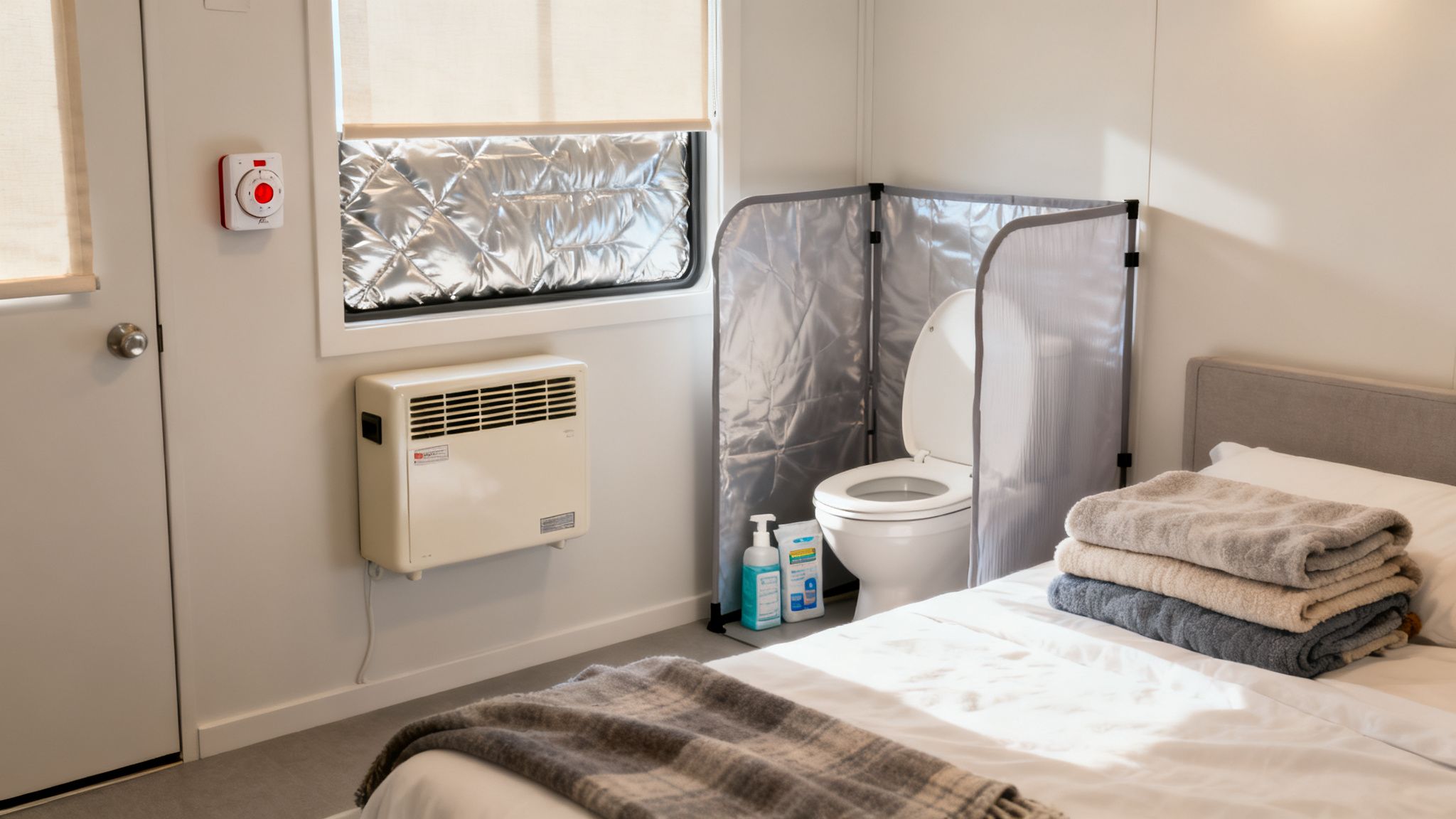
Once you’ve got food, water, and backup power squared away, your focus has to shift. The next critical job is turning your house into a genuine shelter that can keep you safe and healthy for the long haul. When the grid is down, your home is no longer just a place to crash; it’s your fortress against the elements and the frontline defense for your family’s well-being.
This means getting serious about two areas people often push to the back of their minds: climate control and sanitation. Let’s be blunt—without a solid plan for heating, cooling, and waste management, even the best-stocked home can become dangerous and miserable in a hurry.
Staying Warm Safely in Cold Weather
In a winter blackout, heat is a lifeline, not a luxury. The absolute number one rule for emergency heating is safety. Never, ever bring outdoor gear like charcoal grills or patio heaters inside. The same goes for using your gas stovetop for heat. They all pump out lethal amounts of carbon monoxide (CO), an invisible, odorless killer that can incapacitate you in minutes.
You need a heater specifically rated for indoor use. A portable propane heater like the Mr. Heater Buddy is a go-to for many preppers for a reason—it’s designed with built-in safety features like an oxygen depletion sensor and an automatic tip-over shutoff.
Even with a safe heater, two rules are non-negotiable:
- You must have ventilation. Crack a window an inch or two. This allows fresh air to circulate and prevents CO from building up.
- Use multiple, battery-powered carbon monoxide detectors. Put one near your heat source and another in your sleeping area. And test the batteries religiously.
Your goal isn’t to heat the whole house—it’s to create a single “warm room.” Pick a small, well-insulated room, close it off, stuff towels under the door to block drafts, and hang heavy blankets over the windows. Huddle the family in there. You’ll conserve a massive amount of fuel and stay much warmer.
Beating the Heat Without Air Conditioning
A summer outage can be just as deadly as a winter one. The mission is simple: keep your core body temperature down and avoid heatstroke.
Your first move is to wage war on the sun. Cover every single south- and west-facing window. You can use reflective emergency blankets, or even cardboard wrapped in aluminum foil. During the hottest part of the day, keep all windows and doors shut tight to keep the cooler morning air trapped inside.
Once the sun goes down and the outside air cools off, open up windows on opposite sides of the house to create a cross-breeze. Even a small battery-powered fan from a brand like Ryobi or DEWALT can feel like a miracle, helping sweat evaporate from your skin and cool you down. And it goes without saying: drink water constantly. Hydration is everything.
Managing Sanitation When the Water Stops
Alright, let’s talk about the topic nobody wants to, but everyone needs to. If a blackout is long enough to disrupt municipal water and sewer services, your toilet is now just a porcelain chair.
You must have a plan for human waste, or sickness is almost guaranteed.
The most straightforward method is a “twin bucket” system. Get one bucket, perhaps using a specialized seat like the Luggable Loo, and line it with a heavy-duty trash bag—this is for solid waste only. After every use, toss in a scoop of sawdust, kitty litter, or peat moss. This controls the smell and absorbs moisture.
A second bucket is for urine only. In most cases, you can safely pour this out in a designated spot outside, far away from any water sources. Keeping solids and liquids separate is a game-changer for reducing odors and making waste disposal manageable. If you want to build a more permanent setup, you can learn more about assembling your emergency sanitation supplies before you need them.
Personal hygiene is a huge part of this, too. Stock up on no-rinse body wipes, plenty of hand sanitizer, and maybe a solar camp shower. Staying clean is a massive morale booster and your best defense against getting sick when a trip to the doctor is out of the question. By taking care of these fundamentals, you ensure your home remains a true sanctuary.
Staying Connected, Secure, and Informed
When the grid goes down, the silence can be deafening. Modern communication networks often fail almost instantly, cutting you off from official news, emergency alerts, and even your own family members down the street.
In a long-term power outage, information isn’t just a convenience. It’s a lifeline that helps you make critical decisions about safety and resources. Your entire strategy needs to be independent of the internet and cell towers, which means turning to reliable, old-school tech that doesn’t need a functioning grid.
Establishing Your Information Hub
The cornerstone of your communication plan should be a quality emergency radio. A hand-crank NOAA weather radio, like those made by Midland or RunningSnail, is non-negotiable. It gives you direct access to the National Oceanic and Atmospheric Administration’s broadcast system for official updates on weather, civil emergencies, and other critical alerts without needing any external power.
For local, two-way communication, a set of reliable walkie-talkies can be invaluable. They provide a direct line of contact with family or neighbors within a certain radius, allowing you to coordinate plans, check on each other, or call for help.
You can’t overstate the need for redundant power for these devices. The 2003 Northeast Blackout plunged 50 million people into darkness for up to four days, teaching a brutal lesson about preparedness. A robust plan means having multiple ways to power your gear, from battery banks (aim for at least 20,000mAh per person) to the simple, reliable hand-crank function on your emergency radio. You can explore the details of major power outage events to understand why these backups are so essential.
A common mistake is buying a great radio but forgetting to learn its features. Take the time to understand how to tune into NOAA channels, use the hand-crank efficiently, and maximize battery life. To get the most out of your device, check out our guide on the most important emergency radio features.
Securing Your Home Without Power
When the power is out, so are most modern security systems. Alarms, cameras, and automated lighting become useless, forcing you to rely on practical, low-tech methods to keep your family safe. The goal is to make your home a less appealing target by creating physical barriers and the illusion of occupancy.
Your first line of defense is reinforcing potential entry points.
- Doors: Install heavy-duty deadbolts and reinforce the door frame’s strike plate with long screws that go deep into the wall stud. A simple door security bar also provides a powerful physical deterrent against forced entry.
- Windows: Apply a security film to ground-floor windows. It won’t make the glass unbreakable, but it will hold it together if shattered, making entry much more difficult and noisy.
- Lighting: Strategically placed solar-powered motion lights are a fantastic off-grid security tool. They cost nothing to run and can startle potential intruders, drawing attention to areas you can’t see in the dark.
Beyond physical reinforcements, maintaining a low profile is a key security tactic. Keep curtains and blinds drawn, especially at night, to avoid advertising that you have light, supplies, or people inside. The less you stand out, the less you’ll attract unwanted attention.
The Power of a Connected Community
Ultimately, the most powerful tool you have when learning how to prepare for a long term power outage is your community. No matter how well-stocked your pantry is, you can’t do everything alone.
Building relationships with your neighbors before a crisis is one of the most important prep steps you can take. Get to know the people on your street. Get to know the people on your street—especially those with medical training, mechanical skills, or who may have young children or elderly parents needing extra support.
A coordinated neighborhood can pool resources, share information, and establish a neighborhood watch. This mutual assistance network creates a powerful layer of collective security. Whether it’s sharing a generator for a few hours to run a freezer or taking turns keeping watch at night, a strong community turns a group of vulnerable households into a resilient, self-supporting team.
Answering Your Top Power Outage Questions
Even the best-laid plans can leave you with nagging questions. When it comes to something as serious as a long-term blackout, you want to be sure you’ve covered all your bases. Let’s tackle some of the most common questions I hear from people getting prepared.
How Much Water Do I Really Need to Store?
Everyone repeats the “one gallon per person, per day” rule, and for good reason—it’s a solid baseline for drinking and basic sanitation. For a family of four, that means you’d need 56 gallons just to get through two weeks.
But let’s be realistic: storing enough water for months is a huge challenge for most of us. A much smarter, more resilient strategy is to combine stored water with a reliable way to purify more. I recommend keeping a 1-2 week supply of bottled water on hand for the immediate chaos. Beyond that, invest in a high-quality filter. Something like a Sawyer Squeeze for portability or a larger, gravity-fed Berkey system for home use is perfect. This setup gives you the power to make water from a rain barrel, a nearby creek, or even your water heater safe to drink, ensuring true long-term security.
What’s the Best Power Source for an Apartment?
Let’s get this out of the way first: gas generators are an absolute no-go in an apartment, condo, or any enclosed space. The carbon monoxide they produce is a silent killer, making them strictly for outdoor use.
For apartment dwellers, the clear winner is a portable power station, sometimes called a solar generator. Brands like Anker, Jackery, and Goal Zero are the big names in this space, offering a range of sizes and prices. A mid-range unit with around 500-1000 watt-hours is a great sweet spot—it can keep your phones charged, run some lights, and power other small essentials. Pair it with a set of foldable solar panels you can stick on a balcony or in a sunny window, and you’ve got a silent, fume-free, and renewable power source right inside your home.
Think about what’s truly critical. A power station that just charges your phone is helpful, but one that can also run a CPAP machine or a fan during a brutal summer heatwave is a genuine lifesaver. Match the capacity to your real-world needs.
How Do I Save the Food in My Fridge and Freezer?
The moment the power cuts, your number one rule is to keep those doors shut. An unopened, full freezer will stay frozen for about 48 hours; a half-full one will last roughly 24 hours. Every time you open it, you shorten that window.
If you have a generator or a beefy power station, you can cycle it on for a few hours each day to keep the fridge and freezer at safe temperatures. That’s the ideal scenario.
Without a power source, you have to shift into triage mode. Start eating the most perishable items first. Fire up that propane camp stove or grill and cook any meat that’s starting to thaw. You might be able to buy another day or two by moving critical items into high-end coolers packed with ice from a brand like YETI, but ultimately, your long-term survival hinges on what’s in your non-perishable pantry.
Should I Shelter in Place or Evacuate?
For almost every power outage scenario you can imagine, sheltering in place is the right call—if you’re prepared. Your home is your castle. It’s where your food, water, supplies, and tools are. You know the layout, and it’s your most defensible position.
“Bugging out,” or evacuating, throws a dozen dangerous variables into the mix. You’re dealing with clogged roads, an uncertain destination, and the fact that you become much more vulnerable once you’re out in the open.
The only time you should even consider leaving is if your immediate location has become fundamentally unsafe. Think secondary disasters: a spreading wildfire, a major flood, or targeted, escalating civil unrest right on your street. You should always have an evacuation plan and a “go-bag” ready, but make no mistake—your primary strategy should always be to hunker down and ride it out at home.