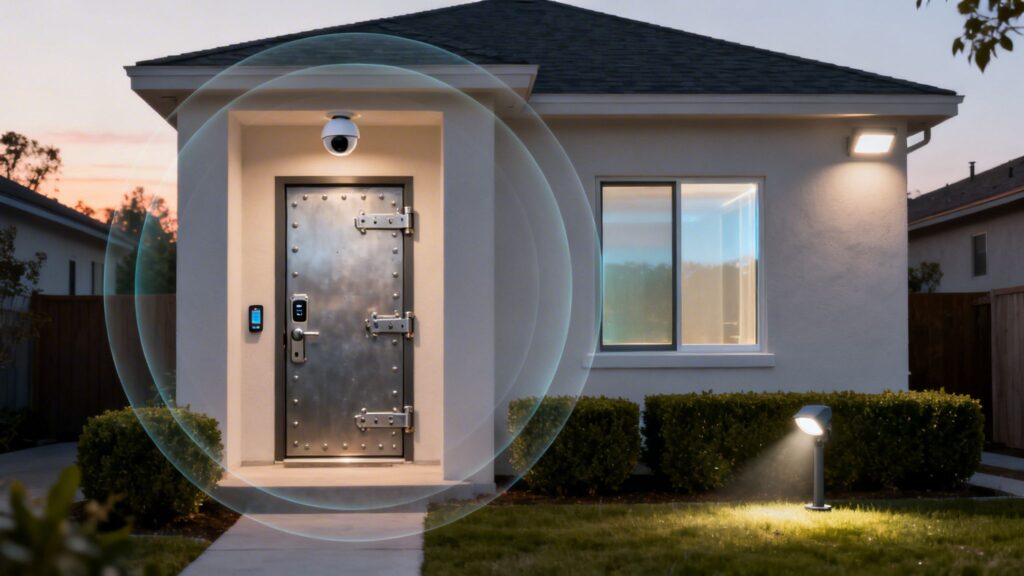
Fortifying your home isn’t just about slapping a bigger lock on the door. It’s about creating a smart, layered defense system that starts with understanding the real threats you face and then systematically hardening your home against them.
Think of it as turning your house from a soft target into a resilient stronghold. This means reinforcing doors and windows, securing the perimeter of your property, setting up an internal safe room, and making sure you have independent power and communication when the grid goes down.
Why Home Fortification Is Now Essential
Let’s be honest, the world feels a lot less predictable these days. This isn’t about giving in to paranoia; it’s about taking practical, rational steps to prepare for real-world scenarios—things like extended power outages, crumbling supply chains, or a local spike in crime. Proactive home security is simply a logical step toward self-reliance and genuine peace of mind.
Getting started can feel overwhelming, but it’s more manageable when you break it down. Imagine your home’s security as a series of concentric rings, starting at your property line and moving inward toward your family. Each layer is designed to deter, delay, or defeat a potential threat long before it gets close.
This approach transforms your home from a simple shelter into a robust safe haven. It’s a complete mindset that goes beyond locks and alarms to integrate physical barriers, smart technology, and resource independence.
The Four Layers of a Fortified Home
A truly effective home defense strategy is built on four core concepts. Each one addresses a different aspect of security, and when you combine them, they create a formidable system that protects you from the outside in.
The Four Layers of Home Fortification
Here’s a breakdown of the core concepts behind a layered defense strategy, moving from your property line to your final safe room.
| Layer | Focus Area | Key Actions |
|---|---|---|
| Perimeter Defense | The Outermost Ring | Fencing, defensive landscaping, motion-activated lighting, surveillance cameras. |
| Structural Integrity | The Shell of the Home | Reinforcing doors, upgrading locks, securing windows with film or bars. |
| Internal Strongholds | A Final Safe Haven | Establishing a designated safe room with its own supplies and communication. |
| Resource Independence | Self-Sufficiency | Backup power (generator/solar), independent communication, stored essentials. |
Let’s dig a little deeper into what these layers mean for you.
- Structural Integrity: This is the absolute foundation. We’re talking about hardening the weakest points of your house—your doors and windows—to physically resist a forced entry. It’s your first and most important line of defense.
- Perimeter Defense: This layer pushes your security outward from the walls of your house. It includes tactical lighting, surveillance, solid fencing, and even hostile landscaping designed to make your property an unattractive and difficult target from the start.
- Internal Strongholds: If your outer layers are somehow breached, this is where you make your stand. This layer focuses on creating a secure internal space, like a safe room, where your family can shelter safely while you call for help or wait out the threat.
- Resource Independence: True security means not being completely dependent on public utilities that can fail. This involves having backup power, independent communication methods, and enough essential supplies to ride out an extended emergency. You can learn more about this by exploring how to prepare for situations that disrupt normal life, like martial law.
The goal is simple: make any intruder’s job as difficult, noisy, and time-consuming as possible. Most criminals are looking for an easy score. If your home presents too much resistance or risk of exposure, they’ll almost always move on to an easier target.
This shift toward proactive preparedness isn’t just a feeling; the numbers back it up. The home security system market is projected to grow by USD 29.1 billion by 2029, a clear sign that people are moving from reactive fear to proactive preparation. And considering that 34% of burglars just walk right in through the front door, simple upgrades can have a dramatic impact on your risk. You can dig into more of these insights about the home security market on technavio.com.
Hardening Your Home’s Doors And Windows
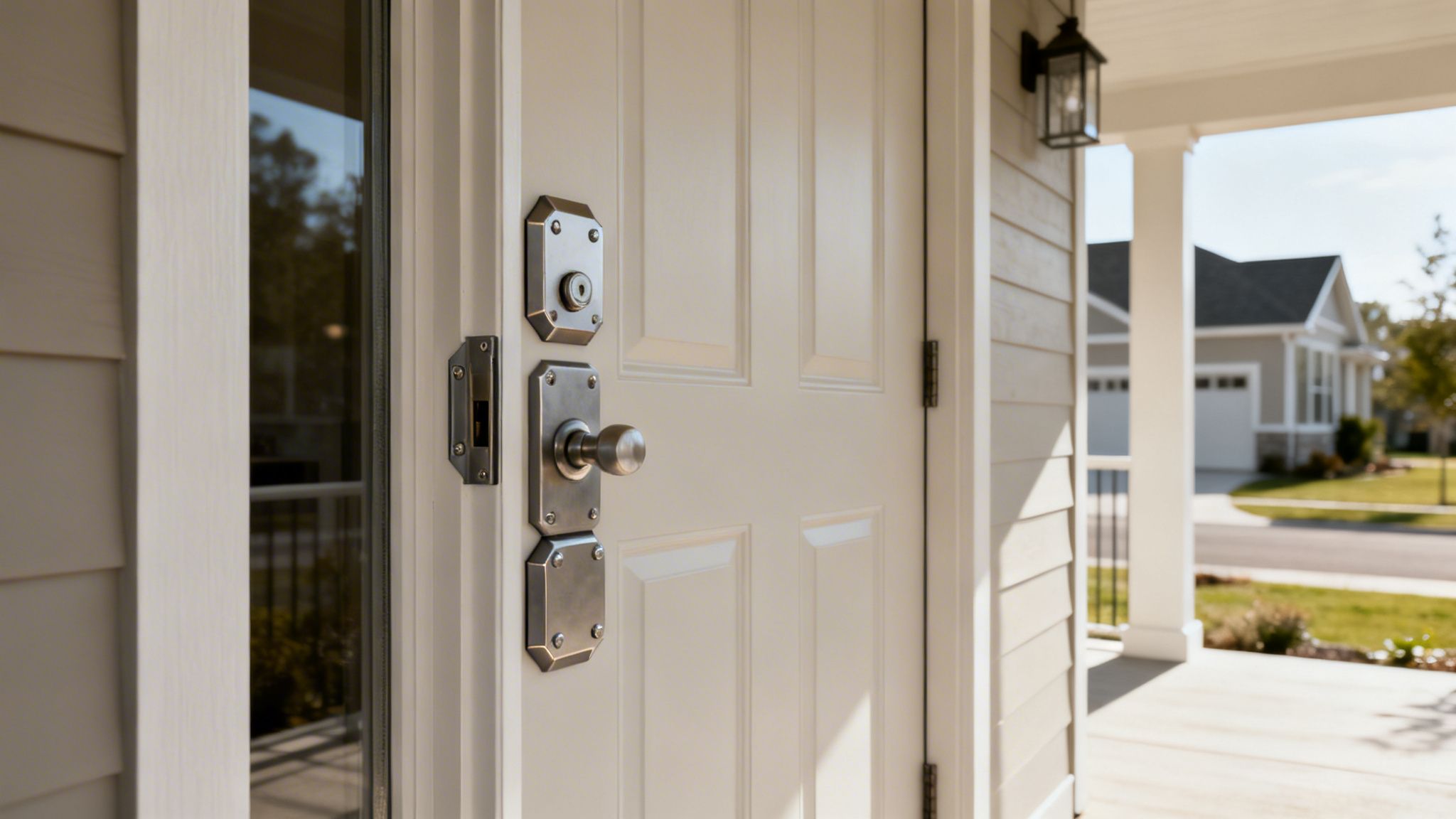
The structure of your house is its first line of defense, but doors and windows are the weakest links. Intruders want one thing: fast, quiet entry. Your job is to systematically harden these access points, turning them from vulnerabilities into serious obstacles that buy you critical time.
Most people think a deadbolt is all they need. The hard truth is that a single well-placed kick can splinter a standard door frame, making the lock completely useless. The lock itself is rarely the problem—it’s the flimsy wood and short screws holding the strike plate that fail first. This is where your efforts will make the biggest difference.
Reinforcing Your Doors Beyond The Lock
Upgrading door security is one of the most cost-effective moves you can make. It starts with a solid-core door (made of wood or metal), since hollow-core doors offer almost zero resistance. But even the toughest door is only as strong as its frame.
The goal is to reinforce the entire assembly—the jamb, hinges, and lock area—so it can withstand brute force. This isn’t just about installing a new lock; it’s a hands-on process.
- Upgrade to 3-Inch Screws: This is the cheapest, fastest, and most impactful upgrade possible. Swap out the flimsy half-inch screws in your door hinges and strike plates for 3-inch hardened steel screws. This simple change anchors the hardware directly into the wall studs behind the frame, not just the thin jamb.
- Install a Heavy-Duty Strike Plate: Standard strike plates are thin pieces of metal that bend or tear away under pressure. A heavy-duty box strike gives the deadbolt a much deeper, more secure housing to sink into.
- Add Jamb Armor: The door jamb is the most common failure point in a kick-in. Jamb reinforcement kits are essentially long steel plates that run the length of the jamb, distributing the force of an impact and preventing the wood from splitting apart.
If you want an all-in-one fix, a comprehensive kit like Door Armor MAX will tackle all these weak points at once with pre-drilled steel plates for the jamb, hinges, and lock areas.
Turning Windows Into A Tough Barrier
Windows are the second-favorite entry point for intruders. Their fragile nature makes them an obvious target, but you have several powerful options to dramatically increase their resistance to attack.
One of the best DIY solutions is applying a security window film. This is a clear, tough polyester film that you adhere to the inside of the glass. It won’t make the window unbreakable, but it will hold all the shattered pieces together upon impact.
This completely foils a quick “smash-and-grab” attempt. An intruder would have to strike the window repeatedly and then try to push the entire sheet of broken glass out of the frame. That’s a loud, difficult, and time-consuming process most criminals want no part of.
Key Takeaway: Security film isn’t designed to stop the glass from breaking. It’s designed to stop an intruder from getting inside after the glass breaks. The noise and delay it creates are massive deterrents.
For an even higher level of security, you can turn to physical barriers.
- Security Bars or Grilles: These aren’t just for commercial buildings anymore. Modern residential designs are less obtrusive and can even be decorative, providing a strong visual deterrent and a real physical obstacle.
- Plexiglass or Polycarbonate Sheets: Installing a sheet of this impact-resistant material over existing windows offers incredible protection against blunt force, especially for basement windows or other less-visible areas.
The statistics are sobering: a burglary happens every 26 seconds in the U.S., and 66% of them occur during daylight hours. While smart cameras are useful, physical barriers are your first and best line of defense. Windows account for 23% of entries, but simply reinforcing your doors can visually deter up to 80% of potential intruders.
Whether you’re starting small or going all-out, these practical steps will make a real difference. For more ideas on how to secure your living space, check out our other articles on prepper home improvement.
Securing Your Property’s Perimeter
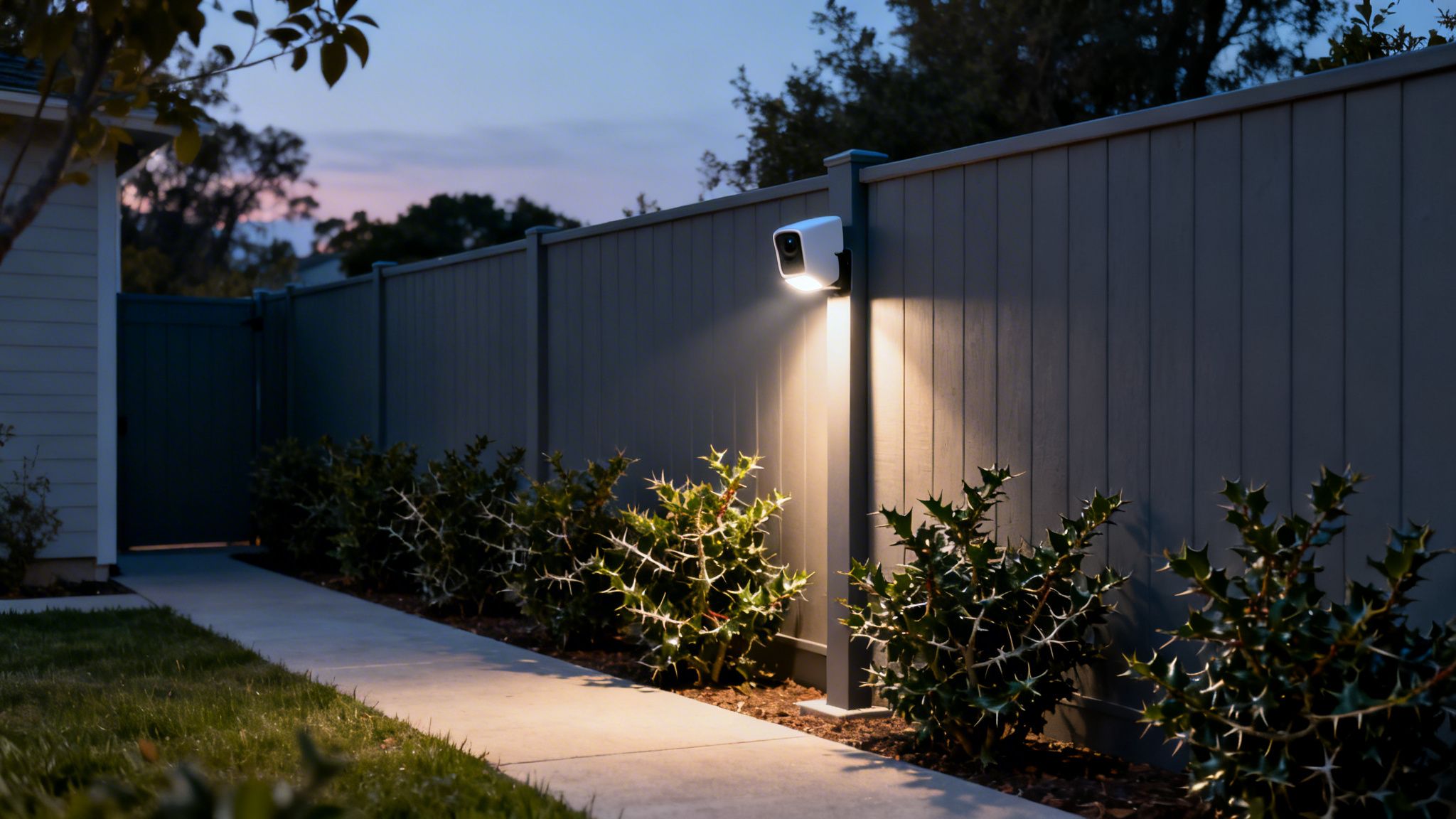
Real security doesn’t start at your front door; it begins at the edge of your property. The most effective home fortification strategy is a layered perimeter defense designed to make your home an unattractive and difficult target from the get-go. This outer ring is all about three things: deterrence, detection, and delay.
By focusing on lighting, surveillance, and physical barriers, you create an environment where any intruder feels immediately exposed and vulnerable. A well-secured perimeter sends a powerful message that your home is not an easy mark, encouraging potential threats to simply move on. This proactive approach buys you critical time and dramatically lowers your risk.
Illuminate Your Defenses
Criminals love the dark. It’s their best friend. One of the simplest and most effective things you can do is take that advantage away by eliminating shadows and dark corners around your home. Strategic lighting makes it impossible for someone to approach your property without being seen.
Motion-activated floodlights are a game-changer here. When placed over entry points like doors and windows, along pathways, and near the garage, they blast an intruder with light the second they step into the zone. That sudden, unexpected exposure is often enough to send them scrambling.
For an all-in-one solution, a product like the Ring Floodlight Cam is fantastic. It combines a powerful motion-activated light with a security camera, so you not only light up the area but can also see and record exactly who—or what—is out there. It’s a formidable first line of defense.
Establish A Watchful Eye
Visible security cameras are a massive deterrent. When would-be burglars are casing a neighborhood, they’re looking for the path of least resistance. A home with obvious cameras is a much tougher target than the one next door without them.
You’ve got a couple of solid options for surveillance systems, each with its own benefits.
- Wi-Fi Cameras: Standalone cameras from brands like Ring or Wyze are incredibly easy to install and let you monitor everything from your smartphone. They’re perfect for covering specific zones but do rely on your home’s internet connection.
- Hardwired CCTV Systems: These are the heavy-duty option. They’re more robust and typically record locally to a DVR. Since they’re physically wired, they keep working even if your Wi-Fi cuts out, giving you a more reliable security blanket.
No matter which system you pick, placement is everything. Make sure your cameras cover all primary entry points, driveways, and any ground-floor windows that aren’t easily visible from the street.
A well-lit and monitored property is an intruder’s worst nightmare. The goal is to eliminate their two biggest advantages: anonymity and the cover of darkness. Make them feel like they are on a brightly lit stage from the moment they step onto your property.
Modern Alarms And Audible Deterrents
While lights and cameras are crucial, a modern alarm system adds an indispensable layer of active defense. The main job of an alarm isn’t just to tell you someone broke in; it’s to create absolute chaos for the intruder.
A loud, external siren is non-negotiable. That piercing sound draws immediate attention from neighbors and makes it incredibly uncomfortable for an intruder to stick around. It puts them on a clock and forces them to get out—fast.
Also, make sure your alarm system has a cellular backup. Smart intruders know to cut phone lines or power before making a move. A system with a cellular connection bypasses this tactic and ensures the monitoring service is contacted, keeping you protected even in a grid-down scenario. For more on handling these kinds of situations, check out our urban survival guide.
Using Nature and Fencing As Barriers
Your final perimeter layer uses physical obstacles to make getting to your house difficult and even painful. You can do this with both man-made and natural barriers.
A sturdy fence is the most obvious choice. A tall, solid fence offers the best privacy and security, but even a shorter chain-link or picket fence creates an obstacle that has to be climbed, slowing an intruder down and leaving them exposed for longer.
You can also use nature to your advantage with defensive landscaping. Planting thorny, dense bushes like barberry, pyracantha, or holly right under your ground-floor windows creates a painful and noisy barrier. Nobody wants to fight their way through sharp branches to reach a window, making this a highly effective and low-cost deterrent that blends right into your yard.
Establishing An Internal Safe Room
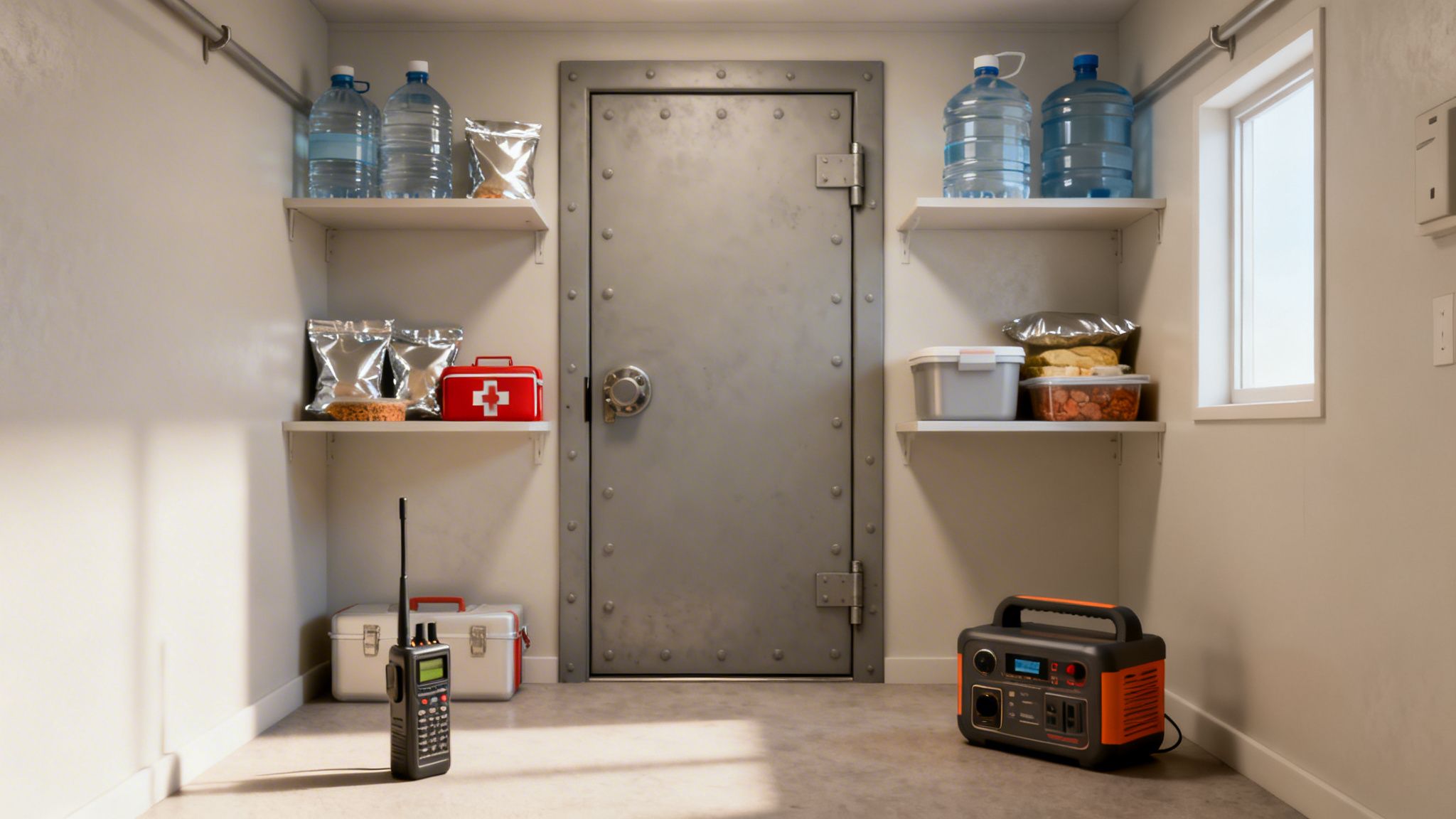
When your outer defenses fail, a designated safe room acts as your final line of defense. This isn’t some Hollywood-style panic room with steel walls. It’s a pre-planned, reinforced space where your family can hunker down, call for help, and wait out a threat.
The whole point is to buy yourself precious time.
Choosing the right spot is the first and most critical decision. The best safe rooms are interior spaces with no windows and, ideally, just one door. Think walk-in closets, basement storage rooms, or even a windowless bathroom. The fewer entry points, the easier it is to secure.
Fortifying The Entry Point
Once you’ve picked your room, that single door becomes your top priority. Just like your home’s exterior doors, the frame is the biggest vulnerability. You’ll want to apply the same hardening principles here.
Start by swapping out the standard hinge and strike plate screws for 3-inch hardened steel screws that bite deep into the wall studs. If the door is a cheap, hollow-core model, replace it with a heavy-duty, solid-core door.
The lock is the final piece of the puzzle. It needs to be a high-security deadbolt that can only be operated from the inside. A thumb-turn deadbolt with no exterior keyhole is what you’re looking for. This makes it impossible to pick or bump from the outside.
Stocking Your Safe Haven
A fortified room is useless if you don’t have what you need to wait out the emergency. Your safe room should be stocked with enough supplies to sustain your family for a minimum of 72 hours. Treat it like a concentrated bug-in location, ready for a prolonged stay.
Your basic checklist should cover:
- Water: At least one gallon per person, per day. No exceptions.
- Food: Non-perishable, high-calorie foods that don’t require cooking. Think protein bars, nuts, and dried fruit.
- First-Aid: A solid first-aid kit, but also include trauma supplies like tourniquets and pressure dressings.
- Sanitation: A simple bucket toilet, toilet paper, and wet wipes are non-negotiable.
- Defense: A means of self-defense you are well-trained and comfortable with.
The core principle of a safe room is self-sufficiency. You cannot assume help will arrive in minutes. Your supplies are the bridge between the start of the threat and the moment help arrives.
Power And Communication Independence
In a real crisis, assume the power grid and cell networks are down. Your safe room needs its own independent systems to keep you informed and connected. This is an absolute must for a functional safe haven.
A portable power station, like a Jackery Explorer, can be a game-changer. It provides silent, fume-free power for lights, charging phones, and running communication gear.
For comms, you need backups for your backups. A simple two-way radio like the Baofeng UV-5R can monitor local emergency frequencies or let you talk with others nearby. For a true lifeline when all else fails, a satellite phone or messenger is your best bet, allowing you to reach help from anywhere. If you’re considering more permanent shelter solutions, our guide on how to build a fallout shelter offers a deeper dive into long-term survivability.
Achieving Off-Grid Power And Communication
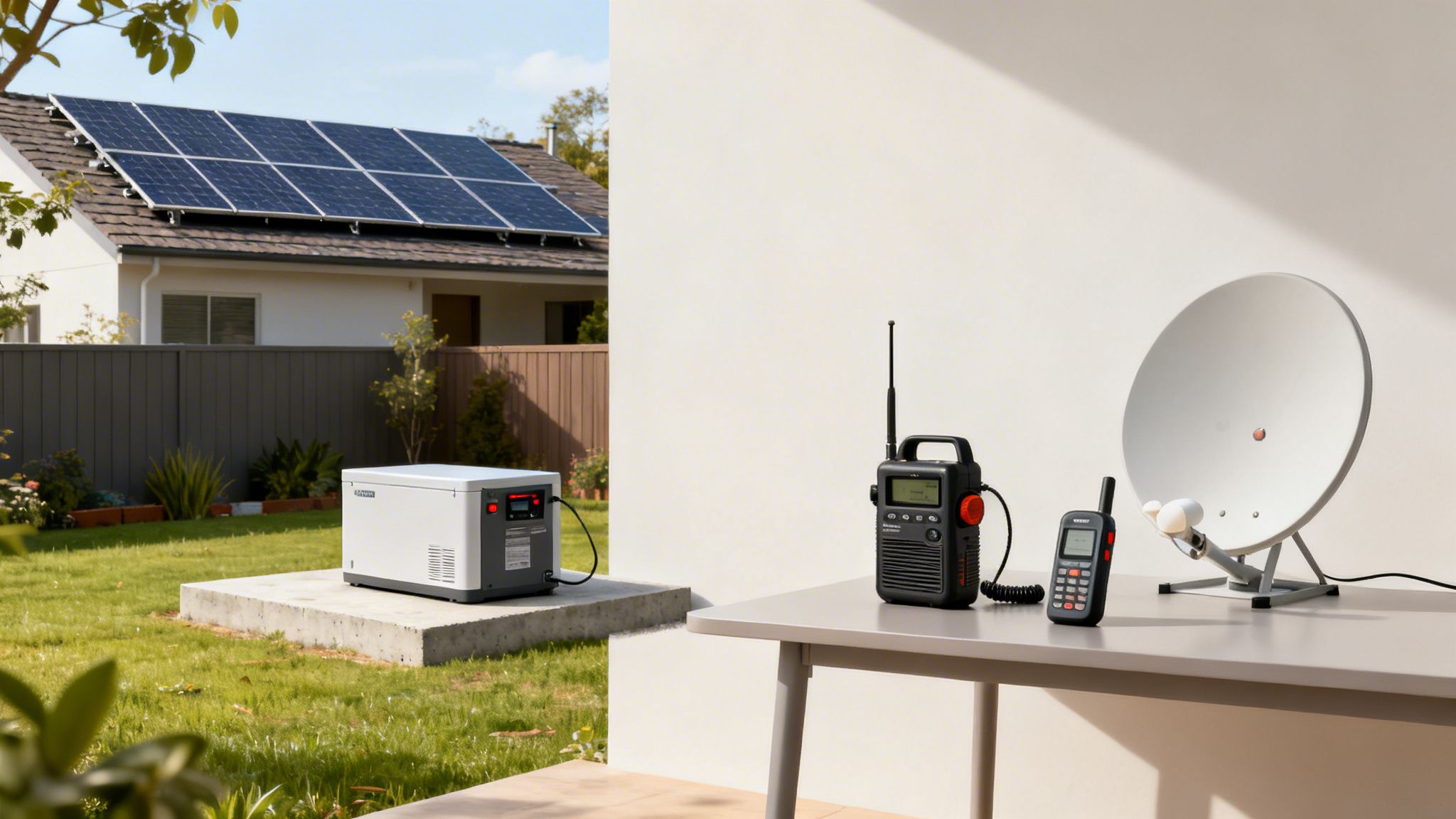
A fortified home without power is just a dark, disconnected box. Even the best physical security measures crumble during a blackout when cameras go dark and alarms fall silent. True self-reliance means generating your own power and keeping communication lines open when the grid fails.
This is the final layer of resilience, transforming your secure shelter into a self-sufficient stronghold. Without power, you lose your eyes and ears—the very systems that give you early warnings and connect you to the outside world. Building this independence is non-negotiable for any serious home fortification plan.
Choosing Your Backup Power Lifeline
First things first: you need an independent power source. For most homeowners, it comes down to two practical options—traditional gas generators and modern solar power stations. Each has its own strengths and demands.
Gas generators are the powerful, relatively affordable workhorses that can run major appliances. The trade-offs? They’re noisy, pump out dangerous carbon monoxide (meaning they must be run far from your home), and rely on a stored fuel supply that can go bad or become impossible to find. Safe fuel storage isn’t just a suggestion; it’s a critical safety measure.
Solar power stations, often called “solar generators,” are the silent, fume-free alternative. Systems like the Goal Zero Yeti series pair portable solar panels with a high-capacity battery, giving you clean power for your essential gear. They may not run your entire house, but they’re perfect for keeping security systems, lights, and communication devices online without the noise or risk of a gas engine.
When you’re picking a power source, think beyond just wattage. Consider your fuel or charging strategy, how quiet you need to be, and which devices you absolutely cannot afford to have go down.
Building Communication Redundancy
When a crisis hits, cell towers get overloaded and the internet goes down. Standard communication networks are often the first to fail. A fortified home needs a multi-layered communication plan so you can get emergency information and reach out for help.
A hand-crank weather radio is your absolute baseline. A device like the Midland ER310 is indispensable because it can be powered by its own crank, a built-in solar panel, or a rechargeable battery. It gives you access to NOAA weather alerts and AM/FM broadcasts, making sure you’re never completely in the dark, even with zero power.
For local, two-way communication, General Mobile Radio Service (GMRS) radios are a huge step up from basic walkie-talkies, giving you much better range and clarity. And when every other network has collapsed, a satellite messenger or phone becomes your ultimate lifeline, letting you send messages or make calls from almost anywhere on Earth.
Keeping Your Security Systems Active
Your backup power is useless if it isn’t seamlessly integrated with your security systems. Think about what happens to your home’s defenses the moment the lights go out.
- Surveillance Cameras: A hardwired CCTV system plugged into a battery backup or solar generator will keep recording. But those Wi-Fi-dependent cameras? They’re dead in the water unless your internet router is also on backup power.
- Alarm Systems: Make sure your alarm has a solid battery backup and—this is crucial—a cellular connection to the monitoring service. This bypasses downed phone and internet lines.
- Lighting: Your motion-activated security lights won’t do a thing without electricity. Tying them into your backup power plan is essential for maintaining this powerful deterrent.
Even the most elite fortifications are built around independent power. High-security private estates often have their own dedicated power plants to ensure they’re never vulnerable. While that’s overkill for most of us, the principle is the same. Homes with active alarms see 300% fewer burglaries, and since 60% of burglars spend less than five minutes casing a home, visible deterrents are vital. A backup power source ensures these deterrents stay online when you need them most.
For a deeper look into selecting the right equipment, you might be interested in our guide on choosing the best portable power sources for emergencies.
Common Questions About Home Fortification
Even with a solid plan, questions always pop up when you start the real work of fortifying your home. Let’s tackle some of the most common practical hurdles, from tight budgets to the unique challenges renters face, and get you clear answers to refine your security strategy.
How Can I Fortify My Home If I’m A Renter?
Renting definitely adds a layer of complexity, but don’t let that stop you. You still have plenty of powerful, non-permanent options to seriously upgrade your security. The trick is to focus on reversible upgrades that won’t get you in trouble with your landlord.
Start with your windows. Applying a security window film is a game-changer for preventing a smash-and-grab entry, and the best part is it can be peeled off when you move out. For doors, forget about modifying the frame with permanent hardware. Instead, get a heavy-duty door security bar that braces against the floor or a portable door jammer like the popular DoorJammer.
Wireless, battery-powered alarm systems are a renter’s best friend. Companies like SimpliSafe or Ring offer fantastic systems that don’t require any drilling or hardwiring. You can even find smart locks designed to fit right over the interior thumb-turn of your existing deadbolt, giving you modern features without altering the original lock.
Always double-check your lease agreement, of course. But these reversible measures can dramatically increase your home’s security without leaving a permanent mark. The goal is to add layers of resistance that you can pack up and take with you.
What Are The Most Cost-Effective First Steps On A Tight Budget?
You don’t need to spend a fortune to make a real difference in your home’s security. By zeroing in on the most critical weak points, you can get the biggest security bang for your buck on a very small investment.
Start with your door frames. The single most effective, low-cost upgrade you can make is swapping out the flimsy half-inch screws in your door’s strike plates and hinges for 3-inch screws. This simple fix costs just a few dollars but anchors the hardware deep into the wall stud, making the door exponentially more resistant to a kick-in.
Next, turn your attention to ground-floor windows. You can buy and install security window film yourself—it’s an affordable and surprisingly effective DIY project. Finally, boost your outdoor visibility and deterrence. Trim back any overgrown bushes near the house that could provide cover for an intruder and install a few inexpensive solar-powered motion lights. These small, deliberate actions make your home a much harder target.
Should I Prioritize An Alarm System Or Physical Hardening?
Physical hardening first. Always. This is a foundational principle of home fortification that simply can’t be overstated.
An alarm system is designed to alert you that a breach is happening or, more likely, has already happened. Physical hardening is designed to prevent the breach from ever happening in the first place.
Your primary goal should be to make any forced entry attempt so difficult, loud, and time-consuming that an intruder just gives up and looks for an easier target. Your reinforced doors, strong locks, and shatter-resistant windows are the actual barriers that stop them from getting inside.
Think of it this way: physical hardening is the castle wall, and the alarm system is the lookout on top of it. You have to build a strong wall first. Once your physical security is solid, a good alarm system becomes a powerful and essential second layer that perfectly complements your defenses.
For a complete overview of what to include in your home’s emergency reserves, check out our comprehensive emergency preparedness checklist.