
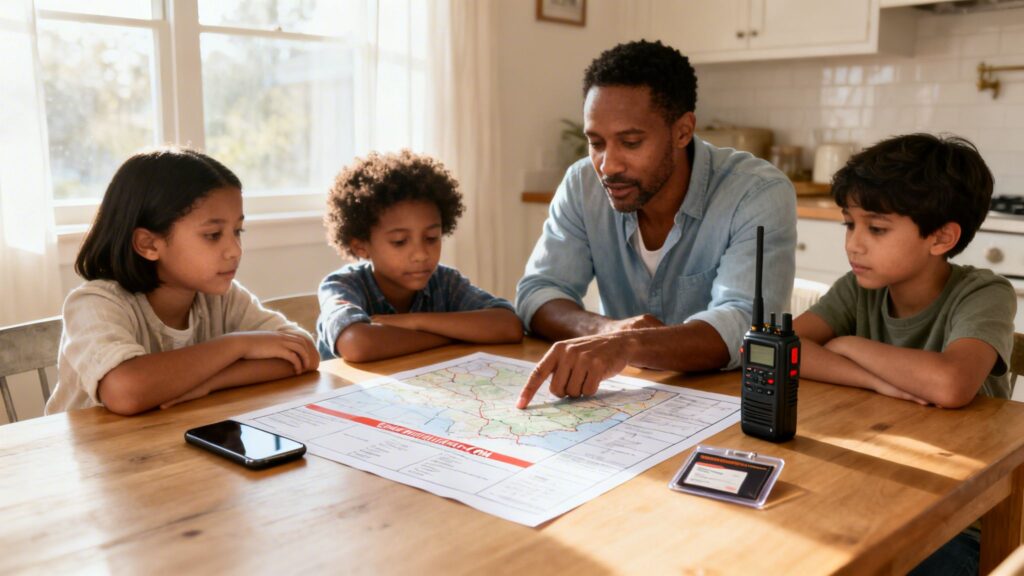
When a crisis hits, everything you thought you could count on disappears in an instant. The power goes out, cell towers get overloaded, and the roads become gridlocked. In those first few moments of chaos, only one question matters: Is my family safe?
A family emergency communication plan is your answer. It’s a simple, pre-agreed strategy that tells everyone who to call, where to meet, and what to do when everything goes sideways. This isn’t just another prep item; it’s the single most important tool for turning panic into calm, decisive action.

Why a Communication Plan Is Your Most Critical Prep
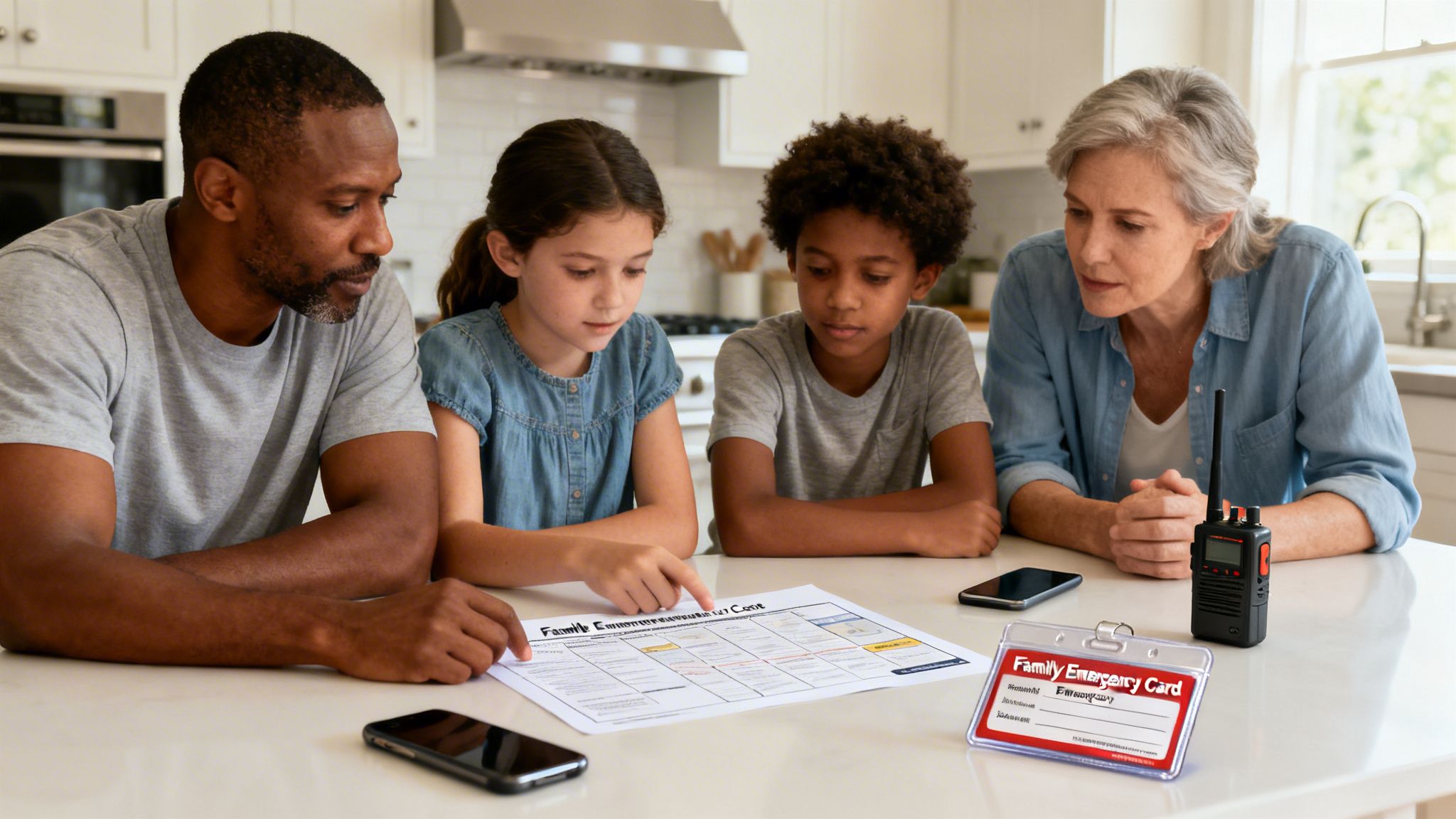
When disaster strikes, the first casualty is always communication. Our modern infrastructure is shockingly fragile, and in those initial moments of uncertainty, finding a way to confirm your family’s safety becomes your entire world. A rehearsed plan isn’t about convenience—it’s about reuniting when every second counts.
Think of it as making critical decisions now, while you’re calm, so you don’t have to improvise under extreme stress. When phone lines are jammed and cell service is a ghost, your plan is the playbook that keeps everyone on the same page. Honestly, it’s more vital than any gadget in your go-bag or food in your pantry, including that high-end LifeStraw water filter or emergency food supply.
Lessons Learned from Real-World Crises
History has shown us time and again why this is so critical. Remember Hurricane Katrina in 2005? FEMA’s after-action reports showed local communication networks were completely overwhelmed within hours, with call volumes spiking 300-500%.
Fast forward to Hurricane Sandy in 2012, and we learned another valuable lesson: text messages have about a 70% better success rate than calls during a network overload because they use so much less bandwidth. You can dig into the specifics in this detailed study on PMC.
These events exposed a massive vulnerability in our dependence on everyday tech. A good communication plan is built to withstand exactly these kinds of failures.
A plan on paper is a good start, but a plan in muscle memory is what saves lives. The goal is to make your emergency response so automatic that it can be executed even when you’re disoriented and afraid.
The Modern Preparedness Gap
Despite these hard-learned lessons, a shocking number of people are still unprepared. A 2018 FEMA National Household Survey found that only about 40% of American households had a family emergency communication plan. That means the majority of families will be making it up as they go during the worst moments of their lives.
The good news? It’s not hard to fix this. Creating a solid plan is straightforward, and by setting up a few simple, agreed-upon steps, you build a resilient strategy that covers all the bases. You replace the fear of the unknown with confidence and clear action.
This isn’t about buying expensive gear; it’s about having a conversation and getting on the same page. It equips everyone, from your youngest child to your elderly parents, to act decisively. You can get a head start by checking out our complete guide on emergency preparedness for families. This roadmap ensures that no matter what happens—a house fire, a regional blackout, or a major natural disaster—your family has a clear path back to each other.
Gathering Your Essential Information and Contacts
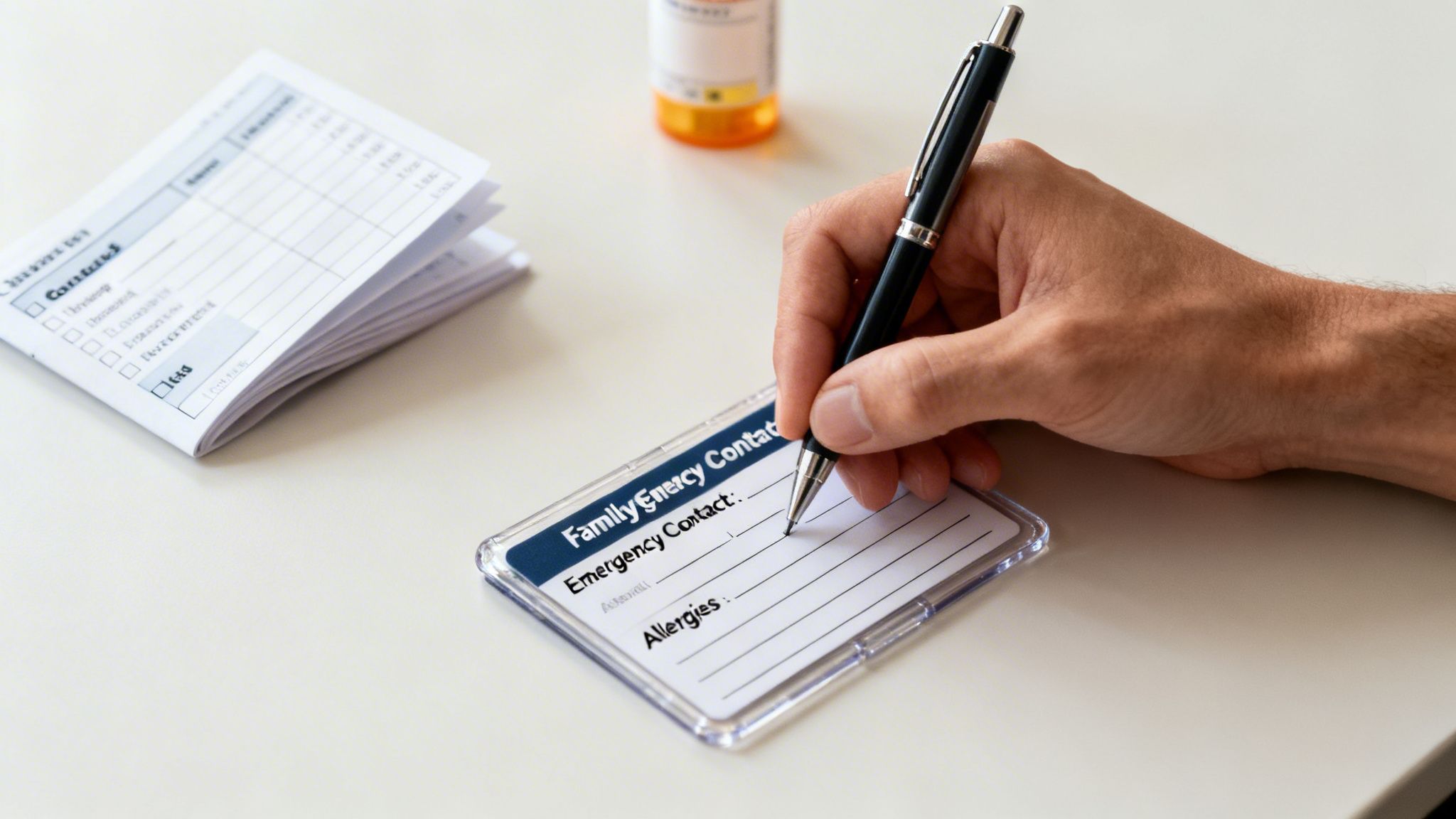
Before figuring out how to talk during a crisis, you need to nail down what you’ll be talking about. A solid family emergency plan is built on a simple, centralized list of critical information. When chaos hits and you can’t think straight, this list becomes your lifeline.
This is more than just having numbers saved in your phone. A bad storm or a blackout can turn that expensive smartphone into a paperweight, making your digital contacts totally useless. The real goal is a master list—both physical and digital—that everyone in the family has, so you’re all working from the same script. Consider using a Rite in the Rain all-weather notebook to create a durable physical copy that can withstand the elements.
The Out-of-State Contact: Your Lifeline When Local Lines Fail
One of the single most important pieces of your plan is an Out-of-State Contact. This is a trusted friend or relative who lives far enough away that they won’t be caught in the same regional disaster you are. History has shown us time and again why this is a non-negotiable part of any serious plan.
Think back to 9/11. Local call volumes in the affected areas skyrocketed by as much as 400%, completely jamming the networks. But long-distance calls? Many of those went through just fine. Your out-of-state contact acts as the central hub for your family’s communications.
The rule is simple: if you can’t reach family locally, call your out-of-state contact. They become the message board, confirming who is safe and relaying updates until you can connect directly.
This one simple trick massively boosts your odds of reconnecting. In fact, studies show that proactive steps like setting up an out-of-state contact can improve preventive actions by 65%. You can read up on preparedness effectiveness here.
Compiling Your Core Information
Think of this as building an information go-bag. You need to pull together a few key categories of info to cover all your bases. Don’t rely on memory for any of this—write it all down.
Your master list needs to include a few key things:
- Family Member Details: Full legal name, date of birth, cell, and work or school phone numbers for everyone.
- Emergency Services: Police, fire, and poison control. Make sure to include the non-emergency police line, too; 911 is strictly for life-or-death situations.
- Key Local Contacts: Your family doctor, kids’ pediatrician, veterinarian, and a trusted neighbor who has a spare key.
- Workplace and School Info: The full address and main phone number for each location. This is crucial if you need to coordinate a pickup during an evacuation or lockdown.
Essential Information for Your Plan
To make sure nothing gets missed, use this table as a checklist. This is the bare-bones information every family member should have on a physical card and saved digitally.
| Information Category | Details to Include | Why It’s Critical |
|---|---|---|
| Personal Info | Full Name, DOB, Cell Phone | Essential for identification and direct contact. |
| Out-of-State Contact | Name, Phone, Email | Central hub for communication when local lines are down. |
| Local Contacts | Neighbor, Doctor, Vet | Immediate, nearby help for specific needs. |
| Work/School | Address, Main Phone Number | Vital for coordinating pickups and lockdowns. |
| Emergency Services | 911 & Non-Emergency Lines | Ensures you use the right channel for the right situation. |
| Medical Details | Conditions, Allergies, Meds | Life-saving information for first responders. |
| Insurance Info | Policy Numbers, Provider Phone | Critical for starting claims and recovery after an event. |
Having this table filled out and distributed is a huge step toward real preparedness. It removes the guesswork when every second counts.
Medical and Insurance Details
During a medical emergency, fumbling for information is the last thing you want to do. Having health details ready can literally save a life, especially if someone is injured or separated from their medication.
Gather these for every person in your family:
- Medical Conditions: List everything known, like diabetes, asthma, or heart issues.
- Allergies: Be specific. Note any reactions to food, medications like penicillin, or the environment.
- Prescriptions: Write down the medication name, dosage, and the prescribing doctor’s name and phone number.
- Insurance Information: Make photocopies of your health, home, and auto insurance cards. Include policy numbers and the provider’s claims hotline.
Once you have all this pulled together, it’s not just for your communication plan; it’s a core piece of your entire family’s readiness. We walk you through how to organize this in our guide to assembling an emergency documents folder. That one folder can be the most valuable thing you grab in a crisis, giving you the proof of identity and coverage you need to start putting things back together.
Layering Your Communication Tools and Backups
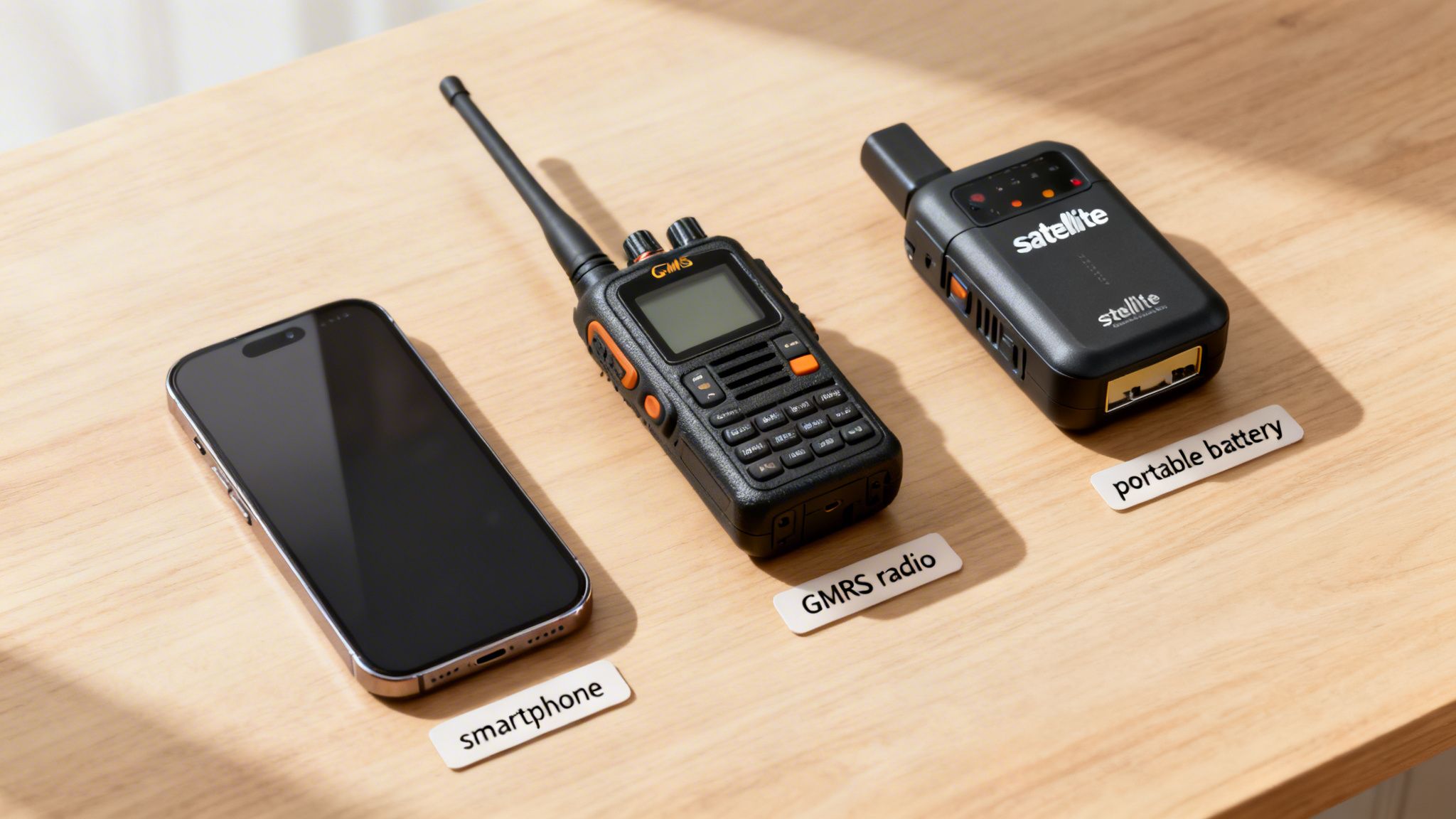
Any solid communication plan has to accept one hard truth: your smartphone is your biggest asset and your most fragile link. When the network is humming along, it’s a miracle of modern technology. When it’s down, you need layers of reliable backups ready to go.
Building this layered approach means you’re never betting the farm on a single piece of tech. It’s about creating a communication toolkit that can adapt to whatever’s happening, whether it’s a simple power outage or a full-blown grid-down disaster. This way, you’ve always got a viable way to reach your family.
Tier 1 Everyday Technology for Immediate Response
The first layer should always be the gear you use every single day. In the first moments of a crisis, speed and familiarity are your best friends. The goal here is to use these tools smarter, not just harder.
We’ve all seen it happen in a local emergency: cell networks get absolutely slammed with voice calls. But text messages (SMS) have a sneaky way of getting through because they use a different, much less demanding channel. A quick text saying, “Safe at neighborhood meeting point,” has a much higher chance of success than a phone call that will likely never connect. Having a reliable power bank, like an Anker PowerCore, ensures your phone has the juice it needs for these critical moments. Understanding how to keep your devices running and your household functional starts with preparing for power outages well before a crisis hits.
Set up a family group chat on a platform everyone already uses, like iMessage or WhatsApp. This gives you one central spot for instant check-ins so one person can update the whole group at once. The main objective of this first tier is a fast, simple status update: “I am safe. I am at [location].”
Tier 2 Local Off-Grid Communication
When the cell towers and internet go dark, your everyday tech is little more than a paperweight. This is where your second layer kicks in, giving you the ability to talk locally without relying on a single piece of outside infrastructure.
This tier is all about two-way radios. They give you a direct, device-to-device link over short-to-medium distances. For most families, General Mobile Radio Service (GMRS) radios are the sweet spot. They pack way more power and range than the cheap FRS walkie-talkies you’d grab off a shelf at a big-box store.
A good set of handheld GMRS radios, like the Midland GXT1000VP4, can be an absolute game-changer for coordinating with family in your immediate area. They’re fairly simple to operate and powerful enough to connect you across a few miles, terrain permitting. That’s invaluable when you’re trying to link up between your home and your local rally point.
Having a reliable set of two-way radios means you create your own private communication network. This single piece of gear can bridge the gap between total isolation and effective local coordination when the grid fails.
Keep in mind that GMRS radios do require a simple, no-test license from the FCC, but one inexpensive license covers your entire family. If you want to go deeper, our guide on what to look for in emergency radio features will help you pick the right gear for your family’s needs.
Tier 3 Last-Resort Satellite Communication
So what happens in a true worst-case scenario? The kind of widespread disaster where every terrestrial network—cell, internet, and even local radio—is either gone or completely unreliable. This is where your third and final layer comes into play, giving you a direct line of communication to the sky.
Satellite communication devices are your ultimate lifeline. They bypass all ground-based systems entirely, sending and receiving messages via orbiting satellites. This tech used to be wildly expensive, but modern satellite messengers have brought it within reach for regular families.
These aren’t for long, chatty conversations. They’re built for critical, short messages. Most allow you to send pre-set “I’m OK” messages, custom texts, and, most importantly, an SOS signal that alerts global search and rescue services with your exact GPS coordinates.
A couple of the most trusted and reliable options in the preparedness community are:
- Garmin inReach Mini 2: This thing is legendary for its rugged build and true two-way messaging. You can have an actual text conversation from pretty much anywhere on Earth.
- Zoleo Satellite Communicator: This device is slick because it pairs with your smartphone via Bluetooth. You get to use a familiar app on your phone to send and receive satellite messages once you’re out of cell range.
Yes, these tools require a subscription plan, but the peace of mind they provide is off the charts. Tucking a satellite messenger into your go-bag means that even in the most dire situation, you have a confirmed way to signal for help and let your loved ones know you’re alive.
Defining Smart and Realistic Meeting Locations
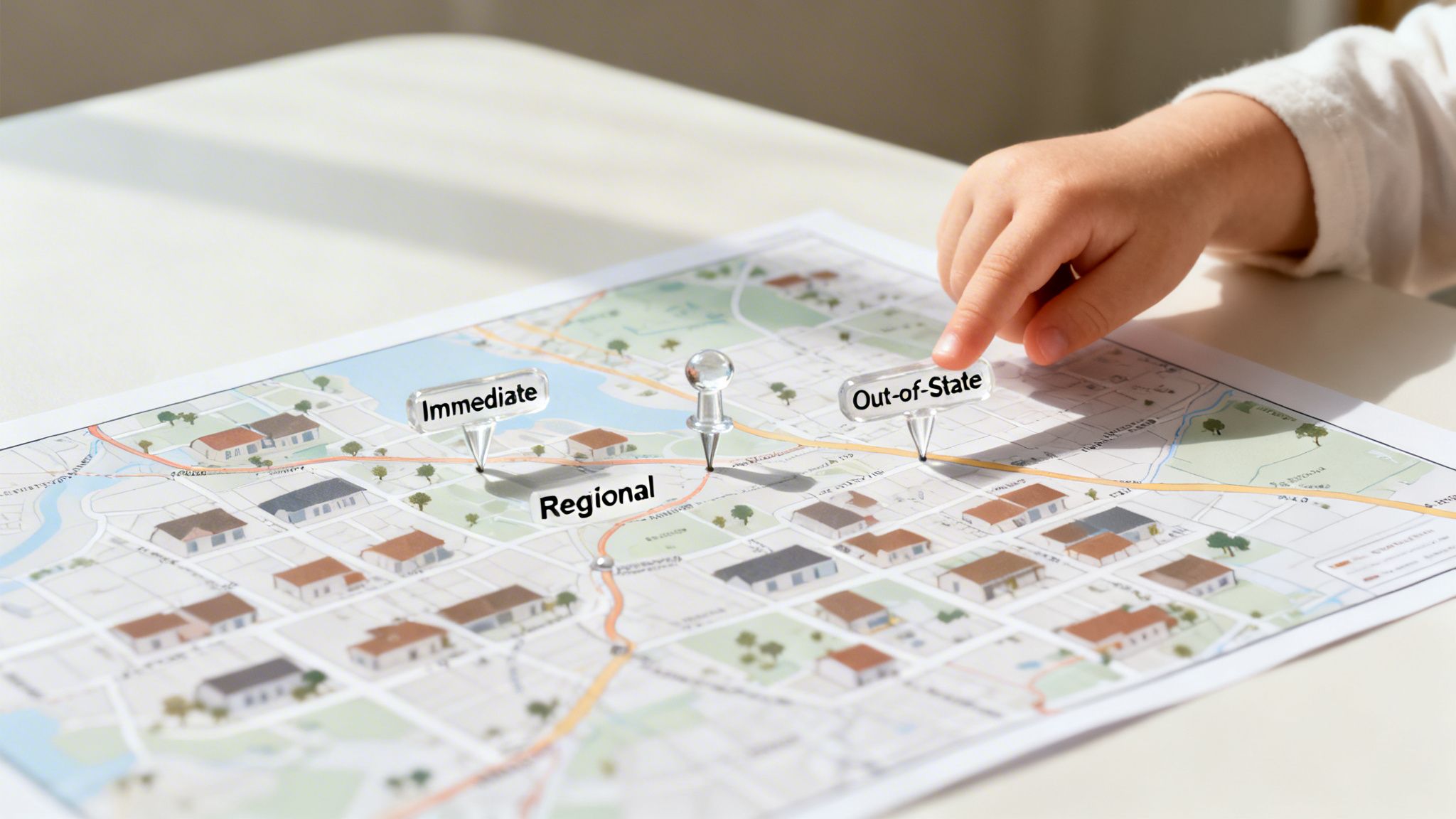
A huge piece of any solid emergency plan answers a simple but vital question: If we get separated and can’t get home, where do we go? Having pre-planned meeting spots is non-negotiable. It takes the deadly guesswork out of a crisis and ensures everyone is moving toward a known, safe location.
The trick is to think in layers. You need a tiered system of rally points, each suited for a different scale of disaster. A house fire calls for a much different plan than a city-wide evacuation, and you need to be ready for both. The goal is to set up three distinct locations that are easy for everyone to remember and find, even your youngest kids.
Tier 1: The Immediate Neighborhood Spot
This is your go-to for sudden, hyper-local emergencies—think a house fire or a gas leak. Something forces you out of the house right now, and you need a spot that’s close, safe, and unmistakable. It has to be within a quick walk.
Pick a specific, obvious landmark. “The big oak tree at the end of the block” is a thousand times better than “somewhere down the street.” The neighbor’s driveway directly across from your house is another great choice. It’s close enough for a fast headcount but far enough to be out of the immediate danger zone.
Your immediate meeting point is all about speed and safety. It needs to be visible from your home so you can see who has made it out, and it must be a safe distance from the hazard itself.
Tier 2: The Regional Hub
So, what happens if the emergency swallows up your whole neighborhood? A chemical spill, a wildfire, or a flash flood could make your immediate area totally off-limits. This is where your second-tier meeting place comes into play, acting as a central hub for everyone to regroup.
This spot should be a familiar public place a few miles away, either in your town or a neighboring one. Think of places like the public library, a community center, or even a specific playground at a big park. You want a location that has public facilities, offers some shelter, and is reachable by more than one route.
- Familiarity is Key: Choose a place you go to regularly. The more your family knows it, the less stressful it will be to find in an emergency.
- Think Accessibility: Make sure it can be reached on foot, by bike, or via public transit if the roads are clogged or you don’t have a vehicle. Having a quality pair of hiking boots from a brand like Merrell or Salomon as part of your get-home gear can make all the difference if you have to travel on foot.
- Get Specific: Don’t just say “the park.” Make it “the slide in the southwest corner of the park” or “by the main entrance of the library.”
Tier 3: The Out-of-State Safe Haven
The final tier is for the big one—a catastrophic event that forces a long-distance evacuation. This is your worst-case-scenario rally point. It should be the home of a trusted friend or relative who lives in another state or, at the very least, several hours away. In extreme scenarios involving civil unrest or government-imposed restrictions, knowing how to prepare for martial law can be the difference between a successful evacuation and being caught completely off guard.
This location pulls double duty. It’s not just a physical place to meet; it’s also often tied to your out-of-state emergency contact—the person who acts as the communication hub for your entire family. By making their home the destination, you create a single, unified objective for both communication and travel.
Of course, this isn’t a plan you make in a vacuum. You absolutely must get on the same page with the friend or relative who lives there. This shouldn’t be a surprise for them in the middle of a crisis. Talk through the logistics beforehand, like the best routes to get there and what supplies they might already have. To really dig into this level of planning, our evacuation plan checklist gives you a comprehensive framework for mapping your routes and packing your gear.
Your Three Tiers of Emergency Meeting Points
To make this crystal clear, here’s a breakdown of the three-tiered system you should establish for your family. Think of it as your roadmap for reuniting, no matter what happens.
| Meeting Point Type | Purpose and Scenario | Example Locations | Key Considerations |
|---|---|---|---|
| Tier 1: Neighborhood | A sudden, localized emergency like a house fire or gas leak. | – A specific neighbor’s driveway – The big tree on the corner – A specific mailbox | Must be visible from home, within easy walking distance, and a safe distance from the immediate hazard. |
| Tier 2: Regional | The neighborhood is inaccessible due to a larger event like a flood or wildfire. | – Public library entrance – A specific playground in a large park – Community center lobby | Familiar to all family members, accessible by multiple routes (foot, bike), and has public facilities. |
| Tier 3: Out-of-State | A catastrophic, wide-scale disaster requiring long-distance evacuation. | – A trusted relative’s home – A close friend’s house in another state | Must be coordinated with the host ahead of time. Serves as both a physical rally point and a communication hub. |
Having these three locations locked in removes one of the biggest sources of panic and confusion in an emergency. It gives every family member a clear, actionable goal, which is priceless when seconds count.
Making Your Plan Second Nature Through Practice
A family emergency plan gathering dust in a folder is just a good intention. A plan that’s been practiced, drilled, and refined becomes muscle memory—the kind of automatic response that saves lives when stress is high and every second counts. The real goal here is to make your strategy so familiar that executing it feels instinctual, turning potential chaos into calm, coordinated action.
This doesn’t have to be some intense, doom-and-gloom affair, especially with kids involved. The key is consistency. By weaving simple, low-stress drills into your family’s routine, you build confidence and competence, ensuring everyone knows their role when it truly matters.
Running Simple, Effective Drills
Practicing your plan should feel more like a family activity than a boot camp. Your objective is to reinforce critical information and actions in a positive, repeatable way. Start with small, manageable exercises and build up from there.
Here are a few easy drills to run regularly:
- The Quarterly Text-In: Once every three months, send a pre-determined “drill” message to your family group chat and out-of-state contact. The goal is a simple confirmation from everyone: “Received. I am safe at [current location].” This quick, five-minute exercise confirms everyone has the right numbers and reinforces the check-in habit.
- The Contact Quiz: Turn it into a game during dinner or on a long car ride. Ask your kids, “What’s Aunt Carol’s phone number in Florida?” or “Who’s the first person you call if you can’t reach Mom or Dad?” This helps commit critical numbers to memory—a vital backup if phones are lost or batteries are dead.
- The Annual Meeting Point Walk: At least once a year, take a family walk or drive to your designated neighborhood and regional meeting spots. Physically going to the location helps cement it in everyone’s mind, especially for children. Point out landmarks and talk about the safest routes to get there from home, school, or work.
A plan is only useful if everyone remembers it. Regular, low-key practice transforms a document into a shared, instinctual response that your family can rely on during a real emergency.
Creating a Routine for Review and Updates
Families change. Jobs and schools switch, phone numbers get updated, and neighbors move. A plan that’s even 12 months out of date might have incorrect contact info or an obsolete meeting spot, making it dangerously unreliable when you need it most.
The best way to combat this is to schedule regular reviews. A great habit to build is tying your plan review to daylight saving time. Twice a year, when you change your clocks and test your smoke detector batteries, pull out the communication plan and give it a once-over.
During this review, check for the following:
- Contact Information: Are all phone numbers and email addresses for family, schools, and workplaces still correct?
- Medical Details: Have there been any changes to prescriptions, allergies, or medical conditions?
- Meeting Locations: Are your chosen spots still safe, accessible, and appropriate? That park that was perfect last year might be under major construction today.
- Supplies: Check the expiration dates on any food, water, or medications in your emergency kits and go-bags. This is also a good time to ensure your Goal Zero solar charger and other power-related gear is functioning correctly.
Making this a consistent, twice-yearly ritual ensures your family emergency communication plan is a living document that evolves with you. For a comprehensive list of what to review, you can use our emergency preparedness plan template as a detailed checklist.
Smart and Redundant Plan Storage
Your meticulously crafted plan is useless if no one can access it during a crisis. Power outages, sudden evacuations, and network failures can all render a single digital file completely inaccessible. The solution is redundancy—storing your plan in multiple formats and locations.
Think in terms of both physical and digital copies, so you have access no matter the circumstances. Most importantly, make sure every family member knows where to find every version of the plan.
Physical Copies: The Fail-Safe Option
Printed copies are immune to power outages and dead batteries, making them the most reliable format in a true grid-down scenario. You should have laminated, waterproof copies stored in several key locations.
- In Every Go-Bag: Each family member’s emergency kit or bug-out bag needs a full copy of the plan.
- In Each Vehicle’s Glove Compartment: If you’re forced to evacuate by car, you’ll have it with you.
- At Your Workplace or School Locker: Keep a copy where you and your family members spend most of your day.
Digital Copies: The Accessible Backup
Digital copies offer convenience and are easy to update on the fly. However, you should never rely on them as your only option. Use a multi-pronged digital storage strategy for the best results.
- Password-Protected Cloud Service: Store an encrypted PDF on a service like Google Drive or Dropbox. This allows you to access it from any internet-connected device.
- On a Rugged USB Drive: A durable, waterproof USB drive like a SanDisk Ultra Dual Drive is a great physical backup for your digital files. It has both USB-A and USB-C connectors, allowing you to plug it into computers and many modern smartphones. Keep this on your keychain or in your go-bag.
- Saved Directly on Your Phone: Store a PDF of the plan locally on every family member’s smartphone so it can be accessed even without a cell or Wi-Fi signal.
Frequently Asked Questions
Putting together a family emergency communication plan is a serious project, and it’s totally normal for questions to come up. Let’s tackle some of the most common ones I hear—getting these answers right is key to building a plan that actually works when you need it most.
How Do I Make This Plan Work for Young Kids Without Phones?
This is a great question. For younger kids, we swap technology for memorization and physical tools. Your goal is to give them simple, automatic actions they can fall back on, even when they’re scared.
Start with the basics: drill them on reciting their full name, your full name, and your home address. It sounds simple, but it’s crucial.
Next, create their wallet card, laminate it, and put it in a specific pocket of their backpack they’ll always remember. Practice with them, explaining that they should only show it to a trusted adult like a police officer, firefighter, or teacher if they get lost. For another layer of safety like an ID bracelet, engraved with an “In Case of Emergency” (ICE) phone number, is a fantastic, low-tech backup.
Finally, make sure their school or daycare has a copy of your plan. This needs to include a list of authorized pickup people and the details for your out-of-state contact, giving them a clear playbook to follow if they can’t reach you.
What Is the Single Most Important Part of the Plan?
Hands down, it’s the out-of-state contact. This is the absolute cornerstone of a solid plan because it works around the single biggest point of failure in any disaster: overloaded local communication networks.
When a local emergency hits, phone lines and cell towers get jammed instantly. It’s often way easier to send a text or call someone hundreds of miles away than it is to reach your neighbor across the street. This person becomes your family’s information hub.
The primary job for every family member is to contact this single person and report their status. That contact can then pass messages between family members who can’t get through to each other, creating a vital bridge over the local communication chaos.
How Often Should We Actually Practice This?
You need to review and practice your plan at least twice a year. A great way to build this habit is to tie it to daylight saving time. When you change your clocks and check the batteries in your smoke detectors, you also take 15 minutes to run through your communication plan.
A “drill” doesn’t have to be some intense, elaborate scenario. It can be as simple as a quick family meeting to review contact numbers and meeting spots. Run a fast text drill: have everyone send a test message to the family group chat and the out-of-state contact. This confirms everyone has the right numbers saved and can get a message through. Once a year, it’s also a really good idea to physically drive by your local and regional meeting points to keep the locations fresh in everyone’s mind.
Regular practice turns a plan on paper into an instinctual response. The goal isn’t perfection; it’s familiarity. When a crisis hits, that familiarity is what keeps panic from taking over and helps everyone act clearly and decisively.
Are There Any Apps That Can Help With Our Plan?
Yes, there are some great apps out there, but they should always supplement, not replace, your core plan. The FEMA App and the American Red Cross “Emergency” app are fantastic for getting real-time weather alerts and official safety guidance.
For secure group chats, an encrypted messaging app like Signal is a solid choice when you have an internet connection. But here’s the critical thing to remember: every single app relies on power and a data network—two things that are notoriously unreliable in a disaster.
This is exactly why your printed wallet cards, physical maps, and backup communication methods are non-negotiable. Think of apps as a helpful layer on top, but your analog plan is the rock-solid foundation that works when everything else fails.