
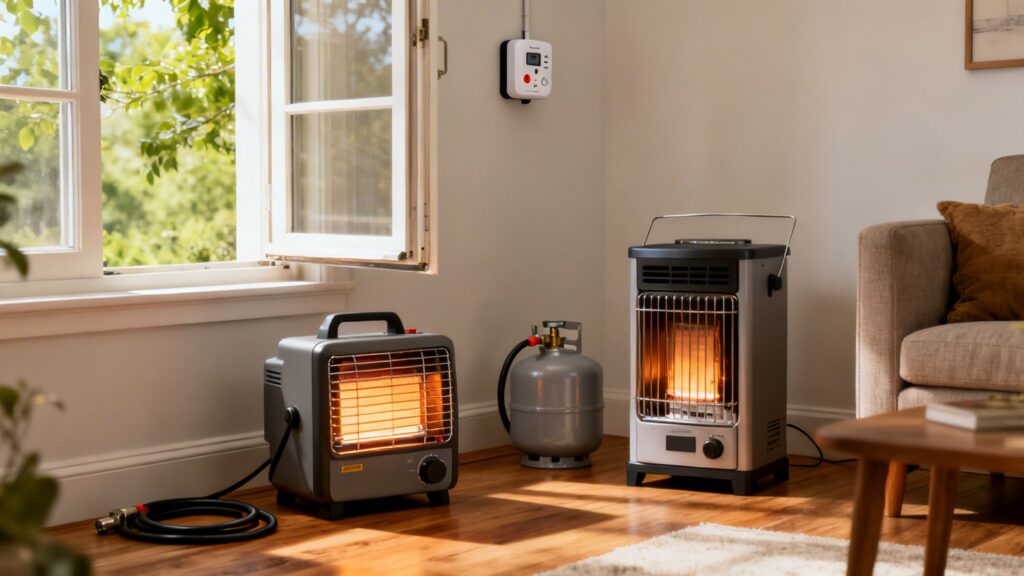
When you’re looking for the best propane heater for indoor use, it’s easy to get fixated on BTUs and how long it’ll run. But let’s be clear: the number one priority is, and always will be, safety.
While no unvented propane heater is ever going to be perfectly safe for indoor use, certain models are what we call “indoor-safer.” These are specifically engineered for temporary, emergency situations. Brands like Mr. Heater build units with critical safeguards that make them a viable option for off-grid heating, but only when you handle them with extreme caution.

The Reality of Using Propane Heaters Indoors
Before you even think about buying a heater, you have to accept a hard truth: combustion uses up oxygen and creates byproducts. That’s just science. When you fire up a propane heater inside an enclosed space, you’re running a machine that eats oxygen and can spit out harmful gases.
This is exactly why most experts will tell you to avoid it completely. Research from the University of Alaska Fairbanks is pretty blunt, classifying all portable propane heaters as unvented and not recommended for home use. They point to the serious health risks from gases like carbon monoxide (CO) and nitrogen dioxide (NO₂).
But for preppers and anyone serious about emergency readiness, a grid-down scenario demands a practical solution. When the power is out for days and the temperature is dropping fast, an indoor-safer propane heater can be a literal lifesaver. The trick is to stop looking for a “safe” heater and start building a “safe heating system.”
The Non-Negotiable Safety Triad
A reliable system starts with a heater that has a trio of essential features. These aren’t nice-to-haves; they are the absolute bare minimum for any unit you’d consider using indoors for temporary emergency heat. This mindset prepares you not just for the cold, but for the risks that come with it. If you’re weighing your options, you can explore other approaches in our guide on survival alternatives for heat.
The three core safety features you must have are:
- Oxygen Depletion Sensor (ODS): This is the big one. It constantly samples the air and will automatically shut the heater down if oxygen levels dip into the danger zone, preventing both hypoxia and a deadly buildup of carbon monoxide.
- Tip-Over Switch: A simple but brilliant mechanical switch. If the heater gets knocked over, it instantly cuts the gas supply and snuffs out the flame. This is your first line of defense against a fire.
- High-Temperature Limit Switch: This sensor acts as a fail-safe, preventing the unit from overheating. It’s another layer of fire prevention that also protects the heater’s internal parts from getting fried.
For anyone preparing for off-grid emergencies, a propane heater is not just a piece of hardware—it’s one component in a complete safety ecosystem that must also include proper ventilation and a reliable, battery-operated carbon monoxide detector. A good quality CO detector from brands like Kidde or First Alert is an essential piece of this system.
Indoor-Safer Propane Heater Safety Feature Checklist
To cut through the marketing noise, use this checklist to vet any heater you’re considering. If a model fails to check any of these boxes, walk away. It’s not worth the risk.
Here’s a quick-reference table summarizing the non-negotiable safety features for any propane heater intended for temporary indoor emergency use.
| Safety Feature | What It Does | Why It’s Critical for Preppers |
|---|---|---|
| Oxygen Depletion Sensor (ODS) | Automatically shuts off the unit if oxygen levels become dangerously low. | Prevents the silent dangers of asphyxiation and carbon monoxide poisoning in a sealed-up emergency shelter. |
| Tip-Over Switch | Instantly cuts fuel flow if the heater is tilted or knocked over. | A crucial fire prevention measure in potentially crowded or low-light survival situations. |
| CSA or UL Certification | Indicates the heater has been independently tested to meet strict safety and performance standards. | Provides third-party validation that the heater’s safety features function as advertised under stress. |
| Adequate Ventilation | A user-enforced protocol of cracking a window or door to ensure fresh air supply. | Replenishes the oxygen consumed by the heater and flushes out harmful combustion byproducts like CO. |
Treating these features as non-negotiable is the first step toward using a propane heater responsibly when everything else has failed.
Catalytic Versus Radiant Heaters for Survival Scenarios
When you’re choosing an indoor propane heater for an emergency, the choice almost always boils down to two technologies: radiant and catalytic. Both run on propane, but they create and distribute heat in fundamentally different ways. Understanding this difference is critical for picking the right tool for your specific survival plan.
Radiant heaters are what most people picture. Models like the ubiquitous Mr. Heater Buddy series have a visible, glowing element. They work like a tiny, focused sun, pushing out infrared heat that warms up objects and people directly in its path, rather than just warming the air.
Catalytic heaters, on the other hand, generate heat through a chemical reaction—no open flame involved. Inside the unit, propane and oxygen react across a platinum-coated surface to create a gentle, consistent warmth. This flameless operation is their defining feature. Heaters from brands like Olympian Wave are a perfect example of this tech in action, often found in RVs and off-grid cabins.
The Radiant Advantage: Speed and Power
The biggest selling point for a radiant heater is its ability to pump out intense, focused heat almost instantly. If you walk into a freezing garage or need to carve out a pocket of warmth in a large, drafty room, a radiant heater is your best friend.
This directional heat is incredibly effective for task-oriented warmth. You feel the heat immediately, just like sitting next to a campfire, even if the surrounding air is still frigid. This is a massive advantage when you don’t have the time or fuel to waste on slowly heating an entire space.
But that raw power comes with trade-offs. The open flame, even when enclosed, demands more careful placement away from anything flammable. They also tend to be less fuel-efficient than their catalytic cousins, burning through propane much faster to produce that powerful heat.
The Catalytic Edge: Silence and Efficiency
Catalytic heaters are the quiet workhorses of the heater world, and their benefits are perfect for long-term heating in smaller, enclosed spaces. Their biggest wins are efficiency and completely silent, flameless operation.
Because there’s no flame, they produce a very gentle, even heat that warms the air through convection. This makes them an excellent choice for keeping a steady, comfortable temperature in a well-ventilated “warm room” during a prolonged power outage. The silent operation is a huge bonus, especially if you’re a light sleeper or find the constant “whoosh” of other heaters jarring in a quiet emergency.
In a long-term grid-down scenario, fuel conservation becomes paramount. A catalytic heater’s lower propane consumption rate can significantly extend your heating capability, potentially turning a three-day fuel supply into five days of warmth.
For a prepper, the most important benefit is fuel efficiency. Catalytic heaters can burn up to 25% less propane than radiant models producing a similar amount of heat. That means your precious fuel supply lasts longer—a crucial factor when you don’t know when a resupply is coming. This focus on longevity and efficiency is a core principle of any good preparedness strategy, just like in a well-stocked winter survival kit.
Comparing Key Survival Metrics
Let’s break this down based on what really matters when things go sideways.
| Feature | Radiant Heaters (e.g., Mr. Heater Buddy) | Catalytic Heaters (e.g., Olympian Wave) |
|---|---|---|
| Heat Type | Directional Infrared: Heats objects and people directly. | Convective: Heats the surrounding air gently and evenly. |
| Best Use Case | Quickly warming a specific zone in a large or drafty space (garage, workshop, large room). | Maintaining a stable temperature in a smaller, enclosed, well-ventilated space (bedroom, RV, cabin). |
| Fuel Efficiency | Lower efficiency; consumes fuel more rapidly for high-output heat. | High efficiency; sips propane, making fuel last significantly longer. |
| Noise Level | Produces a noticeable “whoosh” or humming sound from the burner. | Completely silent operation. |
| Safety Profile | Open flame requires greater clearance from combustible materials. | Flameless design is inherently safer around children and pets, but still requires ventilation. |
Ultimately, neither type is flat-out “better.” The right choice depends entirely on your survival plan and your environment. A radiant heater is your go-to for immediate, powerful warmth in a specific spot. A catalytic heater is the superior option for quiet, efficient, and sustained heat in a confined living area.
Navigating Fire and Carbon Monoxide Risks
Before we even get into comparing different types of heaters, we have to tackle the two biggest dangers of using propane indoors: fire and carbon monoxide (CO). Both are completely preventable, but only if you follow disciplined safety protocols every single time. The first step is simple: treat your propane heater with the same respect you’d give an open flame.
The risk of fire is obvious, but it’s still tragically common. Most heater-related fires aren’t caused by a malfunctioning unit. They happen because someone put the heater too close to flammable materials—blankets, curtains, furniture, even a stack of old newspapers. The most important rule you can follow is to create a non-negotiable three-foot “clearance bubble” around the heater at all times.
Portable space heaters, propane models included, are a serious fire hazard in American homes. According to the U.S. Fire Administration, they were responsible for a shocking 41% of all fatal heating fires in homes from 2017-2019. Think about that. Even though they only caused 3% of total home heating fires, they were disproportionately deadly. The CPSC website has the full safety warning, and it’s a sobering read.
The Invisible Threat of Carbon Monoxide
Fire is a danger you can see. Carbon monoxide is the silent killer. It’s an odorless, colorless gas produced by incomplete combustion—which happens when a propane heater doesn’t get enough oxygen to burn its fuel cleanly. In a well-ventilated space, CO can dissipate without issue. But in a sealed-up room, it can build to lethal levels with terrifying speed.
This is exactly why owning a reliable carbon monoxide detector isn’t a suggestion; it’s an absolute necessity. A quality, battery-powered detector is the only early warning system you have against this invisible threat. For anyone serious about preparedness, a CO detector is just as critical as a first-aid kit or stored water.
Think of your CO detector as your silent partner in a survival situation. While you focus on staying warm, it stands guard against the one threat you can’t see, hear, or smell. A dead battery in your detector is as dangerous as an empty propane tank.
Top-tier brands like Kidde or First Alert make dependable, battery-operated alarms that are easy to find. You need one in the same room as the heater and another one right outside your sleeping area. This creates a layered safety net, making sure you and your family are alerted long before CO levels become a problem.
Establishing an Emergency Heating Safety Protocol
Having a structured safety plan eliminates guesswork during a high-stress event like a power outage. Knowing exactly what to do beforehand prevents a simple mistake from turning into a disaster. For more in-depth strategies on power failures, check out our guide on how to prepare for a blackout.
The checklist below provides a clear, step-by-step protocol for safely using a propane heater indoors during an emergency. Don’t skip a single step.
Emergency Heating Safety Protocol
This checklist isn’t just a list of suggestions; it’s a mandatory process. Following these steps every time you operate your heater is the best way to ensure everyone stays safe.
| Protocol Step | Action Required | Reasoning |
|---|---|---|
| 1. Ventilate First | Before lighting the heater, open a window on one side of the room at least an inch and another on the opposite side. | This creates crucial cross-ventilation, providing a steady supply of fresh oxygen for clean combustion and flushing out any harmful byproducts. |
| 2. Inspect Your Gear | Visually inspect the heater, hose, and propane cylinder for any signs of damage, dirt, or leaks before every use. | A damaged hose or clogged burner can lead to gas leaks or inefficient combustion, increasing both fire and CO risks. |
| 3. Position with Care | Place the heater on a flat, stable, non-flammable surface, maintaining a minimum three-foot clearance from all objects. | This prevents accidental tip-overs and ensures flammable materials like bedding or curtains cannot ignite from radiant heat. |
| 4. Monitor Actively | Never leave a running propane heater unattended. Turn it off completely before going to sleep or leaving the room. | Active monitoring allows you to respond immediately to any issues and ensures the heater is not running when you are unable to supervise it. |
Commit these steps to memory, and post a copy near where you store your heater. In a real emergency, you’ll be glad you did.
Matching the Right Heater to Your Scenario
Theory is one thing, but how these heaters actually perform in the real world is what matters. Knowing the difference between a catalytic and a radiant heater is a good start, but seeing them in action in specific situations is what really makes the choice clear. Let’s walk through a few common prepping scenarios to see how the mission dictates the gear.
Every situation has its own challenges—space, ventilation, how much noise you can tolerate, and how much fuel you can spare. Your choice of heater has to nail every one of these factors to be both safe and effective.
Scenario 1: The Suburban Family Warm Room
Picture a suburban family stuck in a multi-day power outage during a nasty winter storm. The goal isn’t to heat the entire house—that’s a fool’s errand. Instead, they need to create a single, safe “warm room” in a small downstairs den or master bedroom. Here, safety and comfort are everything.
This is the perfect job for a catalytic heater. Its flameless design immediately lowers the fire risk, which is a huge relief when you have kids or pets in a confined space. Even better, it runs completely silent, so it won’t add to the stress of an already tense situation. The family can actually get some sleep without a burner roaring all night.
The incredible fuel efficiency of a catalytic heater is a game-changer in a long-term outage. It sips propane, stretching a limited fuel supply into extra days of life-saving warmth. That’s not just comfort; that’s security.
The heater’s gentle, convective heat will slowly and evenly warm up the room, creating a consistently comfortable space instead of just a single hot spot. Crack two windows for cross-ventilation, place a Kidde carbon monoxide detector at sleeping height, and this setup becomes a rock-solid heat source for riding out the emergency.
Scenario 2: The Homesteader’s Workshop
Now, let’s shift to a homesteader or off-gridder who needs to get work done in a big, uninsulated garage. The space is drafty and massive, and the mission is task-oriented warmth, not trying to heat the whole building. They need powerful, immediate heat aimed right where they’re working.
This is where a radiant heater absolutely shines. A unit like a Mr. Heater Buddy can be pointed to project a powerful beam of infrared heat directly at the workbench. It warms the person and their tools instantly, cutting right through the bone-chilling cold without wasting fuel trying to heat the entire volume of freezing air.
Its portability is also a massive win. As the homesteader moves from the engine block to the welding table, the heater moves with them, providing focused warmth on demand. The higher fuel consumption is a perfectly acceptable trade-off for the intense, on-the-spot heat needed for this kind of work.
Scenario 3: The Bug-Out Cabin or Tent
Finally, think about a bug-out or tactical situation. Portability and fuel flexibility are king. Someone has bailed out to a small cabin, a hunting blind, or a heavy-duty tent like one from Kodiak Canvas. The space is tight, and every ounce of gear had to be hauled in.
In this scenario, a compact and ultra-portable radiant heater like the Mr. Heater Little Buddy is the obvious choice. Its tiny footprint and ability to run directly off a 1 lb. propane canister make it a non-negotiable piece of kit for any mobile setup. Those small canisters are easy to pack and carry, which is exactly what a bug-out plan demands. A solid survival gear list always includes redundant and portable heating options for this very reason.
It doesn’t have the raw power of bigger models, but its output is more than enough to take the dangerous edge off the cold in a small shelter. The key to using it safely, however, is aggressive ventilation. In a tent, that means partially unzipping two opposing windows or vents to guarantee constant airflow. This is non-negotiable for preventing oxygen depletion or CO buildup in such a small, enclosed space.
Mastering Your Propane Fuel Strategy
An indoor-safe propane heater is a fantastic tool, but it’s nothing more than a paperweight without a solid fuel plan. True preparedness goes beyond just owning the gear; it means having the logistics dialed in to keep it running. You need to think critically about how much fuel to store, where to keep it, and how you’ll connect it all together when it counts.
A well-planned fuel strategy is what separates a comfortable wait from a cold crisis. It’s the difference between having heat for a few hours and having it for the entire emergency.
Choosing Your Cylinder Size
Your first big decision is whether to rely on small 1 lb. canisters or the much larger 20 lb. tanks you see on BBQ grills. Each serves a purpose, and understanding their trade-offs is key to building a resilient plan.
- 1 lb. Canisters: These are the kings of portability. They’re perfect for bug-out bags, short-term power outages, or heating a small tent. But their convenience comes at a cost—they offer only a few hours of heat and are far less economical.
- 20 lb. Tanks: This is the backbone of any serious home-based heating plan. A single 20 lb. tank offers 20 times the runtime of a small canister, potentially powering a heater like the Mr. Heater Buddy for over 100 hours on its lowest setting. That’s days of uninterrupted warmth.
The best approach often involves both. A simple piece of gear like the Mr. Heater Propane Hose Assembly lets you connect a small, portable heater to a big 20 lb. tank. This setup gives you the best of both worlds: the massive fuel capacity of a large tank with the small, safe footprint of an indoor-rated heater.
Safe Propane Storage Essentials
How and where you store your propane is just as critical as how much you have. Propane is remarkably stable, but it demands respect. Storing it improperly isn’t just a mistake; it’s a massive fire hazard that could undermine all your other preparations.
The number one rule is non-negotiable: never store propane tanks indoors. That includes your basement, your garage, and any attached sheds. A slow leak from a faulty valve can fill an enclosed space with flammable gas, creating a disaster just waiting for a spark.
Always store your propane tanks outdoors in a well-ventilated, shaded spot. Keep them upright on a stable surface, away from direct sunlight and any potential sources of ignition. This ensures the pressure-relief valve can function correctly in an emergency.
Treat your fuel storage location as a vital component of your heating system, because that’s exactly what it is.
Calculating Your Fuel Consumption
Guesswork is a prepper’s worst enemy. Running out of fuel in the middle of a winter storm is a dangerous and entirely avoidable scenario. A little bit of math now will save you a lot of misery later.
First, find your heater’s fuel consumption rate, usually listed in the manual. For example, a popular portable unit on a low 4,000 BTU setting might burn about 0.044 pounds of propane per hour.
Next, figure out your expected daily runtime. If you plan to run it for 8 hours each day to take the chill off, your daily consumption is:
0.044 lbs/hour * 8 hours/day = 0.352 lbs/day
Finally, multiply that by the number of days you’re preparing for. For a one-week scenario, you’d need:
0.352 lbs/day * 7 days = 2.464 lbs
This quick calculation shows that a single 20 lb. tank could last for weeks at this rate. Knowing your numbers turns your fuel strategy from a guess into a plan. This same principle of calculating your needs applies across all your preps, including things like your portable cooking equipment and fuel.
Making Your Final Decision
Picking the right indoor propane heater isn’t about finding a single “best” model. It’s about matching the right tool to your specific preparedness plan. The most powerful heater on the market is useless if it doesn’t fit your space, your fuel strategy, or your safety protocols.
Thinking through your own situation is the key to moving from theory to a confident, practical choice. Instead of getting hung up on maximum BTUs or brand names, start by asking the fundamental questions. Your answers will naturally lead you to the safest, most effective option for keeping your family warm when it counts.
Your Personal Heater Selection Checklist
Before you pull the trigger on a purchase, run through these critical questions. Think of this as building a blueprint for your emergency heating system. Your answers will create a clear profile of your ideal heater, narrowing the field from dozens of options to the one or two that truly fit your mission.
How big is the space you need to heat? A small, insulated “warm room” of 150 square feet has totally different needs than a drafty 500-square-foot garage. Be realistic about the area you plan to keep livable.
What’s your primary use case? Are you planning for short-term power outages where you’ll need a reliable backup for just a few days? Or are you living off-grid and need a consistent heat source for daily work in an unheated workshop?
What are your fuel storage capabilities? Do you have a safe, outdoor spot to store multiple 20 lb. propane tanks? Or is your plan built around the grab-and-go portability of smaller 1 lb. canisters stored in a bug-out bag alongside essentials like a LifeStraw water filter?
Answering these questions honestly is the fastest way to get the clarity you need to make a solid decision.
Your final choice is more than just a heater; it’s a commitment to a system. This system includes the unit itself, a robust fuel supply, disciplined ventilation habits, and redundant carbon monoxide monitoring with a quality detector like a First Alert alarm.
Working through this framework helps you decide if a radiant heater’s quick, focused power is a better fit than a catalytic heater’s quiet, steady efficiency. The goal is to choose a unit that not only produces heat but integrates seamlessly and safely into your overall preparedness strategy. The heater is just one piece of the puzzle—your commitment to proper ventilation and constant CO monitoring is what truly keeps you safe.
Frequently Asked Questions
Even the best-laid plans can leave you with a few lingering questions. When it comes to using propane heaters indoors during an emergency, getting clear, safety-first answers is the only way to operate your gear with confidence. Let’s tackle some of the most critical questions preppers ask.
Can I Safely Run a Propane Heater While I Sleep?
The answer here is an absolute, non-negotiable no. Never, under any circumstances, should you run a propane heater while you’re asleep. The risk is just too great.
When you’re sleeping, you’re not aware of your surroundings. You can’t monitor the heater for a malfunction, notice if a blanket has fallen too close, or recognize the early, subtle symptoms of carbon monoxide poisoning. Even with an ODS and a CO detector in place, running a heater unattended overnight removes the single most important safety feature: a conscious, alert human being.
How Much Ventilation Do I Really Need?
This is a fantastic question because “adequate ventilation” can feel a bit vague. The goal isn’t to create a bone-chilling draft, but a constant, gentle exchange of air that draws fresh oxygen in and pushes combustion byproducts out. The easiest way to achieve this is with cross-flow.
Just crack a window about an inch on one side of the room, and do the same for a window on the opposite wall. This creates a natural air current that safely circulates the air without making things uncomfortable. If you only have one window, opening it an inch or two and cracking the door to an adjacent room can accomplish the same thing.
Remember this simple rule: The heater needs to breathe, and so do you. Not enough ventilation starves the heater of oxygen, which leads to incomplete combustion and the creation of deadly carbon monoxide. Always open your window before you light the heater.
Is It Okay to Bring a 20 Lb Propane Tank Inside?
No, you should never bring a 20 lb. propane tank inside your home, garage, or any other enclosed space. This is a major safety rule, and organizations like the National Fire Protection Association (NFPA) are crystal clear about it: large tanks belong outdoors.
The logic is simple. If that tank’s pressure relief valve ever vents or a leak develops, it can release a huge volume of highly flammable gas into your living space in seconds. To use a big tank, keep it outside and run a certified hose, like the Mr. Heater Propane Hose Assembly, through a wall or a slightly open window to your heater. This setup gives you the long run-time of a large tank while keeping the bulk fuel hazard safely outside where it belongs.