
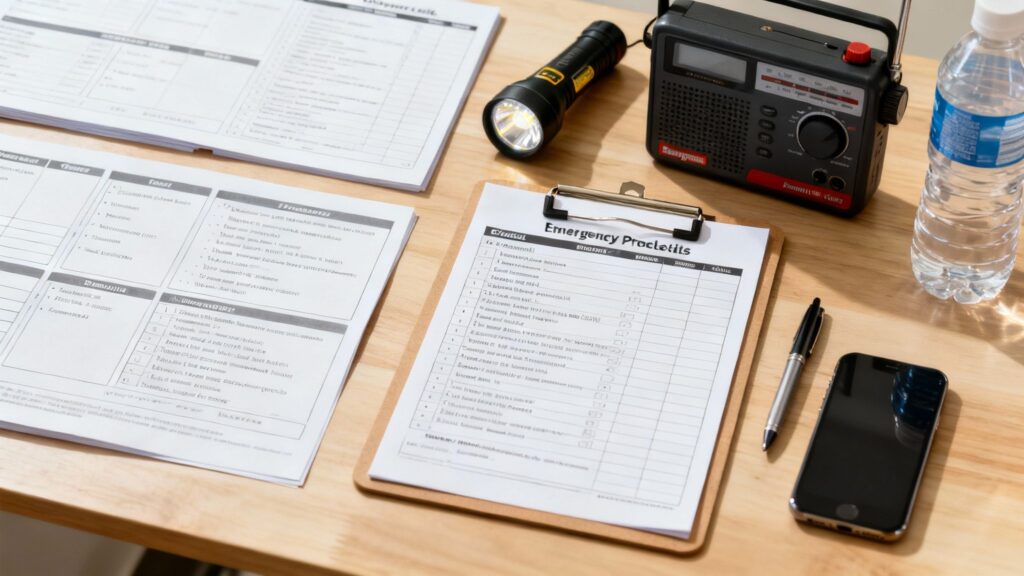
In an emergency, the first things to fail are often power and internet access, rendering your digital notes and cloud-based documents useless. That’s why having a physical, printed emergency preparedness checklist is non-negotiable for true readiness. When stress is high and chaos looms, a simple piece of paper can guide you through critical steps, ensuring you don’t forget life-saving supplies, vital contacts, or crucial actions for your family’s safety. A well-structured checklist is more than just a list; it’s a systematic plan that prevents panic-induced oversights, like forgetting prescription medications or a can opener for your emergency food supply.
This article goes beyond a single, generic list. We’ve curated and analyzed the 12 best printable and downloadable emergency preparedness checklist PDF resources available from trusted sources. From comprehensive federal guidelines by FEMA and the American Red Cross to specialized lists for families with infants, pets, and specific disaster scenarios like hurricanes or wildfires, these tools will help you build a resilient plan tailored to your unique needs.
Think of this as your central hub for preparedness paperwork. We will explore each resource, highlighting its strengths, explaining its ideal use case, and providing direct download links. Whether you’re assembling a 72-hour bug-out bag with gear like a personal water filter or creating a detailed home inventory for insurance purposes, you’ll find the right printable template here. Our goal is to help you create a comprehensive emergency binder so you can take decisive, organized action when it matters most.
1. AATF Survival Guide
AATF Survival Guide stands out as a premier resource hub, offering a wealth of practical, hands-on knowledge that goes far beyond a simple emergency preparedness checklist pdf. While it provides the foundational documents families need, its true value lies in teaching the skills required to act on those plans effectively. The platform translates complex survival concepts into easy-to-follow, actionable steps, making it an excellent starting point for beginners and a valuable reference for seasoned preppers.
The content is deeply rooted in real-world scenarios, from short-term power outages to long-term supply chain disruptions. This focus on pragmatic application is what sets it apart. Instead of just listing items, AATF explains the why and how behind each recommendation.
Core Strengths and User Experience
The site operates as a frequently updated blog, ensuring the information is current and relevant. The user experience is straightforward, with content organized into clear, digestible articles that cover a broad spectrum of preparedness topics.
- Skill-Building Focus: Tutorials on critical skills like water purification with a Sawyer Squeeze filter, long-term food preservation techniques using FoodSaver vacuum sealers, and building a versatile pantry are central to its mission.
- Gear and Tool Analysis: The site provides detailed guidance on selecting essential equipment. For instance, articles compare the utility of multi-tools like the Leatherman Wave+ versus the Gerber Suspension-NXT, helping users make informed decisions based on practical needs rather than just marketing hype.
- Accessibility: All content is freely accessible without a paywall. By subscribing to their email newsletter, users receive a complimentary survival guide and weekly tips, fostering a sense of community among what they call “1,000s of smart preppers.”
For those looking to build a resilient pantry, understanding survival food shelf life is essential. AATF Survival Guide offers detailed insights into how long various foods last and how to rotate them effectively.
Practical Applications and Limitations
This resource is ideal for individuals and families who want to move beyond passive planning and into active skill development. It provides the context needed to understand why having a checklist is just the first step. For example, a checklist might say “store non-perishable food,” but AATF teaches you how to read Mountain House meal date codes and build a pantry that can sustain hundreds of meals.
However, its guidance is primarily U.S.-centric, so international readers may need to adapt certain recommendations. Furthermore, while the blog-based information is excellent for self-education, it is not a substitute for professional, hands-on training in areas like first aid or self-defense.
A reliable multi-tool for emergencies can be a game-changer, and AATF Survival Guide provides recommendations on which ones are best suited for survival scenarios.
Visit the Website: AATF Survival Guide
2. Ready.gov — Build a Kit (FEMA)
When seeking the most authoritative and widely recognized resource, Ready.gov is the definitive starting point. Operated by the Federal Emergency Management Agency (FEMA), this platform provides the foundational emergency preparedness checklist PDF used by government agencies and community organizations nationwide. It offers a no-frills, direct approach to building a basic disaster supplies kit, making it an excellent, trustworthy resource for beginners. The guidance is clear, concise, and focused on essential items without overwhelming newcomers.
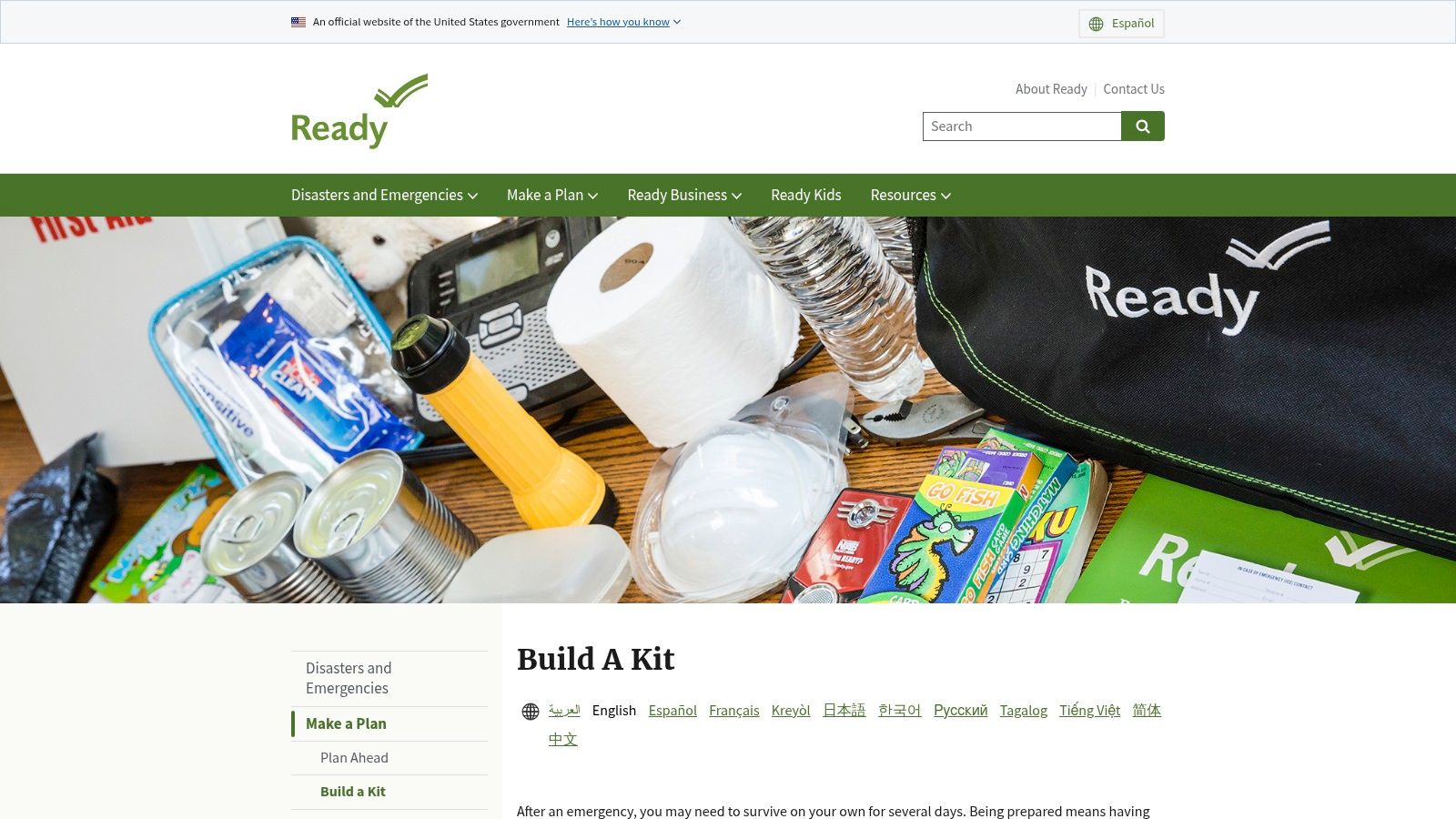
The primary offering is a free, printable “Emergency Supply List” PDF available in multiple languages, including Spanish, Chinese, and Vietnamese. This broad accessibility ensures diverse communities can access critical information. Ready.gov excels by providing specialized considerations, offering tailored advice for building kits for seniors, individuals with disabilities, and pets. For example, the list will remind you to include not just food and water, but also specific items like a manual can opener or a LifeStraw personal water filter for backup purification. For a deeper analysis of each item on FEMA’s list, you can explore this detailed disaster supply kit guide.
Key Features and Assessment
| Feature | Assessment |
|---|---|
| Credibility | Excellent. As the official U.S. government source, its information is reliable and serves as the national standard. |
| Usability | Good. The website is simple to navigate, and the PDF is easy to download and print. The focus is purely informational. |
| Customization | Basic. While it offers guidance for different needs, the core PDF is a static document, not an interactive or editable template. |
| Cost | Free. The website and all its resources are completely free and ad-free. |
Practical Tip: Print multiple copies of the FEMA emergency preparedness checklist PDF. Keep one with your emergency supplies to serve as an inventory sheet, one in your car’s glove compartment, and another with your important documents. This ensures you can reference it even if digital access is unavailable.
- Website: https://www.ready.gov/build-a-kit
3. Ready.gov — Free Publications (FEMA printed brochures)
For those who need to distribute preparedness information to a community group, school, or workplace, FEMA’s free publications portal is an invaluable resource. This section of Ready.gov goes beyond a simple download, allowing U.S. residents to order professionally printed brochures, including the essential emergency supply list, to be shipped directly to their address at zero cost. This service is ideal for community leaders, educators, and anyone looking to share reliable, vetted information without incurring printing expenses. The materials are designed for bulk distribution, ensuring consistent messaging across a wider audience.
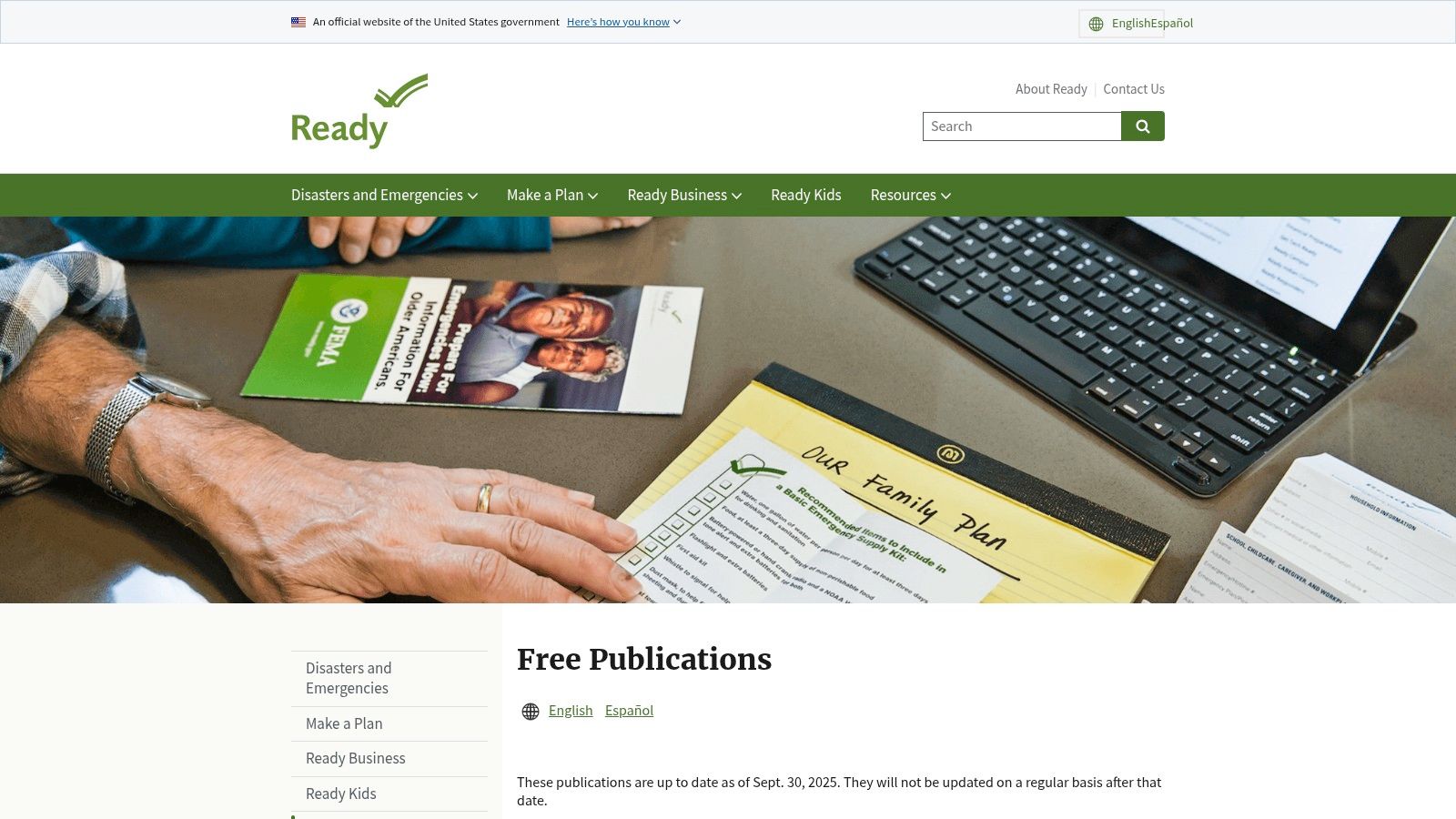
The platform provides access to a catalog of FEMA’s official preparedness materials, including multi-language versions of key documents. This makes it a powerful tool for ensuring inclusive access to critical safety information. Beyond the standard emergency preparedness checklist PDF, you can find guides on specific threats like floods and wildfires. This service ensures everyone has access to high-quality, tangible resources, which are crucial in a crisis when digital access may be unavailable. The core supply list content remains the same, advising staples like non-perishable food, a NOAA Weather Radio, and first-aid supplies.
Key Features and Assessment
| Feature | Assessment |
|---|---|
| Credibility | Excellent. Materials are official, vetted FEMA publications, representing the national standard for emergency advice. |
| Usability | Good. The ordering process is straightforward, though navigation can occasionally present non-English pages first. |
| Customization | None. These are fixed, printed documents. Users can download reprintable PDFs but cannot edit the content. |
| Cost | Free. All printed materials and shipping within the U.S. are provided at no cost, which is the platform’s primary benefit. |
Practical Tip: Plan ahead when ordering for an event. Shipping times from the FEMA warehouse can vary, especially during peak disaster seasons or national preparedness campaigns. Check the stock status and order well in advance to ensure your materials arrive on time.
- Website: https://www.ready.gov/publications
4. Ready.gov — Family Emergency Plan Form
Beyond a simple supply list, true preparedness involves communication. Ready.gov addresses this critical need with its Family Emergency Plan Form, a free tool that focuses on how your family will reconnect and communicate during a disaster. This resource is not a supply checklist; instead, it’s a vital companion document that captures essential contact information, meeting places, and medical details. It guides users through creating a plan, ensuring everyone knows who to call and where to go if separated.
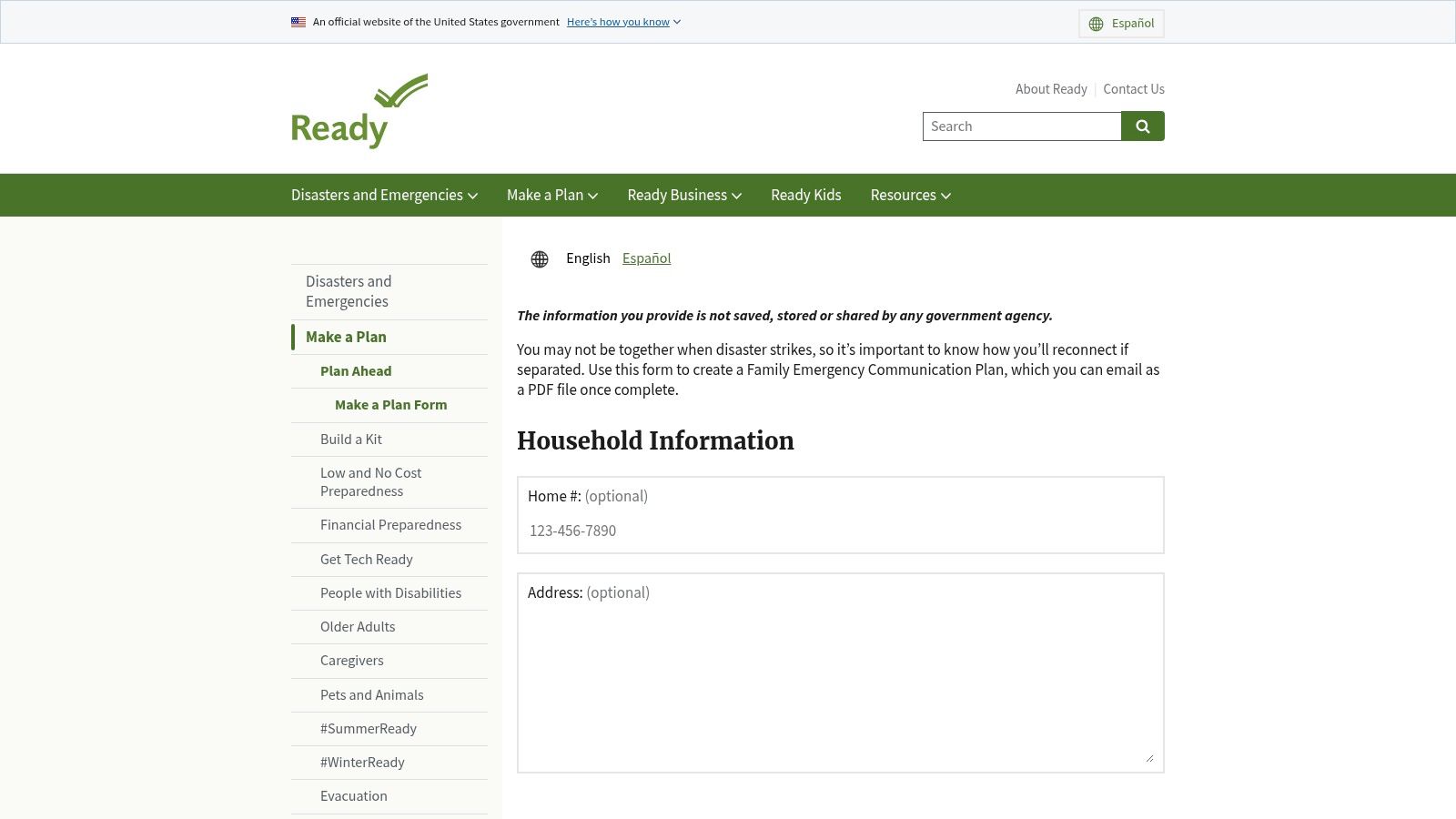
The platform functions as a fillable web form available in English and Spanish. You input details for household members, out-of-town contacts, and designated safe meeting spots, both nearby and outside your neighborhood. Once completed, the system generates and emails a shareable, printable PDF of your customized plan. While the formatting is basic, its strength lies in its simplicity and official backing. This tool expertly centralizes the human element of disaster planning, which is often overlooked. To see how this form fits into a broader strategy, you can review this emergency plan template guide.
Key Features and Assessment
| Feature | Assessment |
|---|---|
| Credibility | Excellent. As another official FEMA tool, the information framework is authoritative and trusted. |
| Usability | Excellent. The step-by-step form is incredibly simple to fill out, making it accessible to non-technical users. |
| Customization | Basic. The tool generates a standardized PDF; you cannot alter the layout or add custom fields beyond what is provided. |
| Cost | Free. This government resource is completely free to use, with no sign-ups or ads. |
Practical Tip: Complete this form as a family activity. This ensures everyone, including children, understands the plan and has a chance to ask questions. Keep a printed copy of the final PDF in each family member’s school bag, work bag, and vehicle.
- Website: https://www.ready.gov/plan-form
5. American Red Cross — Be Red Cross Ready
Alongside FEMA, the American Red Cross is a globally recognized authority on disaster response and preparedness. Its “Be Red Cross Ready” hub provides a comprehensive suite of resources that go beyond simple checklists, integrating actionable training and community support. The platform is ideal for families, schools, and workplaces looking for a trusted source that combines downloadable materials with practical, life-saving skills education. The approach feels holistic, encouraging users not just to pack a kit, but to understand the “why” behind each item.
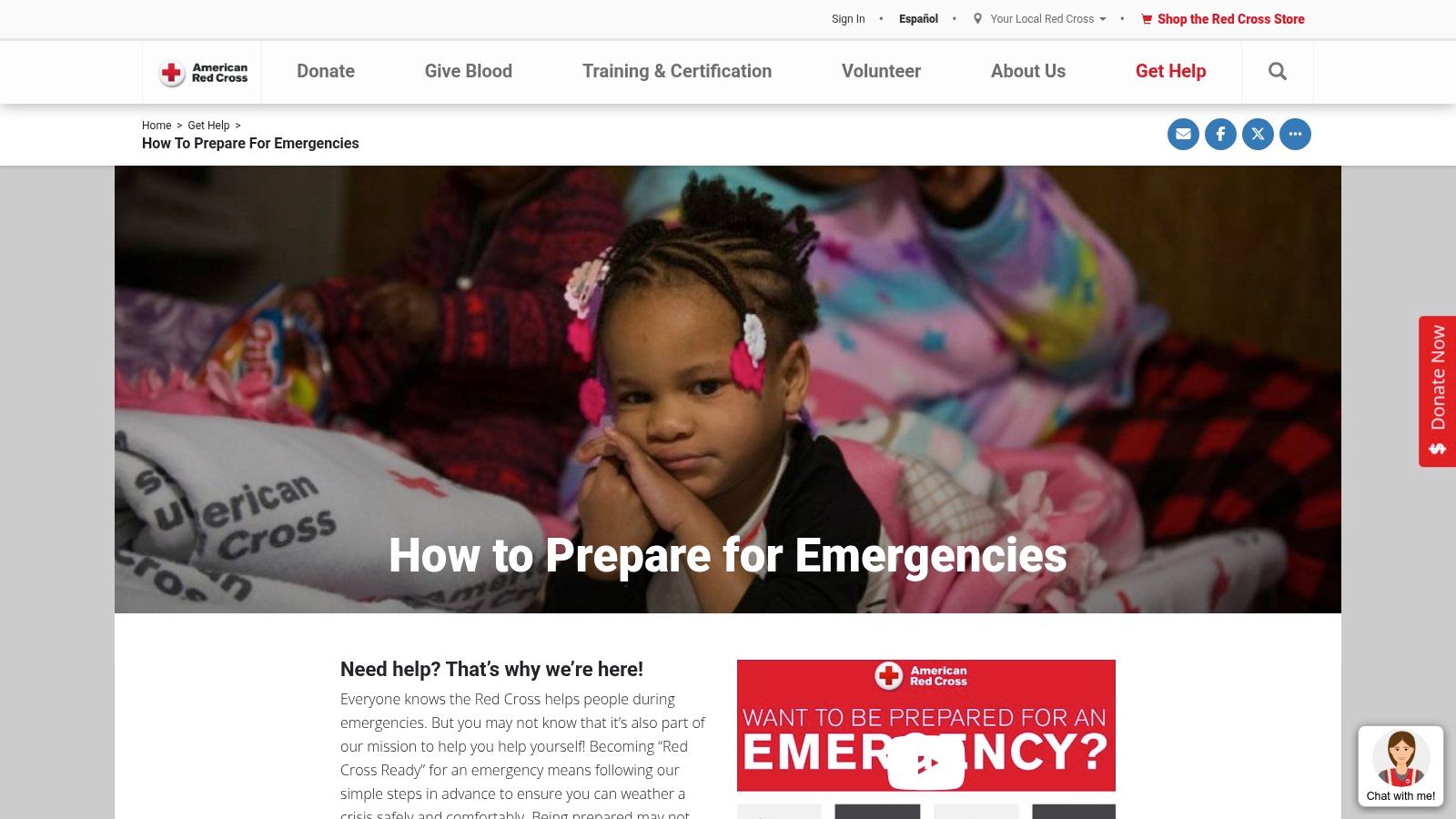
The core offering is a printable “Preparedness Essentials Checklist,” a clean and easy-to-follow emergency preparedness checklist PDF. What sets the Red Cross apart is how it complements these documents with tangible next steps, such as links to first-aid and CPR classes, volunteer opportunities, and its own suite of preparedness apps. The checklist itself is thorough, covering essentials like a three-day supply of non-perishable food, a gallon of water per person per day, and a well-stocked first-aid kit that includes items like CAT Tourniquets and antiseptic wipes. It also provides useful templates like emergency contact cards for children’s backpacks.
Key Features and Assessment
| Feature | Assessment |
|---|---|
| Credibility | Excellent. The Red Cross is a highly trusted, non-governmental organization with a long-standing global reputation in humanitarian aid. |
| Usability | Good. The website is well-organized, and finding the main checklists is straightforward. However, some resources gently guide users toward app downloads. |
| Customization | Basic. Similar to FEMA, the primary checklists are static PDFs. Customization comes from using their broader resources to tailor your plan. |
| Cost | Free. All checklists, templates, and informational resources on the site are available at no charge. |
Practical Tip: Download and print the Red Cross emergency contact cards. Laminate them after filling them out and place one in each family member’s wallet, car, and emergency kit. This provides durable, waterproof access to critical contact information when digital devices may fail.
6. CDC — Emergency Kit Checklist: Kids and Families
While many checklists cover the basics, the Centers for Disease Control and Prevention (CDC) offers a vital resource specifically tailored for households with children. This emergency preparedness checklist PDF adds a critical health and pediatric layer to standard kits, addressing the unique needs of infants, toddlers, and youth. The guidance is grounded in public health expertise, ensuring that caregivers consider often-overlooked items essential for a child’s well-being during a crisis. It moves beyond general supplies to include pediatric-specific considerations.
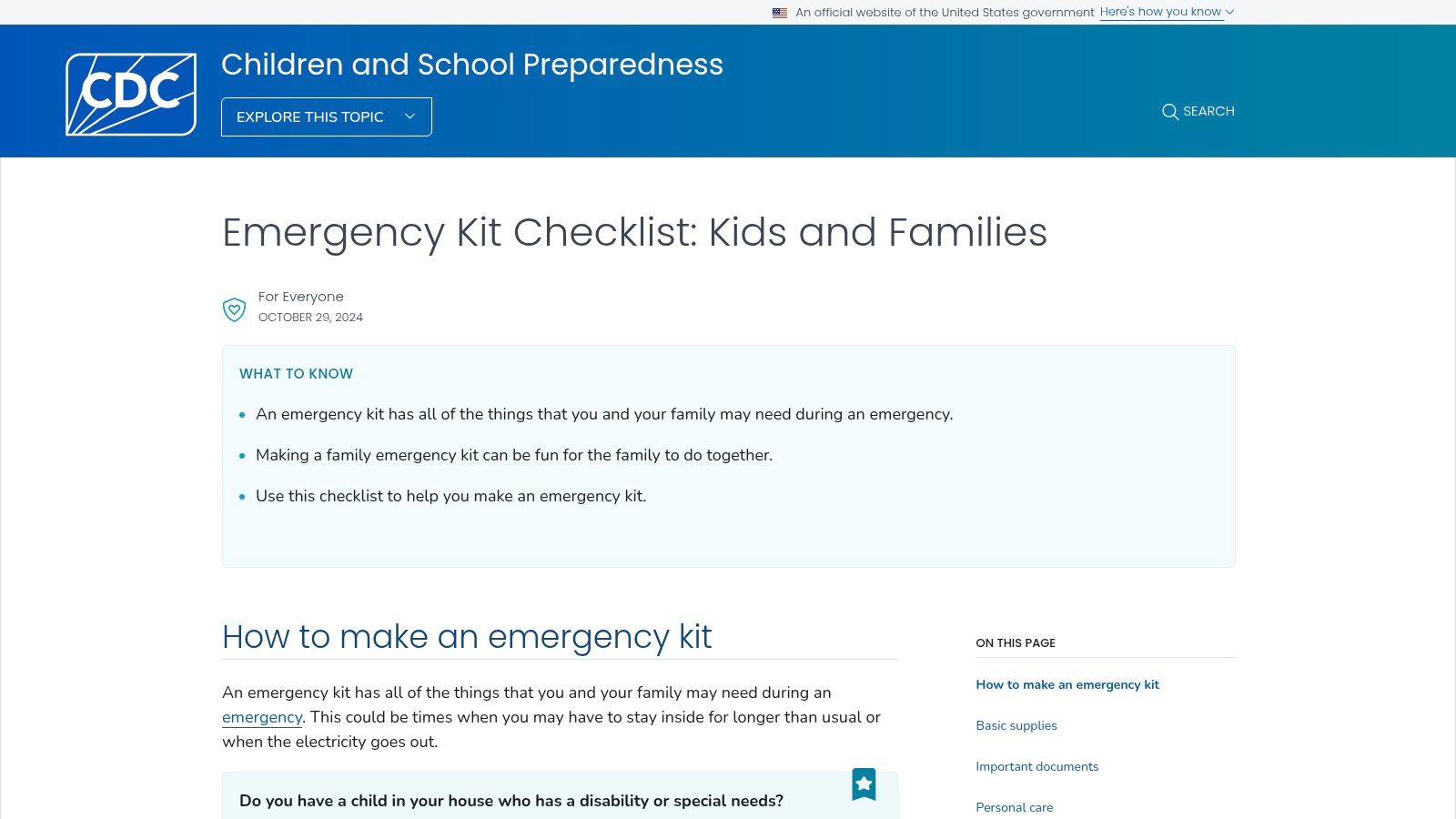
The free, printable PDF is presented in plain language, making it accessible to all caregivers. It uniquely emphasizes maintenance, reminding users to check expiration dates on food, water, and medications every six months. The checklist complements general guides from FEMA by adding items like infant formula, diapers, and children’s pain relievers. It also provides crucial links to resources for children and youth with special healthcare needs, a segment not always addressed in broader survival guides. The focus remains on health-first preparation, ensuring families are ready for medical needs as well as basic survival.
Key Features and Assessment
| Feature | Assessment |
|---|---|
| Credibility | Excellent. As a leading public health institution, the CDC’s advice is authoritative, evidence-based, and medically sound. |
| Usability | Good. The website is straightforward, and the single-page PDF is easy to print and use. It’s designed for quick reference. |
| Customization | Basic. The document is a static PDF. Customization involves manually adding items specific to your family’s needs. |
| Cost | Free. All resources on the CDC’s website are available at no cost and are free of advertisements. |
Practical Tip: Use this CDC checklist alongside a more general one like FEMA’s. Merge them into a single, comprehensive family plan. Keep copies of prescriptions, medical records, and your pediatrician’s contact information with the printed checklist in a waterproof bag.
- Website: https://www.cdc.gov/children-and-school-preparedness/resources/emergency-kit-checklist.html
7. CDC — Infant and Young Child Feeding in Emergencies: Emergency List (PDF)
Caring for infants and young children during a disaster requires a specialized approach, and the Centers for Disease Control and Prevention (CDC) provides an essential resource for this exact need. Rather than a general household list, the CDC offers a highly focused, two-page emergency preparedness checklist PDF dedicated to infant and young child feeding supplies. This bilingual (English/Spanish) document is a critical supplement to any family’s core emergency plan, ensuring the most vulnerable members are not overlooked. It is an authoritative, evidence-based tool designed for maximum clarity and immediate use by caregivers.
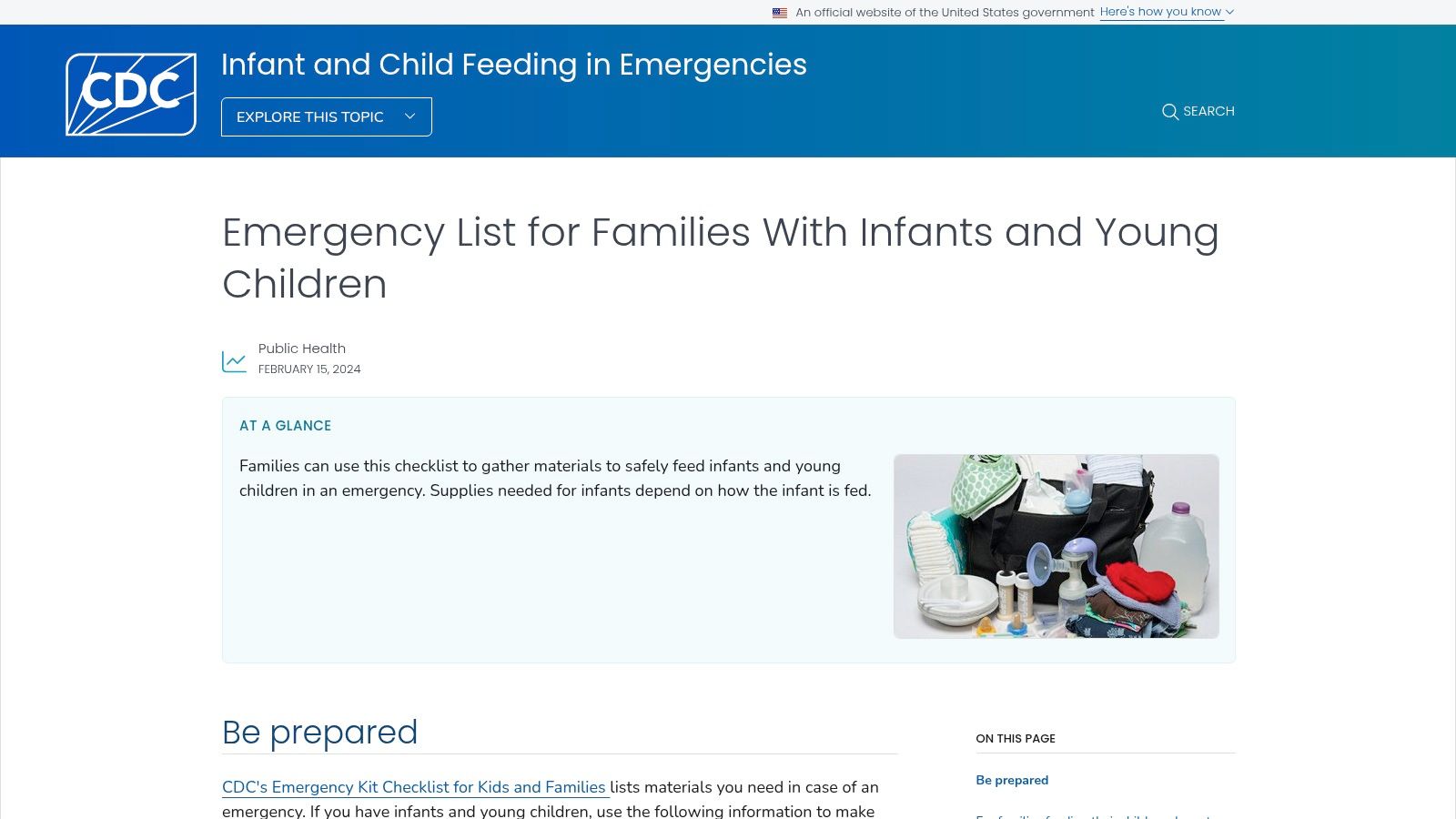
This checklist stands out by emphasizing sanitation, a critical factor when preparing formula or cleaning feeding items. It specifically highlights items that are unsafe without clean water and recommends kit add-ons like a portable camp stove, such as a Jetboil, and a pot for boiling water. Proper water purification is paramount for infant safety, a topic you can explore in this guide on how to purify water. The CDC’s thoughtful inclusion of these practical details transforms it from a simple list into a life-saving guide for parents and guardians facing an emergency.
Key Features and Assessment
| Feature | Assessment |
|---|---|
| Credibility | Excellent. As a leading public health institute, the CDC’s guidance is medically sound and highly reliable for infant care. |
| Usability | Excellent. The two-page, bilingual format is extremely clear, concise, and easy to print and add to an emergency binder. |
| Customization | Not Applicable. This is a specialized, static list, not a customizable template. Its strength is its focused, expert-driven content. |
| Cost | Free. All resources on the CDC website are publicly available at no cost. |
Practical Tip: Print this specific checklist and store it inside the container you use for your baby’s emergency supplies. This keeps the inventory list directly with the items, making it easy to check expiration dates and restock essentials like ready-to-feed formula, diapers, and wipes.
8. REI Co‑op — Emergency Essentials: Preparedness Basics
For those who view preparedness through the lens of durable, high-quality outdoor gear, REI Co-op offers a fantastic resource. Their “Emergency Essentials” article provides more than just a list; it delivers a comprehensive educational guide rooted in the expertise of outdoor adventuring. This approach is perfect for individuals who want to build a kit with reliable equipment that can withstand rugged conditions, moving beyond basic supplies to items tested in the elements. The guidance focuses on building a robust kit designed to last 10–14 days, a step up from the typical 72-hour recommendation.
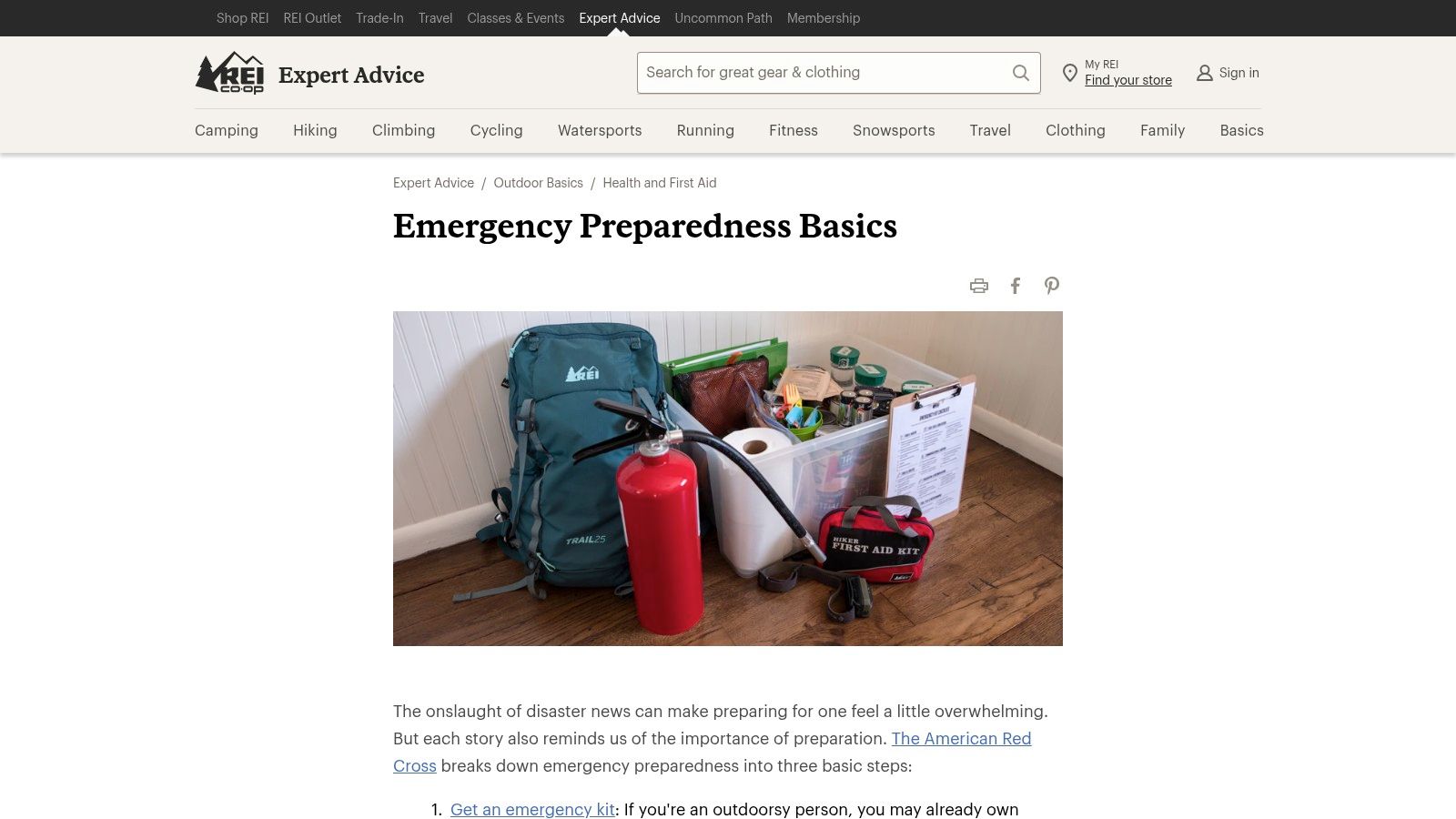
The centerpiece is a printer-friendly emergency preparedness checklist PDF embedded directly within the educational article. What makes REI unique is the integration of this checklist with curated links to their product ecosystem. As you review the need for a reliable light source, you’ll find recommendations for gear like a Goal Zero solar lantern. This one-stop-shop approach simplifies the process of acquiring high-performance gear. For those new to the field, this article serves as an excellent primer on how to begin your prepping journey by focusing on quality over quantity from the outset.
Key Features and Assessment
| Feature | Assessment |
|---|---|
| Credibility | Excellent. REI is a trusted name in outdoor and survival gear, lending strong authority to its equipment recommendations. |
| Usability | Good. The article is well-organized, and the embedded PDF is easy to print. The integrated product links make sourcing items convenient. |
| Customization | Basic. The checklist itself is a static PDF, but the surrounding educational content provides the knowledge needed to customize a kit effectively. |
| Cost | Free. The article and checklist are free to access, though it naturally encourages purchasing from REI’s premium product selection. |
Practical Tip: Use the REI checklist as a guide for upgrading your existing kit. Identify basic items like generic flashlights or disposable batteries and use REI’s recommendations to find durable, rechargeable, or solar-powered alternatives that will be more reliable in a long-term emergency.
9. The Home Depot — Storm Prep Checklist
For those who want to turn a checklist into immediate action, The Home Depot provides a highly practical resource. Instead of just offering a document, its Storm Prep Checklist is directly integrated with its product inventory, allowing you to identify needs and acquire supplies in one streamlined process. This action-oriented approach is perfect for last-minute preparations when a storm is forecast or for systematically building your kit over time. The focus is less on a single printable document and more on a guided shopping experience for critical supplies.
The platform excels by linking checklist items like “Secure Outdoor Items” or “Gather Emergency Supplies” directly to relevant product categories, from tarps and tie-downs to portable generators and weather radios. This direct link between planning and procurement is its unique strength. While it may not offer a single, consolidated emergency preparedness checklist PDF across all its guides, the web-based checklist is invaluable for quickly seeing what you need and confirming if it’s available at your local store for pickup, which can be critical when time is short.
Key Features and Assessment
| Feature | Assessment |
|---|---|
| Credibility | Good. While a commercial retailer, the information is practical, well-organized, and aligned with standard preparedness advice. |
| Usability | Excellent. The checklist is integrated with its e-commerce platform, making it easy to find and purchase needed items. |
| Customization | Limited. The checklist is a static guide designed to lead users to product categories; it is not an editable template. |
| Cost | Free. The checklist and all associated guides are free to access. Product costs vary. |
Practical Tip: Use The Home Depot’s checklist to perform a pre-season inventory of your durable goods. Check if your flashlights, like a Maglite or similar rugged model, need new batteries, or if your stock of propane for a portable stove is low. You can build a shopping list on their site or app and set in-stock alerts for high-demand items before storm season begins.
10. Emergency Zone — Family Prep Checklist
For those looking to bridge the gap between building a kit from scratch and buying a pre-made solution, Emergency Zone offers a practical, family-focused approach. The platform provides a straightforward emergency preparedness checklist PDF that is clean, printable, and covers the essential bases for a 72-hour kit. Its unique value lies in how it integrates the checklist with direct links to its curated survival kits, food storage, and water solutions, making it a “one-stop shop” for those who want to quickly acquire necessary supplies. This is especially helpful for beginners who might be unsure which specific products to choose.
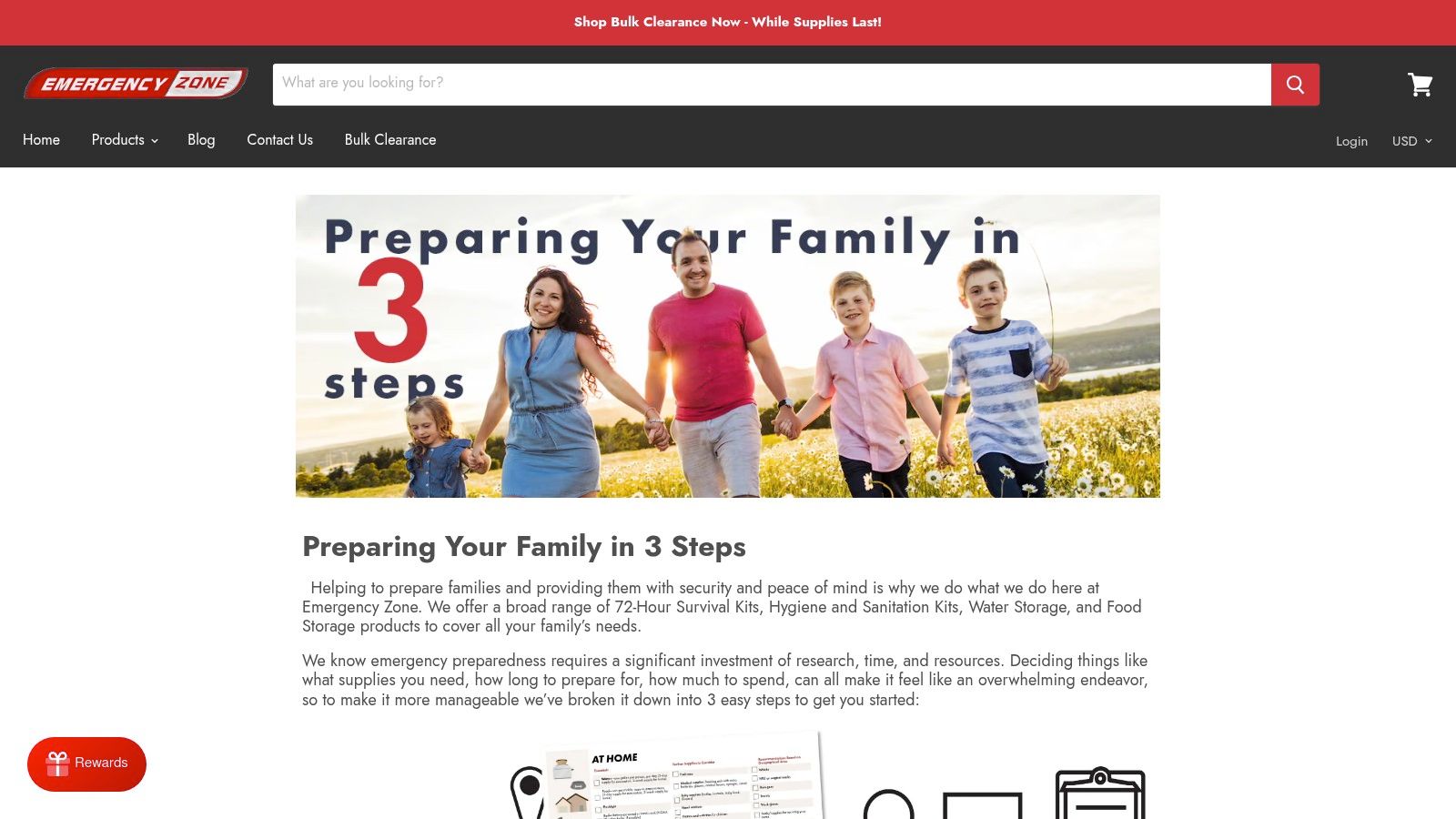
The “Family Prep” page presents a clear three-step process: Get a Kit, Get a Plan, and Be Informed. While the downloadable checklist supports the “Get a Kit” phase, the site also links to FEMA resources to help users identify specific hazards in their state. This blend of providing a simple checklist, offering product solutions like long-term food buckets from brands like Augason Farms or Sawyer water filters, and guiding users to official planning resources makes it a useful starting point. While the checklist content leans toward items the company sells, it remains a solid foundation for any family’s basic emergency preparations.
Key Features and Assessment
| Feature | Assessment |
|---|---|
| Credibility | Good. While a commercial site, it bases its checklist on standard preparedness principles and links to authoritative sources like FEMA. |
| Usability | Excellent. The website is clean and very easy to navigate. The PDF is immediately accessible, and product categories are clearly defined. |
| Customization | Basic. The PDF itself is a static, non-editable document designed for printing and manual checking. |
| Cost | Free. The checklist and informational resources are free. The primary focus of the site is selling preparedness products. |
Practical Tip: Use the Emergency Zone checklist to conduct an initial inventory of what you already own. Before purchasing one of their pre-made kits, cross off the items you have on hand. This will help you decide whether a full kit or just a few specific components are the more cost-effective choice for your family.
11. QuickSeries — Go‑Bag Checklist Magnet (printed product)
Moving beyond downloadable files, QuickSeries offers a tangible, physical emergency preparedness checklist in the form of a durable magnet. This product is designed not as a comprehensive planning document but as a constant, high-visibility reminder of “go-bag” essentials. By placing it on a refrigerator or filing cabinet, the checklist becomes a part of daily life, encouraging gradual and consistent preparation rather than a one-time effort. Its purpose is to keep core evacuation items top-of-mind for the entire household.
The “Go-Bag Checklist Magnet” is primarily geared toward organizations, community groups, and businesses looking to distribute readiness materials in bulk. The business model focuses on volume orders, making it an excellent resource for employers to provide to staff or for community leaders to hand out at safety fairs. While not an emergency preparedness checklist PDF itself, it serves a similar purpose by providing a scannable list of crucial items like a first-aid kit, a reliable flashlight such as a Streamlight, and backup power sources like the Grid Doctor 3300 EMP, or Anker power bank. The goal is rapid reference during a high-stress evacuation scenario.
Key Features and Assessment
| Feature | Assessment |
|---|---|
| Credibility | Good. QuickSeries is a known publisher of educational and public safety materials, often used by official agencies. |
| Usability | Excellent. The magnet format is the ultimate in at-a-glance accessibility, requiring no power, internet, or printing. |
| Customization | Poor. This is a static, pre-printed product. Customization is possible for large bulk orders but not for individual buyers. |
| Cost | Variable. The product is sold in bulk with a significant minimum order quantity, making it impractical for single-family purchases. |
Practical Tip: If you are part of a neighborhood watch, a church group, or a workplace safety committee, consider pooling resources to place a bulk order. This makes a highly practical and visible safety tool affordable for everyone in your community.
12. Etsy — Emergency Preparedness Checklist Printables
For those seeking a more visually appealing or highly specialized checklist, the online marketplace Etsy offers a surprisingly vast collection of printable emergency preparedness resources. Unlike institutional sites, Etsy provides hundreds of unique designs from independent creators, ranging from minimalist lists to comprehensive, multi-page family preparedness binders. This platform excels in variety, offering checklists for everything from a 72-hour kit and bug-out bag to specific scenarios like hurricanes, wildfires, or even a basic first-aid kit stocked with items like QuikClot gauze.
The primary advantage of Etsy is the sheer diversity and aesthetic appeal of its offerings. Many sellers provide editable or fillable PDF templates, allowing for deep personalization tailored to your family’s specific needs, dietary restrictions, or medical requirements. Products are typically inexpensive, available for instant digital download, and supported by a user review system that helps you gauge the quality and thoroughness of a checklist before purchasing. For those looking to assemble a comprehensive plan, you can get ideas from this detailed emergency preparedness checklist to see what a complete list entails.
Key Features and Assessment
| Feature | Assessment |
|---|---|
| Credibility | Variable. Quality and accuracy depend entirely on the individual seller. It’s crucial to cross-reference with FEMA or Red Cross guidelines. |
| Usability | Good. The marketplace is easy to browse, and purchasing/downloading is instantaneous. User reviews help guide choices. |
| Customization | Excellent. Many listings are editable templates (e.g., in Canva or as fillable PDFs), offering the highest degree of personalization. |
| Cost | Paid. Most downloads are very affordable, often costing just a few dollars. |
Practical Tip: Use the seller’s ratings and reviews as your primary guide. Look for shops with a high number of positive reviews and check customer photos to see how the printed product looks. Don’t hesitate to message a seller before buying to ask if their emergency preparedness checklist PDF is editable or if it aligns with official guidance.
Comparison of 12 Emergency Preparedness Checklists
| Item | Core features | Best for | User experience / credibility | Price / access |
|---|---|---|---|---|
| AATF Survival Guide | Hands‑on how‑tos, gear reviews, step‑by‑step checklists, pantry & water prep | Beginners to seasoned preppers, families, community coordinators | Practical, regularly updated, community‑oriented; US‑focused examples | Free content + complimentary survival guide via newsletter; no paywall |
| Ready.gov — Build a Kit (FEMA) | Official Emergency Supply List PDF, multilingual, special needs guidance | All US households, beginners | High credibility (FEMA); simple, widely recognized | Free PDF download, ad‑free |
| Ready.gov — Free Publications (FEMA) | Orderable printed brochures + downloadable PDFs for community use | Schools, NGOs, community outreach coordinators | Vetted federal materials; suitable for bulk distribution | Free printed copies (US); shipping lead times possible |
| Ready.gov — Family Emergency Plan Form | Fill‑in web form that generates a printable/emailable family plan (EN/ES) | Families needing a communication/meeting plan | Official, easy to use; limited formatting/customization | Free online tool |
| American Red Cross — Be Red Cross Ready | Printable checklists, emergency contact cards, app & training links | Schools, workplaces, volunteers, families | Trusted nonprofit; pairs PDFs with training and apps | Free resources; some app features may be promoted |
| CDC — Emergency Kit Checklist: Kids & Families | Pediatric‑focused kit list, maintenance reminders, special needs links | Caregivers and families with children | Health‑grounded, evidence‑based public guidance | Free PDF download |
| CDC — Infant & Young Child Feeding in Emergencies | Bilingual 2‑page feeding checklist; safety & sanitation notes | Caregivers of infants/young children | Very specific and concise; evidence‑based | Free bilingual PDF |
| REI Co‑op — Emergency Essentials | Printer‑friendly checklist PDF, gear context, maintenance guidance | Outdoor enthusiasts upgrading to durable gear | Actionable advice with curated product links; outdoor bias | Free guide; equipment sold separately (retail prices) |
| The Home Depot — Storm Prep Checklist | Storm‑readiness checklist tied to in‑stock product categories & pickup | Shoppers needing fast local fulfillment before storms | Useful for quick sourcing; store inventory transparency | Free guidance; products available for purchase in‑store/online |
| Emergency Zone — Family Prep Checklist | Downloadable checklist PDF with direct product links & state hazard guidance | Users choosing between buying kits or DIY builds | Clear starter steps; retailer‑focused recommendations | Free PDF; products sold on site |
| QuickSeries — Go‑Bag Checklist Magnet | Durable fridge magnets/pocket guides, bulk ordering, volume pricing | Schools, workplaces, HOAs, organizations | Physical, visible reminders that encourage readiness | Paid product with minimum bulk quantities (starting high) |
| Etsy — Emergency Preparedness Checklist Printables | Wide selection of downloadable templates, editable options | Budget shoppers, DIYers who want customization | Fast, affordable, variable quality—check seller reviews | Paid downloads (many <$5); instant digital delivery |
From Checklist to Action Plan: Making Preparedness a Part of Your Life
Throughout this guide, we’ve explored a comprehensive collection of resources, from the detailed AATF Survival Guide to the accessible, family-focused templates from Ready.gov and the American Red Cross. We’ve examined specialized lists for children from the CDC, practical retail-based guides from REI and The Home Depot, and even tangible tools like the QuickSeries Go-Bag Checklist Magnet. Each resource offers a unique starting point, yet the true value isn’t in the download link. Rather, it’s unlocked when you transform that digital file into a tangible, actionable strategy for resilience. In fact, this shift from passive to active preparation is what turns a checklist into a life-saving plan.
The journey from awareness to readiness is paved with deliberate action. An emergency preparedness checklist pdf, no matter how thorough, is merely a static document until you use it to assemble your kits, map your evacuation routes, and establish your family communication protocols. The ultimate goal is to move beyond simply having a checklist to embodying a state of preparedness.
Synthesizing Your Strategy: From Multiple PDFs to One Master Plan
One of the most common hurdles is “analysis paralysis,” where the sheer volume of available information prevents you from starting. Instead of trying to implement every detail from every checklist at once, consider a phased approach.
- Start with a Foundation: Begin with a comprehensive but user-friendly checklist, such as the Ready.gov Build a Kit or the American Red Cross Be Red Cross Ready PDF. Use this as your master document to assemble your core 72-hour kit and home supplies. This is where you’ll gather essentials like a reliable water filter (e.g., a Sawyer Squeeze), emergency food rations, a well-stocked first-aid kit, and a quality hand-crank radio like the Midland ER310.
- Layer in Specifics: Once your foundation is in place, augment it with specialized lists. Print the CDC’s Infant and Young Child Feeding in Emergencies list and clip it to your master checklist if you have young children. Integrate the REI Co-op Emergency Essentials checklist to refine the gear in your go-bag with more robust, outdoor-oriented items.
- Create a Central Command Binder: Don’t let your printed PDFs get scattered. Purchase a durable three-ring binder and use page protectors. This binder becomes your “Preparedness Command Center,” holding your Family Emergency Plan, copies of important documents (IDs, insurance policies, deeds), contact lists, and all your key checklists. Store it in an accessible, fire-resistant location.
Prepping on a budget doesn’t mean sacrificing quality—resources like prepping on a budget can help you prioritize essential items without overspending.
To ensure your emergency preparedness kit is comprehensive and well-organized, refer to AATF Survival Guide’s guide on emergency preparedness kit setup for a step-by-step approach.
The Critical Step: Implementation and Regular Maintenance
True preparedness is not a one-time project; it is an ongoing habit. The checklists we’ve reviewed are your roadmaps, but you must drive the vehicle.
Your immediate next steps should be to print the emergency preparedness checklist pdf that best suits your family’s current situation. Place copies where they will be seen and used: one on the refrigerator, one inside your primary go-bag, and another in your vehicle’s glove compartment. Schedule a recurring calendar event every six months to review and refresh your supplies. This is when you’ll rotate food and water, check medication expiration dates, update contact information, and test your gear, from batteries in your flashlights to the fuel in your portable stove.
Building a Culture of Resilience
This process transforms a simple document into a living tool. It builds muscle memory, fosters important family conversations about safety, and systematically reduces your vulnerability to unforeseen events. By taking these methodical steps, you are not just preparing for a hypothetical disaster; you are investing in a culture of resilience and self-reliance. You are empowering yourself and your loved ones with the confidence to face uncertainty, knowing you have a plan, the right supplies, and the knowledge to use them effectively. Your journey started with a search for a checklist, but it culminates in a state of genuine readiness.