

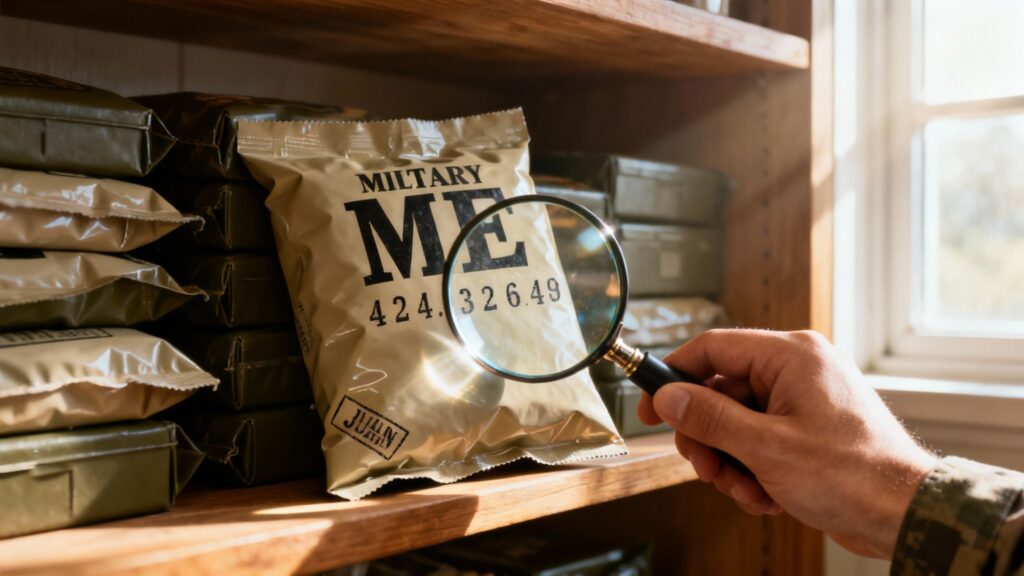
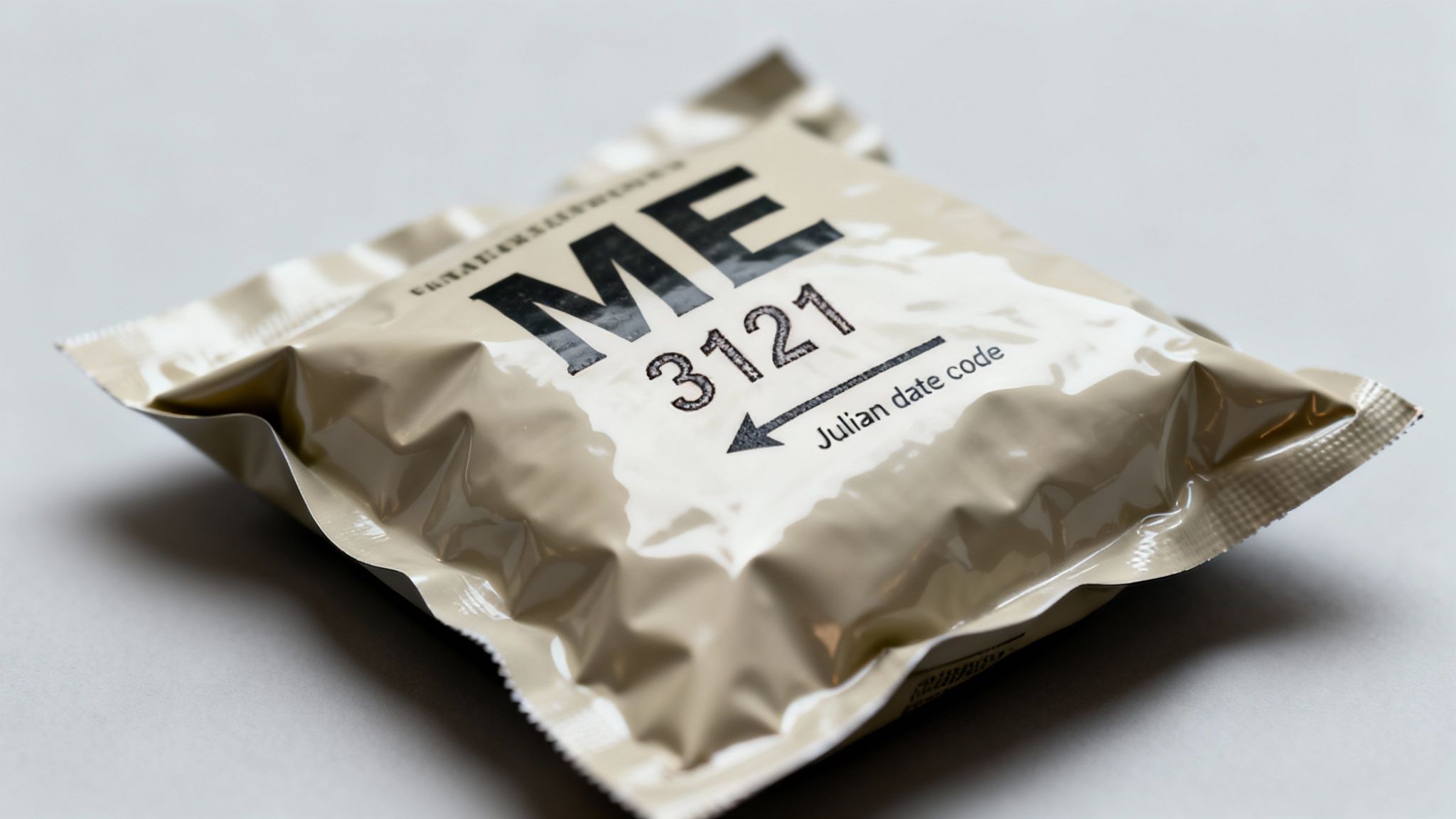
That confusing number stamped on your MRE pouch isn’t an expiration date—it’s a 4-digit Julian date code. Think of it as a birth certificate for your meal. The first digit is the last number of the year it was packed, and the next three digits tell you the exact day of that year, from 001 to 365.
So, if you see a code like ‘3121,’ it means the MRE was packed on the 121st day of 2023. Simple as that.
Your Quick Guide to Reading an MRE Date Code
Unlike the groceries in your kitchen with a clear “Best By” date, MREs use a system built for military logistics. For us, that Julian date code is the key to managing our emergency food supply. Learning to read it lets you rotate your stock, check for freshness, and trust that you have reliable calories ready when you need them most.
This code is the single most important piece of information for figuring out the age and potential condition of your rations. It’s the starting line from which all shelf-life estimates begin.
Why This Code Matters for Preparedness
For anyone serious about being prepared, knowing the age of your food is non-negotiable. That MRE date code helps you practice the golden rule of stockpiling: “First-In, First-Out” (FIFO). This simple rotation method ensures you use your oldest supplies first, preventing waste and guaranteeing the meals you’re counting on are in the best possible shape.
Properly managing your food supply is a cornerstone of self-reliance, right up there with having a dependable water filter, like a LifeStraw, or a well-stocked first-aid kit. Ignoring these dates is a recipe for disaster—you don’t want to discover your emergency food has gone bad when it’s too late. Managing your MRE dates is just one part of comprehensive emergency readiness—learn more in our complete guide on how to prepare for natural disasters. To get a better handle on how long different supplies last, check out our detailed guide on survival food shelf life.
If you’re building your emergency food supply from scratch, our guide to the best survival food kits can help you choose reliable options that complement your MRE stockpile.
The Julian date system is crucial for military logistics, allowing for the efficient tracking of millions of meals. For civilians, it serves the same purpose: it provides a clear, standardized way to manage your food stores for maximum longevity and safety.
Quick Reference for Decoding MRE Date Codes
To make things easy, I’ve put together a simple reference table. Use this to quickly break down the 4-digit Julian date code format and understand the pack date of your MRE.
| Code Format | Example Code | First Digit (Year) | Last Three Digits (Day of Year) | Decoded Date |
|---|---|---|---|---|
| YDDD | 3121 | 3 (for 2023) | 121 (the 121st day) | May 1, 2023 |
| YDDD | 9001 | 9 (for 2019) | 001 (the 1st day) | January 1, 2019 |
| YDDD | 2365 | 2 (for 2022) | 365 (the 365th day) | December 31, 2022 |
With this table, you can decode just about any standard MRE date you come across. It’s a small skill, but it makes a huge difference in managing your food preps with confidence.
Decoding the Julian Date System Step by Step

At first glance, the Julian date system can seem a little strange. But once you get the hang of it, you’ll see it’s a super-efficient way for manufacturers to track millions of MREs worldwide. It’s less like a “best by” date you’d find at the grocery store and more like a car’s VIN—it tells a very specific production story. After you decode a few, it’ll become second nature.
Let’s walk through a couple of real-world examples. Say you’ve got a pouch stamped with the code 9001. The first digit, 9, is the year. The last three digits, 001, represent the day of that year. Simple enough—this MRE was packed on the very first day of 2019, or January 1st, 2019.
How about another one? A code of 2365. The 2 stands for the year (in this case, 2022), and 365 is the 365th—and last—day of the year. So, this MRE was packed on December 31st, 2022. It’s a pretty straightforward system once you see the pattern.
Solving the Decade Dilemma
This brings up a common question: if a code starts with a “2,” how do you know if it means 2012 or 2022? This is where you get to do a little detective work. The packaging itself usually holds all the clues you need to solve the mystery.
Manufacturers update their MREs all the time, changing the designs, logos, and—most importantly—the menu items printed on the cases.
- Menu Items: A quick search online for MRE menu lists can tell you a lot. For example, the famous “Pizza Slice” entrée didn’t show up until around 2018. So, if you find a pizza MRE with a code starting in “2,” it’s almost certainly from 2022, not 2012.
- Packaging Design: Look at the graphics and fonts. Does the plastic pouch have a modern, professionally printed design? It’s probably from a more recent decade than something with a more basic, older look.
- Component Dates: Every now and then, you might get lucky. Individual items inside the main MRE pouch, like the crackers or peanut butter, can sometimes have their own date codes that help you narrow down the timeframe.
Think of the 4-digit Julian code as your primary key. While other numbers and text appear on the MRE packaging, this specific code is the one that directly tells you the age of the meal and serves as the starting point for estimating its remaining shelf life.
Beyond the Julian Code
The 4-digit code is what you need for determining age, but don’t completely ignore the other markings. You’ll often find a lot number or a manufacturer’s code stamped nearby. These are mostly for the company’s internal tracking and quality control, but they can sometimes offer extra context if you’re trying to identify a specific production run.
When it comes to your own stockpile rotation and safety checks, though, the Julian date is your most reliable tool. It’s the official production date that all shelf-life calculations are based on. Learning to read it consistently is a fundamental skill for proper emergency preparedness. For a deeper dive into making your food supplies last, our guide on how to store food long term covers essential strategies for keeping your stockpile in top shape.
Identifying Who Made Your MRE with Manufacturer Codes
While the Julian date code tells you when an MRE was packed, another critical detail reveals who made it. Knowing the manufacturer is more than just trivia—it helps you confirm you’ve got the real deal, track quality, and, for many of us with experience, stick with a brand we’ve come to trust.
The U.S. military doesn’t just hire anyone to make its MREs. It contracts with a select few companies that have to meet rigid military specifications (MIL-SPEC). This ensures every meal delivers the right nutrition and can handle the rough-and-tumble of field conditions. Still, just like with anything else, you start to notice differences and develop preferences over time.
The Big Three MRE Producers
When it comes to genuine U.S. military MREs, you’re almost always looking at one of three names: AmeriQual, Sopakco, and The Wornick Company. Each one has its own identifier code stamped right on the case, usually hanging out near the Julian date. Learning to spot these is a core prepper skill.
So, why does this matter? A few good reasons:
- Authenticity: This is your first and fastest check to distinguish between genuine military-issue MREs and the countless civilian copycats out there.
- Quality Control: If you ever run into a bad batch—it happens—knowing the manufacturer is the first step to figuring out what went wrong.
- Taste and Preference: Let’s be honest, you’ll probably find that you like the entrees from one producer more than the others. For a full breakdown of different brands and meals, our survival food review is a great place to start.
Think about it like picking a reliable water filter. You go with a proven brand like the Sawyer Squeeze because you know it performs. Identifying MRE manufacturers lets you apply that same logic to your food supply, so you can stock what you know works for you.
How to Find and Read Manufacturer Codes
Finding the manufacturer code is easy once you know what to look for. It’s usually just a name or a short string of letters printed clearly on the case. While the exact spot might shift a bit, it’s almost always grouped with the lot number and that all-important MRE date code.
Here’s a quick rundown of the main players:
| Manufacturer | Common Code(s) or Name |
|---|---|
| AmeriQual Group, LLC | “AMERIQUAL” or “Code A” |
| Sopakco, Inc. | “SOPAKCO” or “Code S” |
| The Wornick Company | “WORNICK” or “Code W” |
These three companies are the backbone of military field nutrition. Seeing one of their names or codes on an MRE case is a solid sign you’re holding a genuine, MIL-SPEC product. It’s a simple check that gives you confidence that your rations were built to last and will be there to fuel you when it counts.
How Storage Conditions Impact MRE Shelf Life
Here’s something every prepper needs to burn into their memory: the MRE date code marks the start of a meal’s life, not the end. Unlike a carton of milk from the grocery store, MREs don’t have a fixed “use by” date. Their real-world lifespan is a direct result of how they’ve been stored.
I like to think of an MRE like a battery. Keep it in a cool, dark place, and it holds its charge for years. But leave that same battery on the dashboard of a hot car, and its power will drain in no time. MREs work the exact same way.
Temperature: The Ultimate Factor
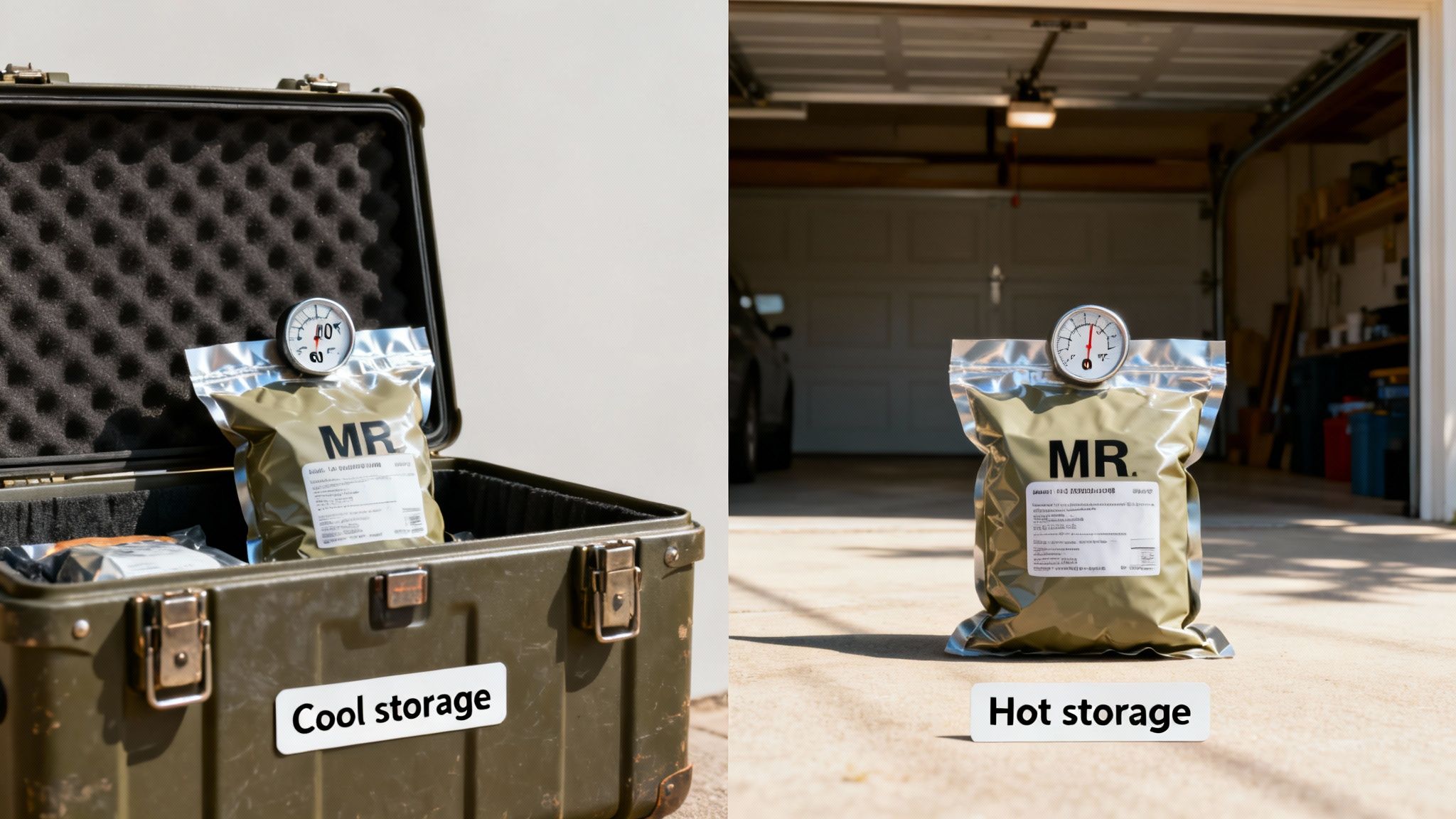
Heat is the absolute number one enemy of MRE longevity. A meal stored in a stable, cool environment—think a basement sitting at 60°F (15°C)—can easily stay in good shape for a decade or more.
But take that same MRE and stick it in a hot garage or attic that hits 100°F (38°C) in the summer. Its quality will tank, and you might only get a year or two out of it before it’s no good. This is precisely why you can’t trust the date code alone. The date tells you its age, but its storage history tells you its condition.
This incredible shelf stability is all thanks to retort pouch technology, which basically sterilizes the food right inside its tough, flexible package. The military perfected this process to create rations that could survive three to ten years without any refrigeration, making them ready to go anywhere. You can dive deeper into the history of this revolutionary technology on Defense Media Network.
To get a clearer picture of how dramatically temperature affects your MREs, check out this table. It breaks down the expected shelf life based on the average temperature where they are stored.
MRE Shelf Life vs. Storage Temperature
| Average Storage Temperature (°F) | Estimated Shelf Life (Months) | Estimated Shelf Life (Years) |
|---|---|---|
| 120°F | 1 | < 1 |
| 110°F | 6 | 0.5 |
| 100°F | 22 | ~ 2 |
| 90°F | 55 | ~ 4.5 |
| 80°F | 85 | ~ 7 |
| 70°F | 120 | 10 |
| 60°F | 156 | 13 |
| 50°F | 180+ | 15+ |
As you can see, even a 10-degree difference can add or subtract years from an MRE’s life. The takeaway is simple: the cooler you can keep them, the longer they will last.
Choosing the Right Storage Location
Finding the right spot in your home to stash your MREs is one of the most important things you can do to protect your investment. You’re looking for a place that is cool, dark, dry, and free from big temperature swings.
Here are a few good and bad ideas for MRE storage:
- Best Locations: A climate-controlled basement, an interior closet on a lower floor, or a pantry that stays consistently cool are all excellent choices. These spots buffer against outside heat.
- Worst Locations: Stay away from attics, garages, sheds, or the trunk of your car. These areas are notorious for extreme temperature changes that will absolutely destroy your MREs in short order.
For those pursuing long-term self-sufficiency, proper food storage is a critical skill covered in our guide to off-grid living for beginners.
Beyond just temperature, you have to protect the pouch itself. Keep your supply safe from pests, moisture, and getting crushed or punctured. Investing in a sturdy, pest-proof container like a Plano Sportsman’s Trunk is a smart move. It keeps the pouches secure, organized, and shielded from anything that could compromise the meal’s integrity. These trunks are readily available on Amazon and other outdoor retailers.
For more ideas on protecting your supply, check out our guide on the best food storage containers. Taking these simple steps will ensure your MREs are actually ready to eat when you need them most.
Practical Tips for Inspecting and Rotating Your MRE Stockpile
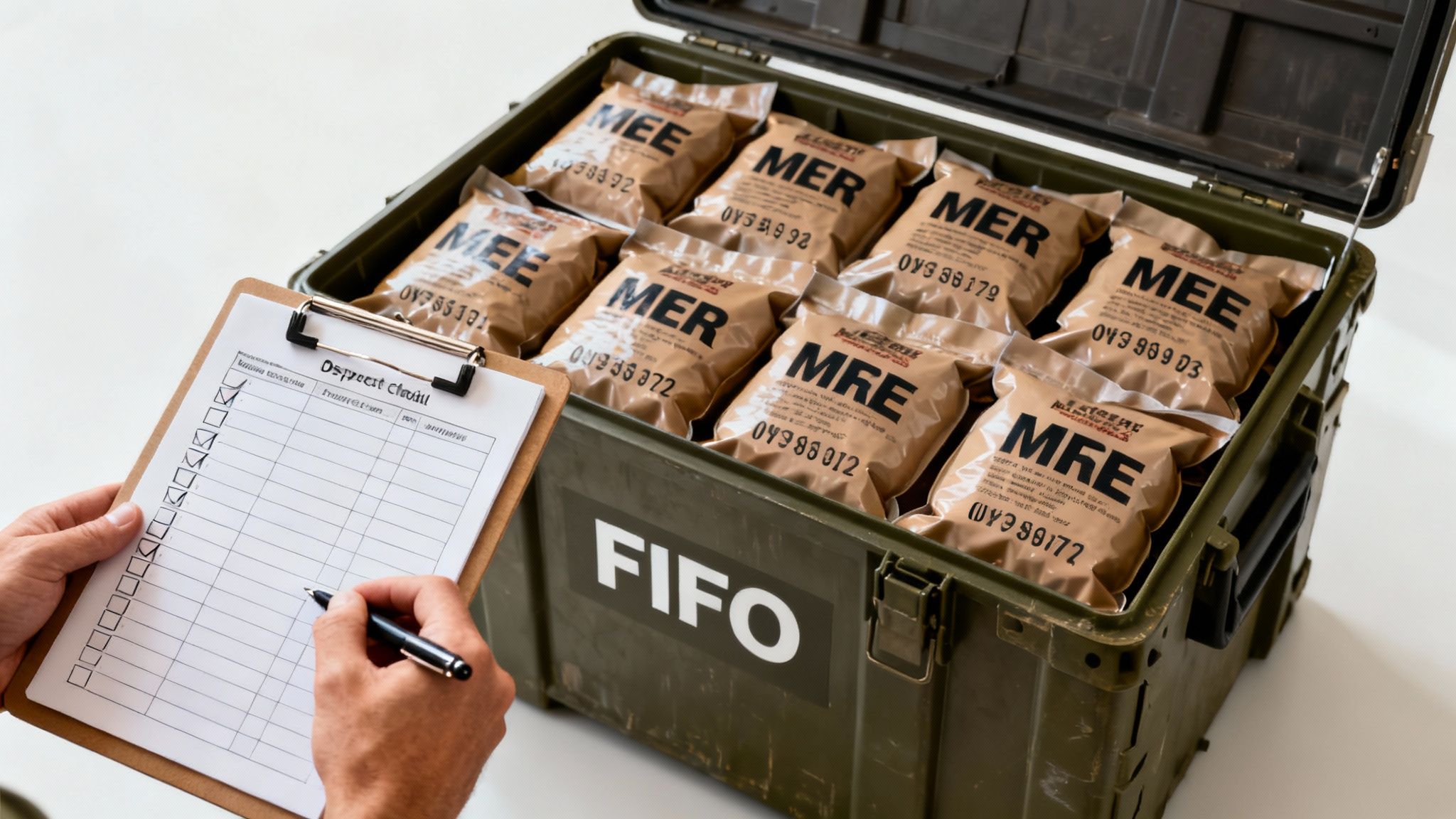
Knowing how to read an MRE date code is a great start, but turning that knowledge into action is what really counts. The single most important strategy for managing your stockpile is the First-In, First-Out (FIFO) method. It’s simple: use your oldest MREs first. This keeps your supply fresh and ensures nothing gets pushed to the back and forgotten until it’s too late.
This basic rotation practice is the bedrock of smart prepping. For a deeper dive, check out our complete guide on proper food stockpile rotation. If you just stack your MREs with the oldest in front, the whole process becomes second nature.
Your MRE Inspection Checklist
Before you ever tear into an MRE—especially one that’s been sitting for a while—give it a quick physical inspection. This isn’t complicated. You’re just using your senses to look for obvious red flags. A five-minute check can save you from a nasty surprise and give you confidence that your meal is good to go.
Here’s what to look for before you eat:
- Swollen Pouches: The main meal pouch should be flat. If it looks puffy or bloated like a balloon, that’s a classic sign of bacterial gas buildup. Toss it immediately.
- Foul Odors: Your nose knows. When you open the pouch, any sour, chemical, or rancid smell is a deal-breaker.
- Visible Mold or Discoloration: If the food just looks wrong—weird colors, fuzzy spots—it’s not safe to eat. Don’t risk it.
- Punctures or Leaks: Carefully check the outer pouch for any damage. Even a tiny pinhole can let in contaminants and spoil everything inside.
Understanding the TTI Sticker
If you buy full military cases, you’ll find a small but mighty tool on the outside: the Time-Temperature Indicator (TTI). It’s a sticker with a large, dark outer circle and a lighter-colored inner circle. This little dot is your at-a-glance health report for the entire case, as the inner circle darkens when exposed to heat over time.
If the inner circle is lighter than the outer ring, the MREs inside have been stored properly. If it is as dark as or darker than the outer ring, the case has been exposed to excessive heat. Its contents should be inspected with extreme caution or discarded.
Keeping a simple inventory log in a notebook or spreadsheet is also a game-changer. Just jot down the date code, when you inspected it, and any notes. This makes managing your supply way more efficient. After all, MREs have come a long way. When they were first field-tested in 1983, palatability was such an issue that soldiers only ate 60% of the calories. That feedback led to huge improvements in variety and quality by the early 1990s. You can learn more about the fascinating history of MRE development on MREInfo.com.
Finally, don’t forget a reliable way to heat your food. The flameless heaters are great, but they can fail. Always have a solid backup like the MSR PocketRocket 2 stove on hand. A hot meal is a huge morale booster, and you want to make sure you can have one no matter what. You can typically find this and similar compact stoves on Amazon.
Commonly Asked Questions About MRE Date Codes
Even after you get the hang of decoding MREs, a few questions always seem to pop up. Getting these sorted out is what turns good knowledge into great practice, giving you total confidence in managing your emergency food supply. Let’s tackle the most common ones.
Can I Still Eat an MRE Past Its Estimated Shelf Life?
The official answer is no, but the real-world answer is… maybe. An MRE stored in ideal, cool conditions can stay edible long past its “official” shelf life. But don’t expect a ten-year-old meal to taste like a two-year-old one. Its nutrition, flavor, and texture will definitely degrade over time.
Before you even think about eating an old MRE, you have to play detective.
- Check for swollen or puffy pouches, a tell-tale sign of gas-producing bacteria.
- Listen for a hiss of escaping gas when you tear it open. That’s a bad sign.
- Give it a sniff. Any sour, rancid, or just “off” smells are immediate red flags.
If anything seems remotely suspicious, just remember the golden rule of prepping: when in doubt, throw it out. Your health isn’t worth risking for a few hundred calories.
What Is the Difference Between Military and Civilian MREs?
There’s a world of difference. True military-issue MREs are built by specific, approved contractors who have to meet strict Department of Defense standards. We’re talking serious requirements for nutrition, durability, and shelf life.
Civilian MREs, on the other hand, are made for the public market and can be a mixed bag. Quality, components, and calorie counts vary wildly because they aren’t held to the same tough MIL-SPEC requirements.
Genuine military MREs are usually marked “U.S. Government Property” and almost always include a flameless ration heater, which isn’t a given in civilian versions. The quickest way to know for sure is to check the manufacturer code. And when you’re inspecting your supply, you’ll want a reliable light source like the tough-as-nails Streamlight ProTac to see what you’re doing.
Why Dont MREs Have a Normal Best By Date?
MREs use a production date (the Julian date code) because it’s all about military logistics. When you’re managing millions of meals shipped all over the globe, you need a simple, bulletproof system for tracking massive production runs.
A “Best By” date would be totally misleading. An MRE’s real lifespan has everything to do with its storage history—specifically the temperatures it has endured—not a fixed date on a calendar.
The Julian date gives you a clear starting line. From there, you estimate its real-world shelf life based on how it was stored. This gives you a much more accurate picture of its true condition than any arbitrary “best by” date ever could.
Does the Date on the Case Match the Items Inside?
For all practical purposes, yes, you can trust the date on the case. That 4-digit MRE date code represents the day the entire case was packed.
Sure, the individual components inside—like the crackers or candy—were made on different days, sometimes weeks earlier. But they were all from a similar production window and were inspected before getting assembled into the final meal pouches.
When it comes to your own stockpile rotation, the date on the outer case is the only one you need to worry about. It’s your single source of truth. Relying on it simplifies your inventory and keeps your entire supply tracked with one consistent metric, which is exactly the kind of organized thinking that defines solid preparedness.