
When people talk about preparing for martial law, it’s not just about stocking up on beans and bullets. It’s about truly understanding what happens when the society we know gets flipped on its head. The goal is to move from worrying about “what if” to building a solid, actionable plan that keeps your family safe when civil liberties are suspended and military rule takes over.
What Martial Law Actually Means for You

Martial law isn’t some dusty concept from a history book. It’s a real-world measure governments use when things get truly out of hand—think widespread rebellion, total collapse of public services, or wartime footing.
Essentially, it’s a temporary military takeover of civilian life. The familiar legal landscape you navigate every day can disappear almost overnight. The military steps into the shoes of local law enforcement, and the government’s top priority shifts from protecting individual rights to restoring order, often by any means necessary.
The Suspension of Civil Liberties
The single biggest change you’ll face is the suspension of core civil liberties. Freedoms we all take for granted can be revoked in an instant, without warning or debate.
- Freedom of Movement: Curfews become the new normal, limiting travel to certain hours. You can expect roadblocks and checkpoints on major routes, manned by armed personnel. Getting from point A to point B is no longer guaranteed.
- Freedom of Assembly: Forget public gatherings and protests. They’re typically banned immediately to stop organized dissent before it starts. Your right to peaceably assemble is gone.
- Due Process: Legal protections like habeas corpus—the right to be formally charged before a judge—can be suspended. This means people can be detained without the immediate legal recourse you’d normally have.
- Freedom of Speech: Don’t be surprised if the government takes control of the narrative. They can censor news, shut down websites, and monitor communications to manage public perception and stamp out opposition.
A declaration of martial law is the government’s last resort—a signal that the crisis is so severe, constitutional norms are being set aside for the sake of national security and order.
Why Rational Preparation Matters
Getting your head around this grim framework is the first step. This isn’t about giving in to paranoia; it’s about a logical response to a potential, however unlikely, reality. History is filled with examples of how quickly rights can evaporate.
Under Ferdinand Marcos’ martial law in the Philippines, Amnesty International documented over 50,000 arrests between 1972–1975 alone, many without any meaningful due process. For anyone reading this, that statistic should translate into a clear planning guideline: assume your ability to move and communicate will be slashed by 50–90% almost immediately. You can dig deeper into the constitutional mechanics of martial law with this comparative study.
This is why your prep needs to be grounded in logic, not just fear. It explains why having food, water, and medical supplies on hand is so critical when you can’t just run to the store. It’s the reason having off-grid communication methods is a smart move when normal channels are being watched or have been shut down.
Our complete guide on how to start prepping can give you a solid foundation for these crucial first steps. The goal is simple: build enough personal resilience so you can protect your family when the systems you count on are no longer there for you.
The Critical Decision To Bug In or Bug Out
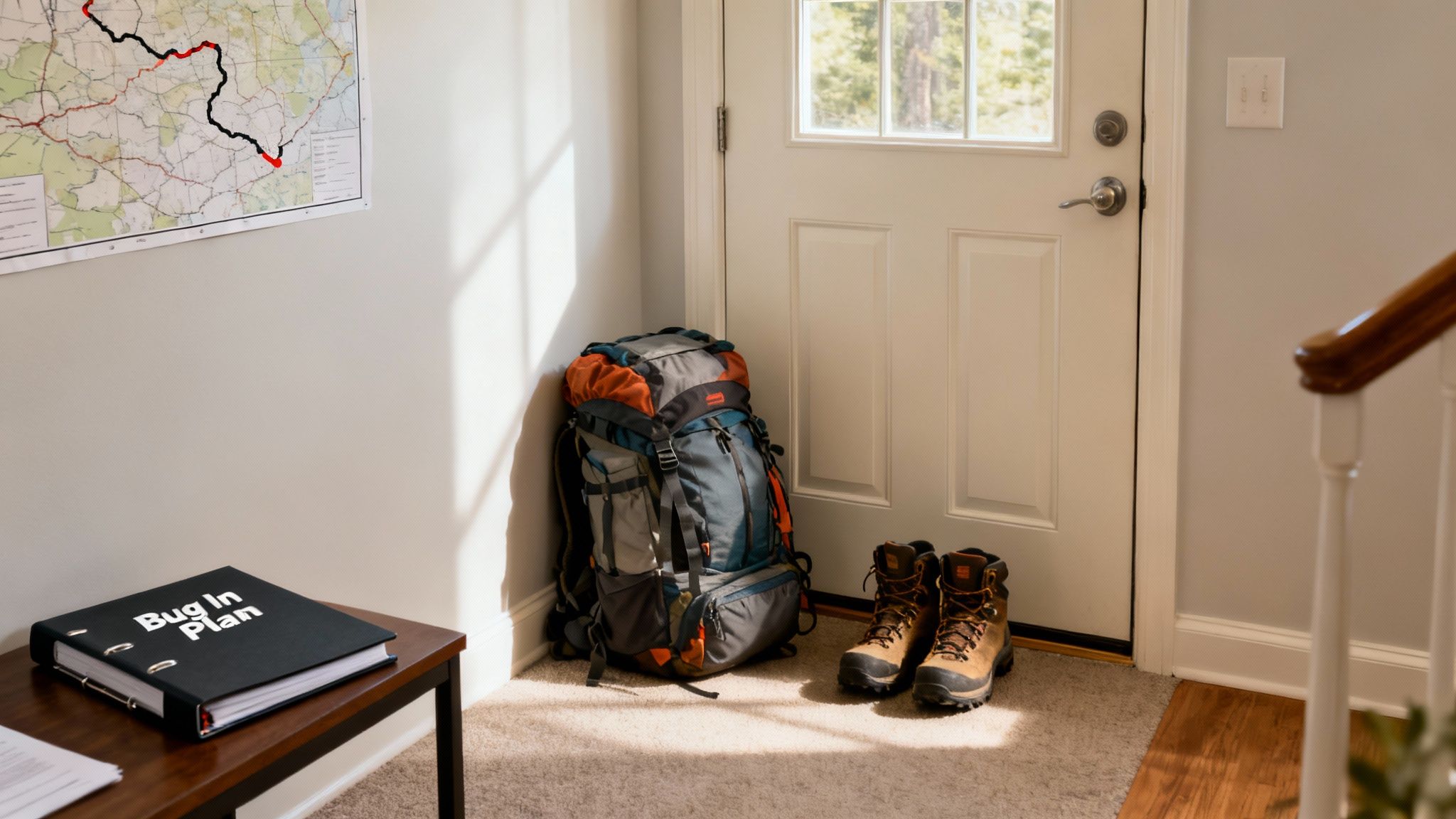
When civil order fractures, one of the first and most consequential decisions you’ll have to make is whether to hunker down or get out. This isn’t a simple choice. It’s a strategic calculation based on your unique circumstances, and making the wrong call could trap your family in a deteriorating situation or expose them to unknown dangers on the move.
Bugging in means sheltering in place, leveraging the familiarity and resources of your home. You’ve got your supplies, your security measures, and a known environment. For many situations, especially if the disruption seems short-lived, this is the default best option.
On the other hand, bugging out is a calculated retreat to a pre-planned, safer location. This becomes the right call when your immediate area poses a greater threat than the risks of travel. A martial law declaration in a dense city, for instance, could quickly turn your neighborhood into a hotspot for conflict, supply shortages, and severe restrictions on your movement.
Make sure you have a properly packed bug out bag ready to grab at a moment’s notice, containing the essentials you’ll need for at least 72 hours on the move.
Analyzing Your Location And Situation
Your physical location is probably the single most important factor in this decision. Someone living in a high-rise apartment in a major city faces a vastly different set of threats than someone on a few acres out in a rural county.
- Urban Dwellers: You’re on the front lines of potential civil unrest, military checkpoints, and supply chain meltdowns. High population density means more competition for scarce resources and a higher chance of running into authorities or desperate people.
- Suburbanites: You might have a bit more space and a stronger community network, but you’re still tied to fragile utility grids and vulnerable to travel restrictions that can cut you off from everything you need.
- Rural Residents: You likely have more self-sufficiency, space for supplies, and natural concealment. But that isolation can be a double-edged sword, making you a target if you’re seen as having resources that others desperately lack.
The decision boils down to one core question:
Does my current location offer more security and resources than my bug-out location, even when I factor in the immense risks of traveling during a military lockdown?
Deciding when it’s time to go requires setting clear “triggers” before things go sideways. These are your non-negotiable red lines. If they get crossed, your plan goes into motion automatically. Waiting until you feel unsafe is waiting far too long.
Examples of Personal Triggers:
- Loss of running water or electricity for more than 48 hours.
- Military or police checkpoints are set up within a one-mile radius of your home.
- Widespread, uncontrolled fires or violence breaks out in your immediate neighborhood.
- You or your family receive a specific, credible threat.
To help you think through this, we’ve put together a simple matrix. Use it to weigh your personal situation and see which column your circumstances favor.
Bug-In vs. Bug-Out Decision Matrix
| Factor | Favorable for Bugging In | Favorable for Bugging Out |
|---|---|---|
| Location | Rural or suburban home with defensible space and resources. | Urban apartment, high-crime area, or proximity to likely conflict zones. |
| Home Security | Reinforced doors/windows, security systems, established community watch. | Minimal security, easily accessible ground-floor apartment, uncooperative neighbors. |
| Supplies | 3+ months of food, water, medical supplies, and power sources on-site. | Limited storage space, unable to build a deep pantry. |
| Community | Strong network of trusted, prepared neighbors who communicate and cooperate. | Isolated from neighbors, or living in an area with high social tension. |
| Threat Level | The primary threat is temporary (e.g., natural disaster, short-term unrest). | The threat is direct and escalating (e.g., advancing conflict, targeted violence). |
| Skills/Health | Family members have medical conditions requiring a stable environment. | All family members are physically fit and capable of difficult travel. |
| Bug-Out Plan | No vetted bug-out location or reliable transportation. | A well-stocked, secure bug-out location is ready and reachable via planned routes. |
This matrix isn’t exhaustive, but it provides a solid framework for making a logical, rather than emotional, decision when every second counts.
Planning Your Routes And Rally Points
If bugging out is the call, having a single route isn’t a plan—it’s a gamble. You need primary, secondary, and even tertiary evacuation routes that avoid the obvious chokepoints. Think major highways, bridges, and tunnels, because they will almost certainly be controlled or impassable.
Your evacuation is only as good as what you’re carrying—make sure your bug out bag items are carefully selected and regularly maintained.
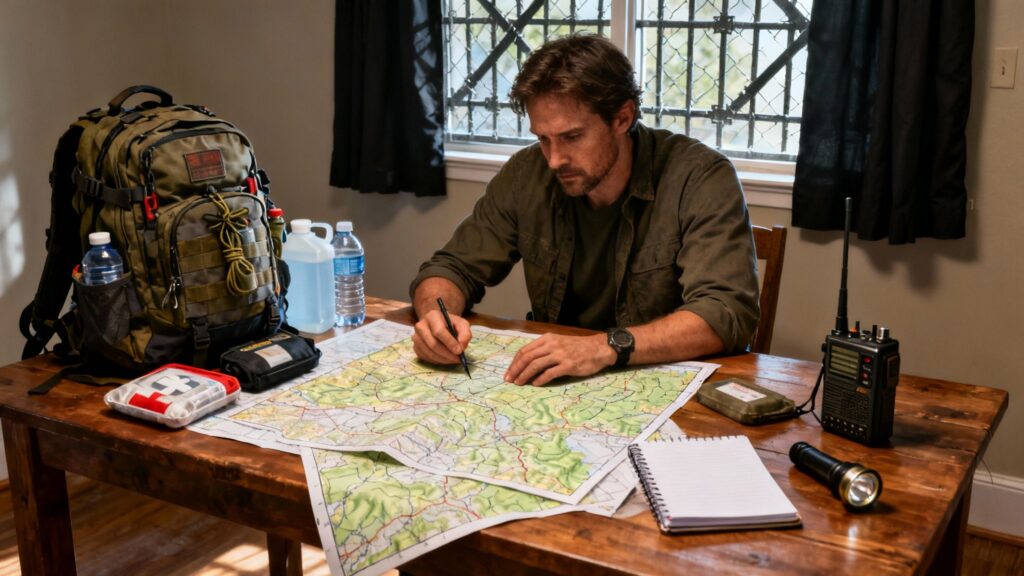
Scout these routes ahead of time. I mean actually drive them. While you’re at it, use topographic maps to identify potential hazards, hidden water sources, and concealed spots to rest. Your plan has to account for the very real possibility that you’ll be on foot. For a deep dive into building a robust plan, our evacuation plan checklist gives you a step-by-step framework to make sure you cover all your bases.
When the grid goes down, reliable communication and navigation become lifelines. A device like a Garmin inReach runs on satellite networks, giving you two-way texting and GPS tracking far from any cell signal. This can be crucial for coordinating with family members at a designated rally point or calling for help if you’re in a remote area.
And finally, your bug-out location itself needs to be thoroughly vetted. It could be a trusted relative’s home, a secluded cabin, or a piece of rural property. The key is that it’s ideally pre-stocked with its own cache of supplies. This ensures you’re not just fleeing from danger, but moving toward a prepared sanctuary.
Fortifying Your Home for Long-Term Defense
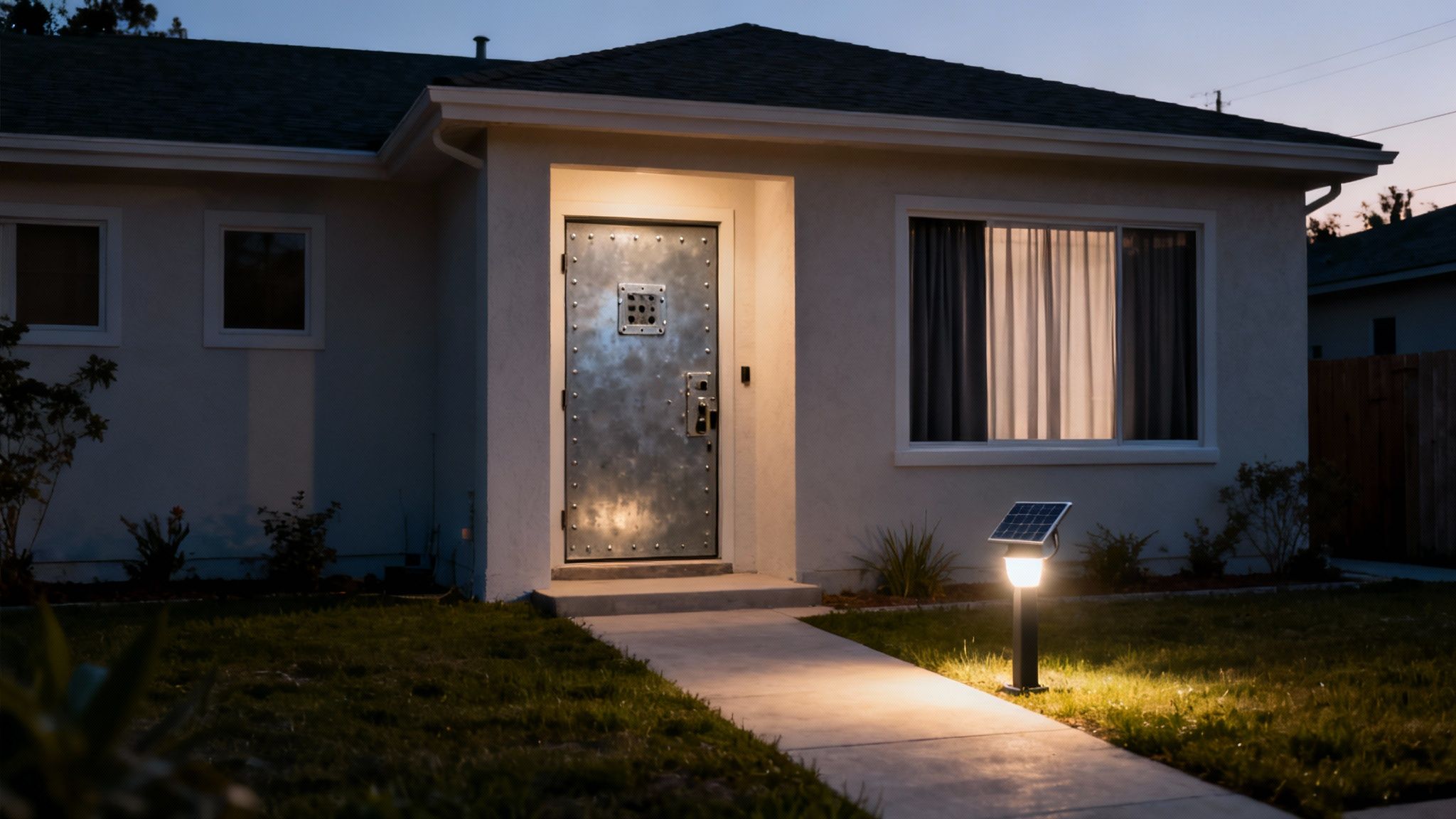
If your bug-in vs. bug-out decision matrix points to sheltering in place, your home needs to shift from a place of comfort to a defensible position. Let’s be clear: this isn’t about turning your house into a military compound. It’s about creating smart, layered security that makes you a “hard target.” The goal is simple: stay unnoticed, and if you are noticed, look like way too much trouble to bother with.
This whole process starts from the outside and works its way in. Think of your perimeter as your first line of defense. It’s meant to give you a heads-up about potential threats long before they’re knocking on your door. The key is to create an environment that’s a real turn-off for unwelcome visitors, whether they’re desperate civilians or overzealous authorities.
Establishing Your Outer Perimeter
Your property line is where your security truly begins. The objective here is to make any approach difficult, noisy, and highly visible. You don’t need a high-tech, expensive system for this; some of the most effective solutions are surprisingly low-tech.
- Natural Barriers: Planting thorny bushes like holly, barberry, or pyracantha under your ground-floor windows creates a painful and noisy deterrent for anyone trying to sneak up close.
- Perimeter Alarms: Simple tripwire alarms are easy to set up. A bit of fishing line connected to some bells or a dedicated device can alert you to movement along fence lines or key pathways. Their only job is to let you know something’s out there.
- Strategic Lighting: Solar-powered motion lights are a game-changer. They cost nothing to run and blast anyone approaching your home with light, stripping them of the cover of darkness. Something like the Sunforce 180 LED Triple Head Solar Motion Light can be found on Amazon and easily installed to cover driveways and entry points.
The whole idea is deterrence and early warning. Anyone looking for an easy score will likely move on the second they hit physical obstacles and a spotlight.
Reinforcing Entry Points
Your doors and windows are your most glaring vulnerabilities. A standard residential door can be kicked in with one or two solid hits. Upgrading these weak points is one of the most critical security investments you can make.
Go to the hardware store and replace those flimsy half-inch screws in your door’s strike plates and hinges with 3-inch hardened steel screws. It’s a cheap, five-minute fix that anchors the door frame directly into the wall studs, making it exponentially harder to bust through. For another layer, a door security bar braced against the floor from the inside makes a forced entry nearly impossible without serious tools and a lot of noise.
For windows, applying a security film will make the glass shatter-resistant. It’s not bulletproof, but it will keep the glass from being easily smashed, buying you critical time. It’s also smart to have plywood cutouts, pre-sized to fit your windows, ready to go. You can slap them up in minutes for robust physical protection and to block any view inside.
Your goal is not to make your home impenetrable. It’s to make breaking in so time-consuming, loud, and difficult that any potential intruder gives up and finds an easier target.
Creating a Low Profile and Safe Room
In a martial law scenario, the best defense is to simply fly under the radar. That means strict light and sound discipline, especially after any imposed curfew. Blackout curtains are a must-have for every single window. They stop any light from escaping at night, making your home look dark, empty, and uninteresting from the street.
Inside, you need to designate the most secure, preferably windowless, room as your safe room. This is usually a basement, a large walk-in closet, or an interior bathroom. This is your family’s final retreat if your outer defenses are breached. For those with the means and property, learning how to build a fallout shelter offers the ultimate in-place protection.
Make sure this room is stocked with its own set of essential supplies:
- A communication device (like a hand-crank radio)
- Water and non-perishable food for at least 72 hours
- A trauma-focused first-aid kit
- Flashlights and plenty of extra batteries
- Basic sanitation supplies (bucket, toilet paper, etc.)
This layered approach—perimeter alerts, hardened entry points, and a low-profile interior with a fallback position—is what turns a simple house into a defensible space. It’s how you boost your family’s safety and resilience when things get serious.
Stockpiling Essential Food, Water, and Medical Supplies
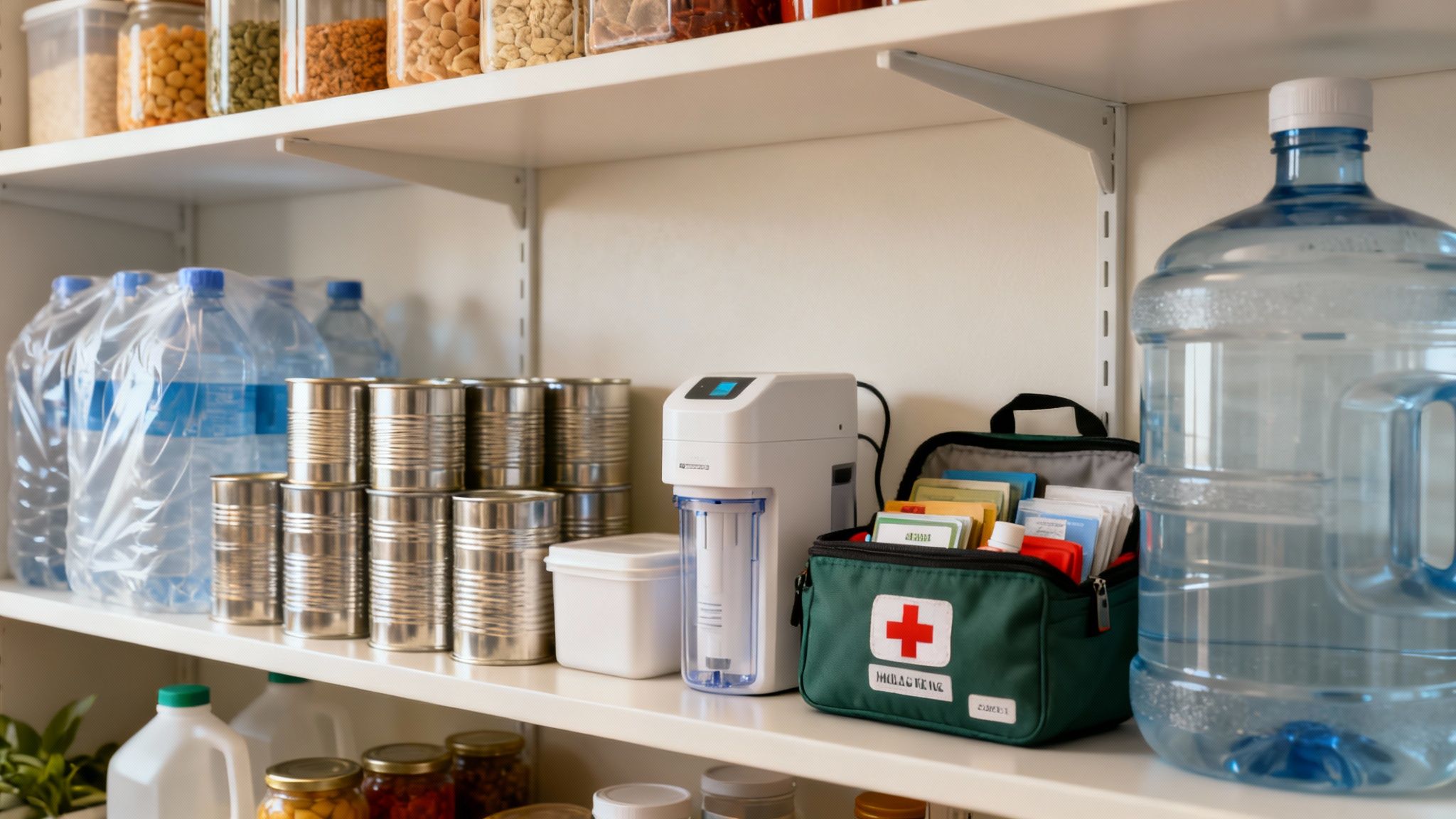
When the world outside your door becomes unpredictable, the supplies within your four walls are everything. If movement is restricted and supply chains snap, a well-stocked pantry, a reliable source of clean water, and a serious medical kit become your lifeline. This isn’t just about riding out a few bad days; it’s about building genuine resilience for a situation that could drag on for weeks, or even months.
Use a comprehensive emergency preparedness checklist to ensure you’re not overlooking any critical supplies or preparations.
Your entire supply strategy should boil down to three critical areas: food, water, and health. Each one demands careful thought and a methodical approach to make sure you have what you need when you can’t just run to the store. The end goal is to create a totally self-sufficient ecosystem right in your own home.
Building Your Food Stockpile
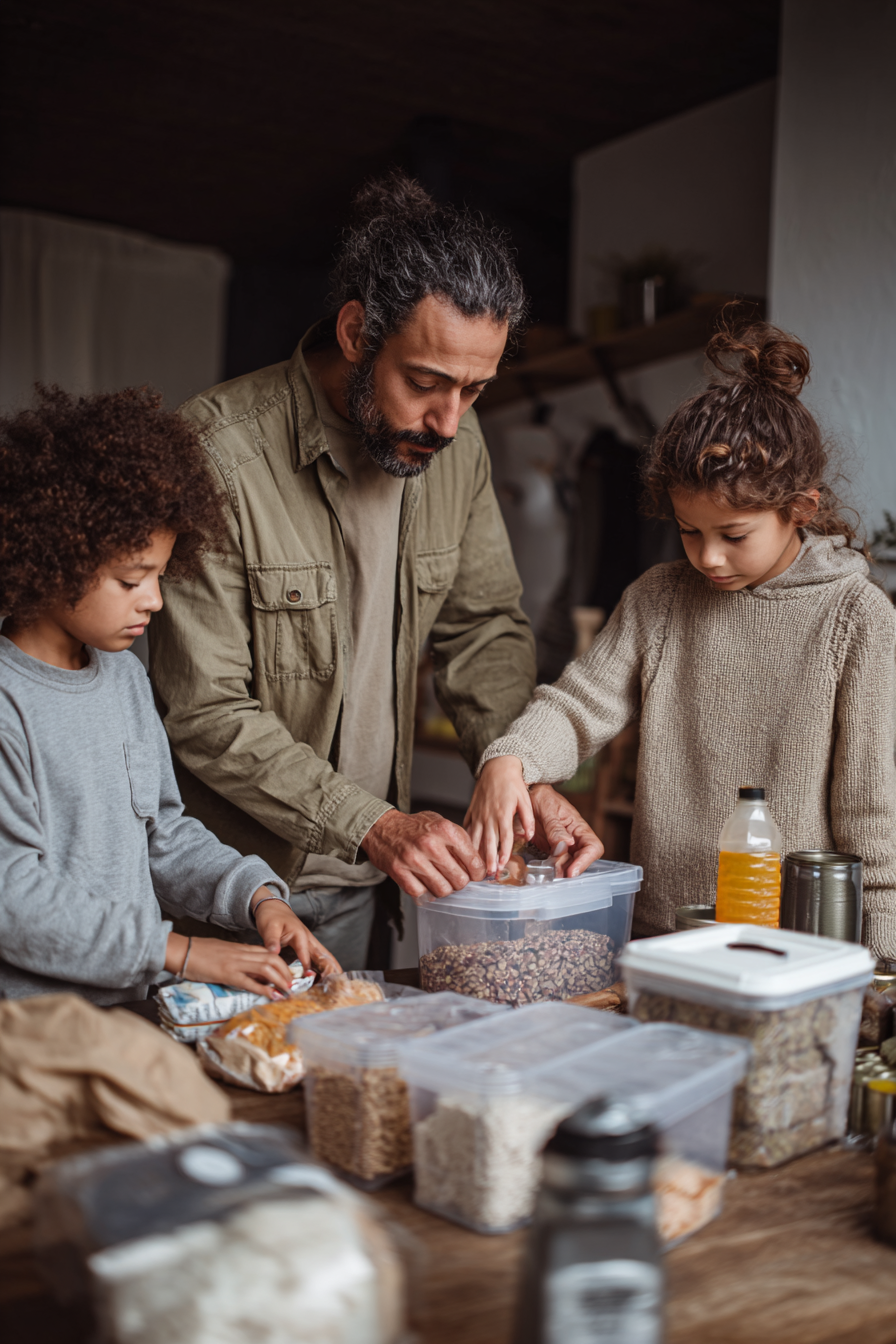
Let me give you the single most important rule of stockpiling: store what you eat, and eat what you store. Now is not the time to buy 50 pounds of wheat berries if your family has never even seen a flour mill. You start by simply expanding what you already do. Every time you go to the grocery store, buy a few extra cans of soup, another bag of rice, an extra box of pasta.
This slow-and-steady method is easy on the wallet and guarantees you’re stocking food your family will actually want to eat when stressed. Once that becomes a habit, you can start layering in dedicated long-shelf-life items.
Here’s What to Prioritize for Your Pantry:
- Calorie-Dense Staples: Think white rice, dried beans, pasta, and oats. These are the absolute workhorses of a survival pantry. They give you the most caloric bang for your buck and take up minimal space.
- Canned Goods: Meats like tuna, chicken, and Spam are invaluable. Canned vegetables, fruits, and soups are just as crucial. They’re ready to eat right out of the can, no refrigeration or complex prep needed.
- Comfort Items: Never, ever underestimate the power of morale. Coffee, tea, powdered drink mixes, hard candy, and a little chocolate can make an incredibly stressful situation feel a bit more normal.
- Fats and Oils: Cooking oil, shortening, and especially peanut butter are critical. They’re essential for cooking and add a massive, much-needed calorie boost to any meal.
Get into the habit of a “First-In, First-Out” (FIFO) rotation system. When you bring new supplies home, put them at the back of the shelf and pull from the front for daily use. It’s a simple trick that keeps anything from expiring and ensures your stockpile is always fresh. For a deeper dive, our guide on long-term food storage will show you how to maximize the shelf life of everything you buy.
Securing Your Water Supply
You can go weeks without food, but you’ll only last a few days without water. The common recommendation is one gallon of water per person per day, but let’s be honest—that’s the bare minimum for drinking and a little sanitation. A much more realistic target to aim for is two gallons per person.
The easiest way to start is by stocking up on commercially bottled water. It’s sealed, safe, and has a practically indefinite shelf life. From there, supplement your stash with food-grade water storage containers. Those blue WaterBrick stackable containers you see on Amazon are fantastic because they’re durable and very space-efficient.
But storage is only half the battle. You absolutely need a way to make questionable water safe to drink.
Your water plan must be layered. Have stored water for immediate use, a primary filter for ongoing needs, and a chemical backup for absolute emergencies.
A high-quality portable water filter is non-negotiable. Something like the Sawyer Squeeze is a popular and field-tested option that can filter thousands of gallons, easily removing dangerous bacteria and protozoa. For a backup to your backup, keep water purification tablets or a simple bottle of unscented household bleach. Just remember the ratio: 8 drops of bleach per gallon of clear water.
Medical and Sanitation Essentials
In a crisis, a small cut can quickly become a life-threatening infection. Your medical kit needs to be more than a box of cartoon bandages and some antiseptic wipes. You have to be ready to become your family’s first responder when calling 911 isn’t an option.
Build a real trauma kit. It must include:
- Tourniquets (and the knowledge to apply them correctly)
- Chest seals for penetrating wounds
- Israeli bandages or other pressure dressings
- Hemostatic gauze to stop severe bleeding
- Materials for splinting broken bones
Don’t forget the everyday stuff, either. Stock up on over-the-counter pain relievers, fever reducers, and allergy meds. Even more important, talk to your doctor about getting at least a 90-day supply of any critical prescription medications your family members depend on.
Sanitation is just as vital as medicine in preventing the spread of disease. When modern plumbing fails, things can get ugly fast. You need a plan for human waste. A simple bucket with heavy-duty trash bags and a carbon material like kitty litter or sawdust makes a perfectly functional emergency toilet. Stockpile disinfectants, hand sanitizer, and plenty of soap.
Maintaining Off-Grid Communication and Intel
When the lines of authority blur and civil order frays, information isn’t just power—it’s survival. The official channels you rely on today will likely become heavily filtered, pushing a specific narrative while silencing anything that doesn’t fit. You have to assume your phone and internet will be monitored, slowed to a crawl, or shut down completely in a real crisis.
Your ability to gather good intel and talk securely with your family or group will directly determine your safety. This means looking beyond your smartphone and building a reliable, off-grid communication plan. It’s not just about buying the right gear; it’s about developing the skills to cut through the noise and misinformation that will be everywhere.
Establishing Reliable Communication Layers
Relying on a single radio or phone is a recipe for disaster. That’s a single point of failure. A solid plan has layers, starting with passively listening for information and building up to two-way, secure conversations. This layered approach means you’ll always have a way to stay informed, even if one method gets compromised.
- Listening In: Your foundational layer is a simple way to receive information. A hand-crank or battery-powered emergency radio is non-negotiable. It should have AM/FM, shortwave, and NOAA weather bands to pick up official broadcasts and news from well outside your immediate area.
- Talking Locally: For short-range chats with family or your mutual assistance group, a basic set of GMRS/FRS radios works. But for something more robust, a handheld ham radio like the Baofeng UV-5R is a popular and affordable step up. It gives you much better range and flexibility, but it does require a license and, more importantly, a lot of practice to use well. Knowing the different emergency radio features available will help you pick the right tools for your situation.
Vetting Information and Protecting Data
During something like martial law, propaganda and deliberate misinformation will be weaponized. Your ability to critically think and vet your sources is just as vital as the radio you’re using. Always question where the information is coming from. Try to get confirmation from multiple, independent sources before you bet your family’s safety on it.
This same discipline has to apply to your personal data. Digital information is a huge liability.
In a lockdown, your personal information can be used against you. Assume every digital message, call, or post is being monitored. Protect what you have by limiting what you send and securing what you store.
Keep hard copies of all your critical documents—IDs, birth certificates, deeds, and financial records—in a waterproof, fireproof, and easily accessible place. For digital backups, use encrypted external hard drives or USB sticks that aren’t connected to any network. This ensures you can prove who you are and what you own even if the power is out or your devices are taken. A simple waterproof document bag, the kind you find in any camping section, is perfect for this.
History gives us clues for realistic planning. Here in the United States, martial law or similar actions involving domestic troops have happened around 68 times. Nearly half of those were related to labor disputes and strikes. This tells us we should plan not just for a total national collapse, but for localized clampdowns. Your focus should be on how to operate within a 5–10 mile radius under curfew, all while keeping a low profile that doesn’t attract the wrong kind of attention.
People and Mindset: Your Two Most Critical Assets
You can have all the best gear and a pantry stocked to the rafters, but none of it means a damn thing without the right people and the right mindset. This is the part everyone overlooks, but it’s the absolute core of getting through a crisis like martial law.
Let’s be brutally honest: the lone wolf dies. It’s a great movie trope, but in the real world, when things go sideways, your strength is in your community. Nobody gets through a long-term, high-stress disaster on their own. This is where your Mutual Assistance Group (MAG) becomes the most valuable resource you have—more than food, more than ammo. A MAG is simply a small, trusted group of people who’ve agreed ahead of time to pool their skills, resources, and security.
Building Your Mutual Assistance Group
You don’t put up a flyer for this. It starts quietly, with people you already know.
Look around your neighborhood. Who’s the guy who’s always fixing his own truck? Who’s the woman with the impressive garden every year? Who are the people who stay calm and check on others when a storm knocks the power out? These are your potential allies.
Start the conversation casually. Talk about the price of groceries, a recent power outage, or home security. You’re not trying to recruit them into a militia; you’re just feeling them out to see if they have a practical, self-reliant mindset. Once you find a few like-minded families, you can start talking more seriously.
The key is to build a team where everyone has a role based on what they already know how to do:
- Security: That vet or retired cop down the street? They probably know a thing or two about setting up a neighborhood watch and being a deterrent.
- Medical: A nurse, a paramedic, even a veterinarian in the group is worth their weight in gold when a trip to the ER isn’t an option.
- Hands-On Skills: The mechanic who can keep a generator running. The ham radio operator who can get information when the internet is down. The electrician who can safely wire things up.
The idea is to create a small, tight-knit network where everyone pulls their weight. This shared responsibility is what makes the group resilient enough to handle whatever comes its way.
Forging Unbreakable Mental Fortitude
When it all hits the fan, your mind is your number one weapon. Panic is a virus—it spreads fast and makes smart people do stupid things. Building your mental toughness now is every bit as critical as stockpiling supplies.
You can start small. Practice stress-reduction techniques or just get used to being a little uncomfortable. Run drills with your family that feel real but are still safe. Practice living without grid power for a weekend—our guide on how to prepare for a blackout will show you exactly what to expect and how to handle it. Fire up that Goal Zero solar generator and see what it can actually run. You’ll find the holes in your plan fast while the stakes are low.
Mental readiness isn’t about being fearless. It’s about being able to function with fear. It’s the discipline to think clearly and act when everyone else is losing their minds.
In a crisis, routine is a powerful anchor, especially for kids. Stick to a schedule as much as humanly possible. Eat meals at the same time. Have a family game night. Read a book out loud. This sense of normalcy is a powerful defense against anxiety and keeps morale from cratering.
Ultimately, your calm, confident leadership will be the bedrock your family stands on. It’s the most important thing you can give them.
Unpacking Common Questions About Martial Law Prep
When you start digging into how to prepare for a scenario like martial law, a lot of the same questions tend to pop up. It’s only natural. Getting straight answers is key to building a plan that actually works and gives you real peace of mind.
Is This Even Legal to Prepare For?
Let’s clear this up right away: yes, it’s 100% legal.
Thinking ahead and getting your household ready for potential emergencies is simply responsible planning. It’s no different from preparing for natural disasters like hurricanes, wildfires, or earthquakes.
The trick is making sure how you prepare is on the right side of the law. Every piece of gear you buy, every supply you stockpile—it all needs to comply with your local, state, and federal regulations. This is about self-reliance, not breaking rules.
How Much Cash Should I Actually Stash Away?
When the power goes out and the banking system grinds to a halt, digital money is worthless. Cash is king.
A good rule of thumb I’ve always followed is to have enough physical cash to cover one to three months of non-negotiable expenses. Think about what you’d need for fuel, critical food runs, or maybe even to barter for something essential.
And don’t just keep it in big bills. A mix of small and large denominations gives you flexibility. One more pro tip: don’t keep it all in one spot. Spread your cash reserve across several smart, hidden locations.
When the financial grid goes down, a solid cash reserve buys you options and the ability to act. It’s not just a nice-to-have; it’s a cornerstone of any serious preparedness strategy.
What’s the One Skill I Absolutely Have to Learn?
You can learn to tie knots, build shelters, and read a map, and all those things are great. But if I had to pick just one, it would be water purification and management.
Think about it: you can go for weeks without a meal, but you’ll only last a few days without clean, safe water. It’s the ultimate non-negotiable.
Don’t just rely on one method, either. Learn how to boil water safely, how to use chemical treatments like purification tablets, and invest in a top-notch portable filter. When you can confidently turn questionable water into something drinkable, you’ve mastered a skill that’s fundamental to surviving just about any crisis.