
When you peel back the romantic image of off-grid living, you find a reality built on sweat, smart planning, and a deep understanding of core systems. True self-reliance isn’t just about cool gear; it’s about creating interconnected systems for Power, Water, Shelter, and Food, all held together by the practical skills you’ve taken the time to learn.
Before we dive into the practical systems, it’s worth understanding the philosophy and lifestyle behind this movement—check out our foundational article on what is off-grid living to get the full picture.
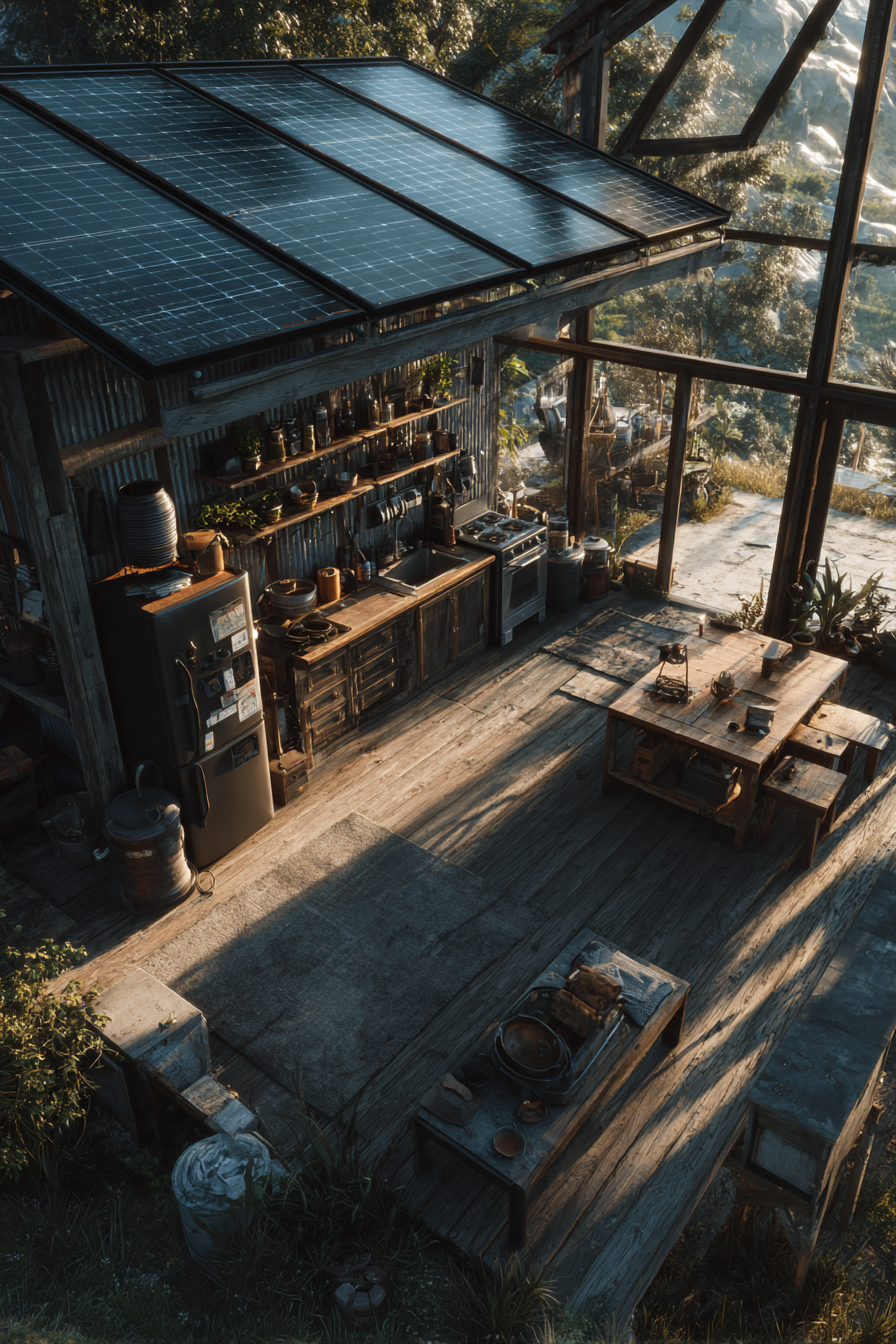
Starting Your Journey to Self-Reliance
Getting off-grid is a lot like building a house—you have to pour a solid foundation before you can even think about putting up the walls and roof. That foundation rests on five interconnected pillars: Power, Water, Shelter, Food, and Skills.
Each pillar supports the others, creating a stable framework for your independence. For instance, a reliable water pump (Water) is just a heavy paperweight without a solar panel system (Power) to run it. Likewise, a well-stocked pantry (Food) won’t do you much good if your shelter can’t keep out the elements.
If you’re completely new to this lifestyle and want a broader overview before diving into the technical details, start with our comprehensive guide on off-grid living for beginners.
This guide isn’t about selling an impossible dream. It’s about a methodical, step-by-step approach to building real freedom. Success comes from mastering the basics first.
Self-reliance is the logical outcome of layering foundational systems one on top of another. It begins not with a dramatic leap, but with the first deliberate step toward reducing dependency, whether that’s learning a new skill or setting up a simple rainwater barrel.
The Five Pillars of Off-Grid Living
To really make this work, you have to understand how these core areas function together. A failure in one pillar can easily cascade, bringing the whole system down with it.
- Power: This is the engine of modern off-grid life. It runs your water pumps, keeps your food cold, powers your tools for repairs, and keeps you connected to vital information.
- Water: This is non-negotiable. Securing a clean, reliable water source—and having multiple ways to purify it—is the absolute first priority before anything else.
- Shelter: More than just a roof, your shelter is your command center. It provides security from the elements, warmth, and the base of operations for everything you do.
- Food: This means creating sustainable food sources through gardening, raising animals, and mastering preservation techniques so you can eat year-round, not just during harvest season.
- Skills: This is the software that runs all your expensive hardware. From first aid and welding to fixing a pump or starting a fire in the rain, practical skills are what turn gear into life-saving tools.
This systematic approach is fundamental. If you’re new to this way of thinking, it’s smart to start with the basics. To learn more about this structured approach, check out our guide on how to start prepping.
To help you get started, here’s a quick-reference table that breaks down the essentials for each pillar into immediate needs versus longer-term systems.
The 5 Pillars of Off-Grid Living At a Glance
Use this table as a quick checklist to understand the non-negotiable essentials in each core category, helping you prioritize your journey to self-sufficiency.
| Pillar | Tier 1 Essential (Immediate Need) | Tier 2 Essential (System Building) |
|---|---|---|
| Power | Portable solar generator, batteries, flashlights, headlamps. | Permanent solar array, inverter, charge controller, large battery bank. |
| Water | Stored water (55-gallon barrels), portable filters (e.g., Sawyer). | Well/borehole, rainwater harvesting system, whole-house filtration. |
| Shelter | Secure, weather-proof structure with basic heating/cooling. | Fortified structure, wood stove, insulation, redundant heating. |
| Food | 30-day supply of non-perishable food, basic cooking setup. | Large garden, livestock, food preservation setup (canning, dehydrating). |
| Skills | Basic first aid, fire-making, knife skills, knot-tying. | Advanced medical training, welding, mechanical repair, animal husbandry. |
Think of this table not as a finish line, but as a roadmap. Start with Tier 1 in every category to build a solid foundation, then methodically work your way toward building the robust, long-term systems in Tier 2.
Establishing Your Independent Power System
In the off-grid world, power is what separates bare-bones survival from a sustainable, thriving homestead. It’s not a luxury. Electricity runs the pump that delivers clean water, keeps your food from spoiling in the fridge, and powers the tools you need to stay connected and safe. Building out your own independent power system is one of the most foundational steps you’ll take.
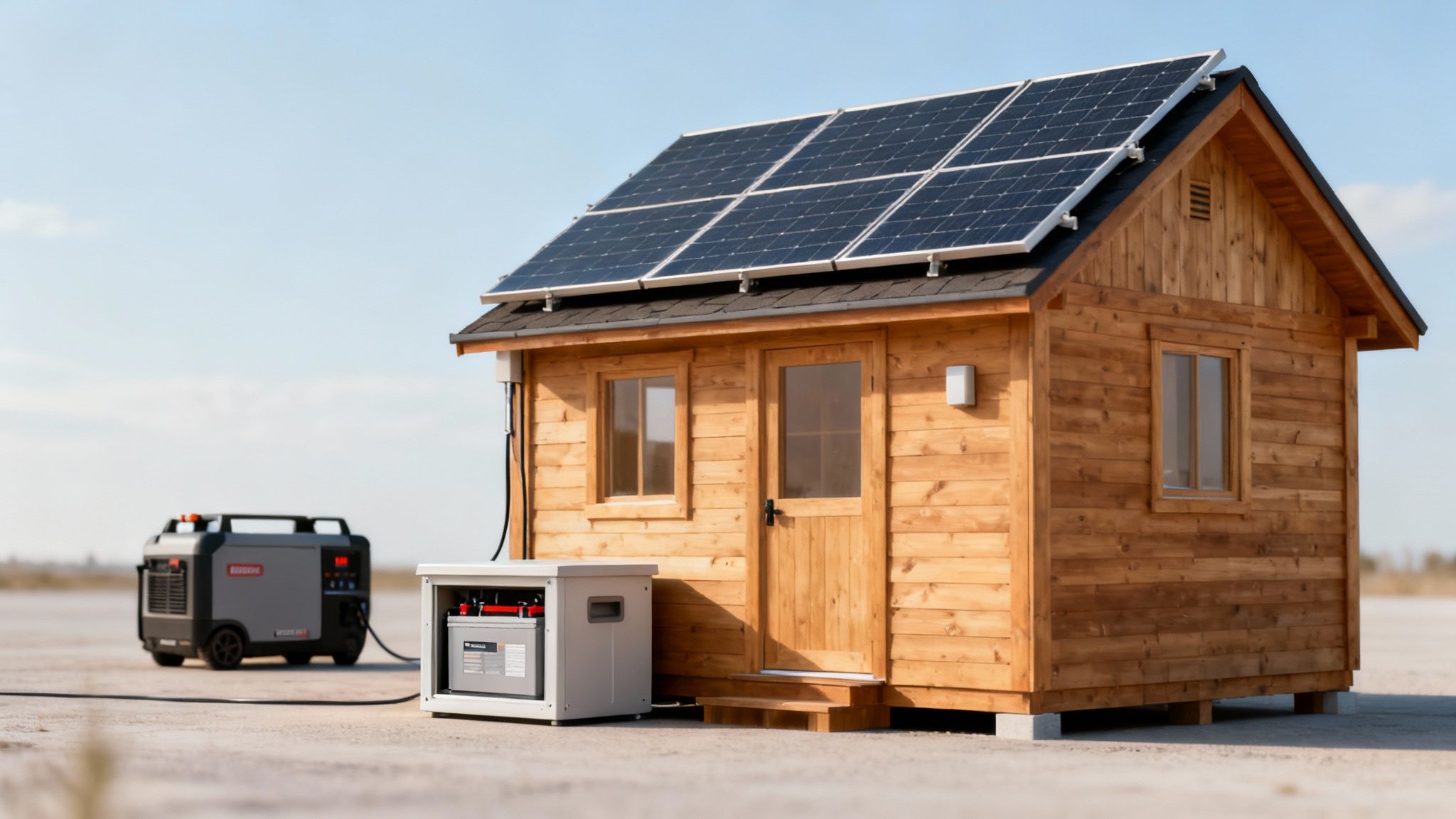
Solar has become the undisputed king of self-reliant power, and for good reason. It’s more efficient and affordable than ever before. The global market for off-grid solar products exploded to US$3.9 billion in 2022, and by the end of 2023, it was providing power to over 560 million people. That’s not a niche hobby—it’s proof that solar is a reliable, scalable solution for real independence.
Demystifying Your Solar Power Setup
A solar power system might seem complex, but it’s really just four key parts working together. Think of it as a complete process: catching sunlight, managing its flow, storing it for later, and then converting it for use. Once you understand the job of each component, the whole setup makes perfect sense.
Here’s how it breaks down:
- Solar Panels: These are your collectors. They sit in the sun all day, capturing its energy and turning it into Direct Current (DC) electricity.
- Charge Controller: This is the brains of the operation. It acts like a traffic cop, managing the energy flowing from the panels to your batteries to prevent overcharging, which can destroy them.
- Battery Bank: This is your energy savings account. The batteries store all that DC power your panels collect during the day, so you can draw from it at night or when the skies are gray.
- Inverter: This is the translator. It takes the stored DC power from your batteries and converts it into Alternating Current (AC) power—the kind that runs just about every standard appliance in your home.
Getting this system right starts with one simple, non-negotiable step: an energy audit.
Calculating Your Power Needs
The single biggest mistake people make is guessing how much power they need. This leads to one of two outcomes: an undersized system that constantly fails or an oversized one that costs thousands more than it should. An energy audit eliminates the guesswork.
To do a quick audit, just make a list. Write down every single appliance you plan on using, find its wattage, and estimate how many hours a day it will run. A 150-watt refrigerator running for 8 hours a day, for example, consumes 1,200 watt-hours. Tally that up for everything on your list, and you’ll have your daily power target.
This number is the blueprint for your entire system. It tells you exactly how many panels you need to generate enough juice and how big your battery bank needs to be to store it.
Choosing the Right Components
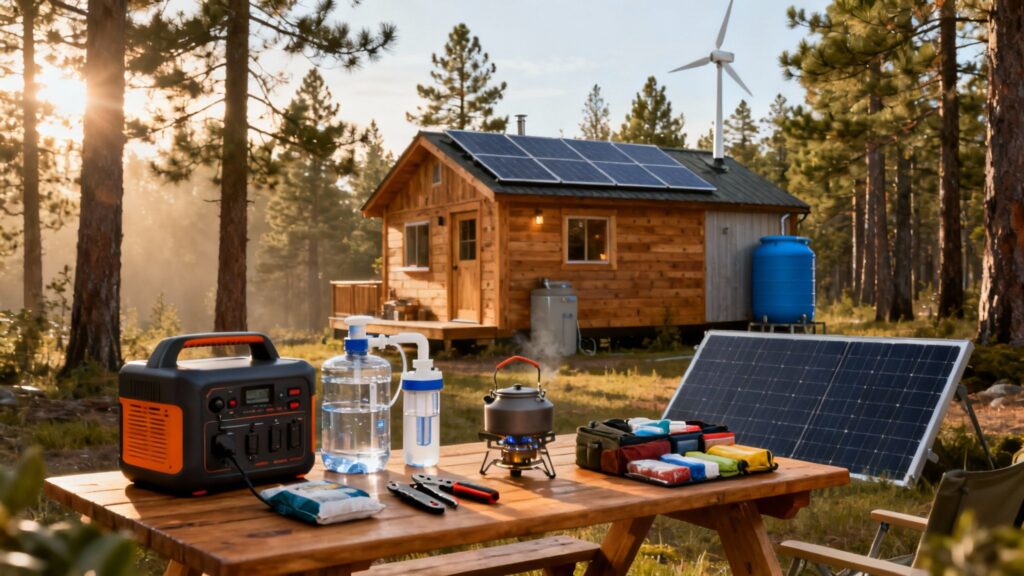
Once you have your numbers, you can start picking out the gear. If you’re just getting started or need something you can move around, a portable power station from a solid brand like Goal Zero or Jackery is a great entry point. These all-in-one units pack a battery, charge controller, and inverter into a simple, plug-and-play box.
For a more permanent homestead, DIY solar kits from a company like Renogy provide an awesome balance of quality and value. They bundle everything you need—panels, controllers, and inverters that are all designed to work together—taking the headache out of building a system from scratch. Our guide on choosing portable power sources can help you figure out the best place to begin.
A well-designed power system is built on layers of redundancy. Your primary system is only as reliable as its backup, ensuring you are never left in the dark when you need power most.
This is a critical mindset. Solar is amazing, but it relies on the sun. A week of solid cloud cover can drain even a massive battery bank. That’s why a backup generator isn’t an add-on; it’s a necessity.
A quiet inverter generator, such as a Honda EU2200i, is the perfect companion to a solar setup. It provides clean power that won’t fry sensitive electronics, and it’s far more fuel-efficient and less noisy than old-school construction generators. Add in a safe plan for fuel storage, and you’ve created a truly resilient system that will keep the lights on, no matter what.
Securing a Safe and Reliable Water Source
Of all the essentials for off-grid living, water is the absolute, non-negotiable foundation. You can survive for weeks without food, but you’ll only last a few days without water. Before you even think about calculating power needs or designing a shelter, your first and most critical job is to lock down a safe, reliable, and redundant water source.
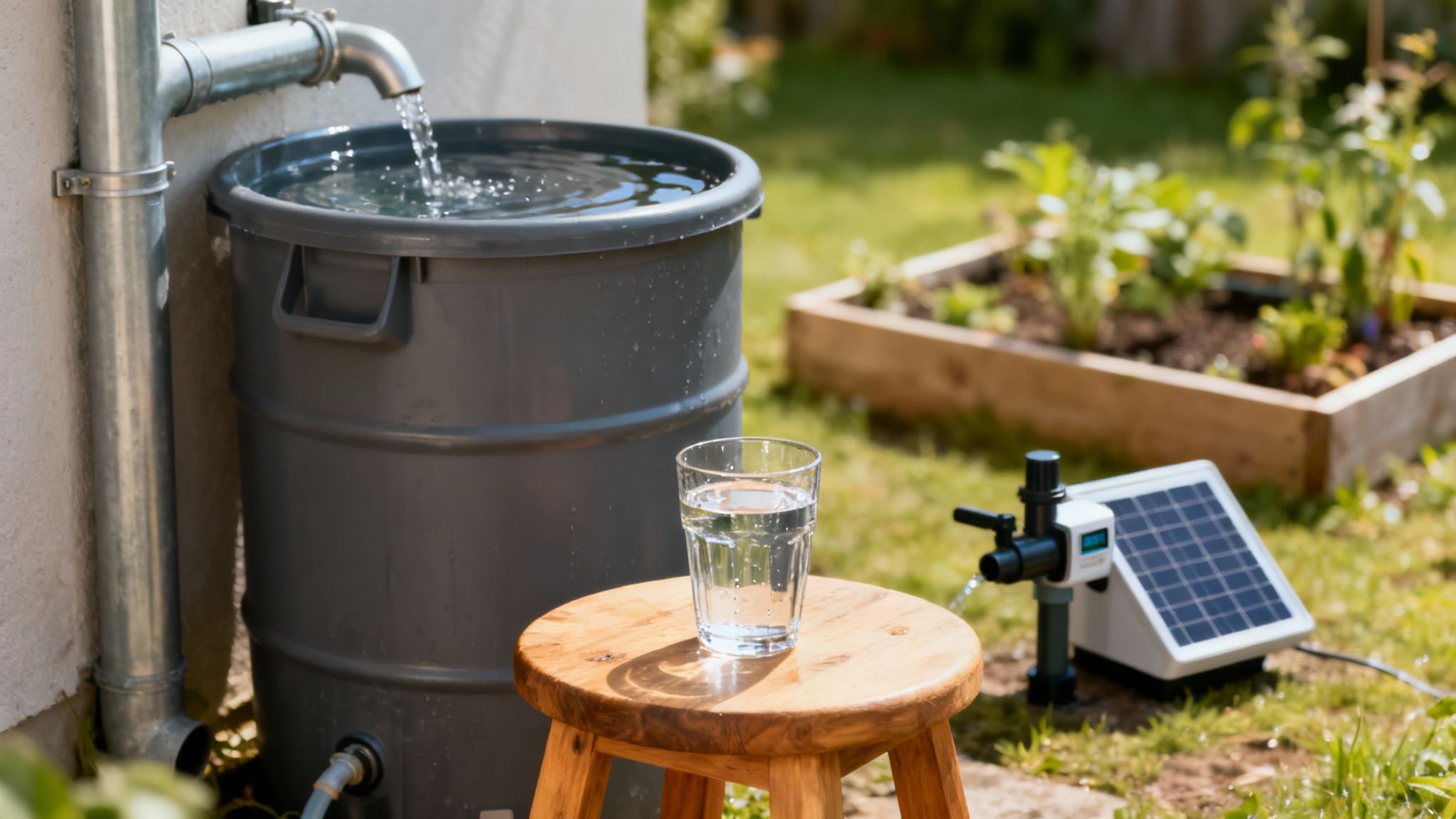
This isn’t about setting up a single rain barrel and calling it a day. True water security is a multi-layered strategy covering sourcing, purification, storage, and distribution. Relying on a single well or tank is a recipe for disaster. Real resilience means having backups for your backups, ensuring that a single point of failure never leaves you high and dry.
Sourcing Your Off-Grid Water
First things first, you need to identify where your water will come from. Your property and your budget will point you toward the best option, but the most common choices can provide a steady supply for drinking, cleaning, and gardening.
- Wells and Boreholes: This is the gold standard for off-grid water. A professionally drilled well taps directly into groundwater, giving you a consistent and naturally filtered source. It’s a serious upfront investment, but the reliability it offers is second to none.
- Rainwater Harvesting: This is an incredibly accessible and affordable starting point for just about anyone. A simple gutter-and-barrel system can capture thousands of gallons of water each year, depending on your roof size and how much rain you get.
- Natural Springs or Rivers: If your land is blessed with a natural spring or a flowing creek, it can be an excellent primary or secondary source. Just remember, surface water is far more likely to be contaminated and always requires serious purification.
Making Your Water Safe to Drink
Getting water is only half the battle; making it safe to drink is the other, more important half. You need to understand the difference between filtration and purification, as they tackle different threats.
Filtration removes larger contaminants like bacteria, protozoa (think Giardia), and sediment. Purification goes a step further by neutralizing or removing viruses, which are too small for most filters to catch. For any unknown water source, a multi-stage approach is always the safest bet.
For portable and emergency needs, a simple hollow-fiber filter like the Sawyer Squeeze is a non-negotiable piece of kit. It’s lightweight, highly effective against bacteria, and can be used to drink straight from a source or attached to a water bottle. Another popular choice is the Lifestraw, which offers similar functionality in a simple, compact design.
When it comes to your home system, though, nothing beats the reliability of a gravity-fed filter. A system like the Berkey water filter uses simple gravity to pull water through powerful purification elements that strip out bacteria, viruses, heavy metals, and chemicals—all without needing a single watt of electricity. This makes it a perfect off-grid solution for your daily drinking water.
To really get into the weeds on the different methods, you can check out our complete guide on how to purify water.
Before we move on, let’s break down the most common purification methods. This table gives you a quick overview of what each system does best and where its limitations lie.
Comparing Off-Grid Water Purification Methods
| Method | Effective Against | Best For | Key Limitation |
|---|---|---|---|
| Boiling | Bacteria, Protozoa, Viruses | Emergency situations; killing all pathogens | Consumes fuel; not practical for large volumes |
| Gravity Filters (e.g., Berkey) | Bacteria, Protozoa, Viruses, Chemicals, Heavy Metals | Daily drinking water at home; no power needed | Slower processing time; initial cost can be high |
| Hollow-Fiber Filters (e.g., Sawyer) | Bacteria, Protozoa | Portable, on-the-go filtration; bug-out bags | Does not remove viruses or chemical contaminants |
| UV Purifiers | Bacteria, Protozoa, Viruses | Treating clear water quickly; portable use | Requires batteries/power; ineffective in cloudy water |
| Chemical Treatment (Tablets) | Bacteria, Viruses (some protozoa) | Lightweight backup; emergency water treatment | Can leave a chemical taste; wait time required |
Choosing the right combination of these methods is what builds a truly resilient water system. A Berkey at home, a Sawyer Squeeze in your pack, and some Potable Aqua purification tablets as a final backup is a solid strategy.
Automating Water Distribution
Once your water is sourced and purified, you need an efficient way to move it where you need it. This is where your power and water systems can work together, creating a powerful synergy that pushes you closer to true self-sufficiency.
A solar water pump is an absolute game-changer for any off-grid homestead.
These pumps connect directly to a small solar panel, using the sun’s energy to move water from your well or storage tank to your house, garden, or livestock troughs. This automates what would otherwise be a back-breaking chore and forges a direct link between your water and food systems.
The impact is huge. A survey of 79,000 off-grid users found that 86% of those using solar water pumps reported higher productivity, and 60% were able to expand the amount of land they could cultivate. That’s a powerful testament to how automating your water supply directly fuels your food security and overall resilience.
Smart Water Storage and Redundancy
Your final layer of water security is storage. The goal here is to have enough water stashed away to get you through a drought, a system failure, or a contamination event. A good rule of thumb is to store a minimum of one gallon of drinking water per person, per day, but for real off-grid living, you’ll need far more for hygiene and growing food.
Large, food-grade plastic tanks or cisterns are perfect for bulk storage, and they can often be connected directly to your rainwater harvesting system. You can start with a few 55-gallon barrels and scale up as your budget allows.
By combining a primary source like a well, a secondary rainwater system, and plenty of storage, you create a robust, layered defense that ensures your most essential resource is never in jeopardy.
Creating a Resilient Off-Grid Shelter
Your shelter is the command center of your off-grid life. It’s so much more than just a roof over your head; it’s where your security, warmth, and daily operations all come together. The goal is to create a smart, resilient base that works with nature, not against it.
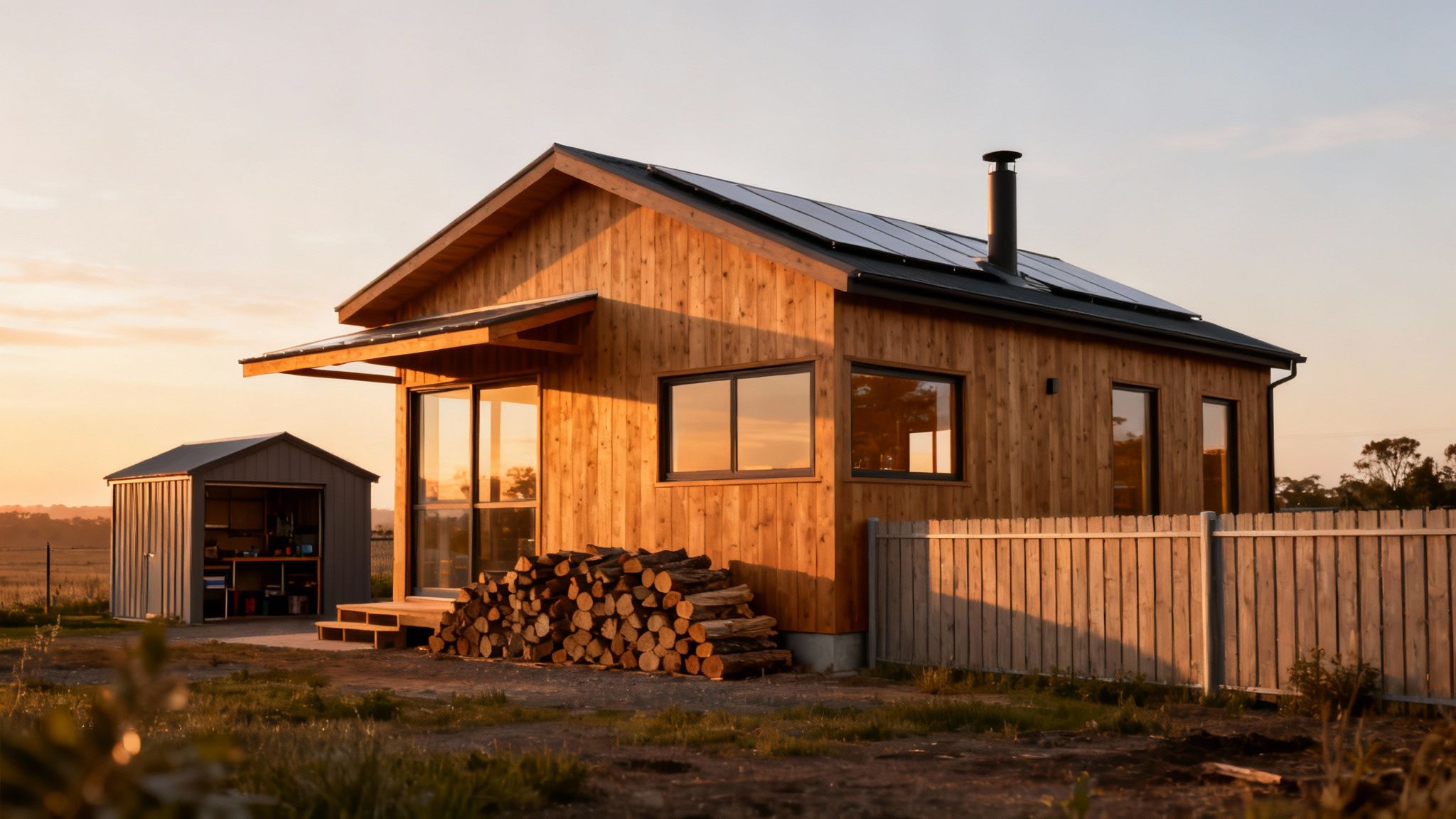
While a traditional cabin is a classic choice, the explosion of the tiny home movement has made this lifestyle more accessible than ever. This isn’t just a fringe trend—it’s a serious shift toward practical self-reliance.
The global off-grid housing market was valued at USD 2.4 billion in 2023 and is on track to nearly double to USD 4.76 billion by 2032. North America is leading the charge with over a 50% market share, largely thanks to tiny houses and solar integration. You can dig into more of the data on this growing market over at SkyQuest.
Designing for Efficiency with Passive Solar
One of the smartest moves you can make is to design a home that cuts down your reliance on power-hungry systems from day one. This is the simple genius behind passive solar design—using your home’s own structure to naturally heat and cool itself.
It’s a powerful concept. By placing large, south-facing windows (in the northern hemisphere), you can catch the low winter sun and heat your living space for free. Come summer, when the sun is high in the sky, a well-designed roof overhang blocks that same direct sunlight, keeping your home comfortably cool.
Passive solar design is the ultimate form of efficiency. It leverages the natural environment to do the heavy lifting for climate control, drastically cutting down on the energy you need to generate and store.
This principle also applies to your building materials. By incorporating thermal mass—dense materials like a concrete slab floor, brick, or tile—inside your home, you give that solar heat a place to go. These materials absorb warmth during the day and then slowly release it back into the room at night. It’s a simple trick that helps stabilize your indoor temperature year-round with almost no energy input.
Essential Homestead Infrastructure
A truly resilient shelter is more than the four walls of your house. It’s the supporting infrastructure that makes your property functional and secure. Without these key pieces, even the best-built cabin is just an isolated building waiting for a problem.
Here’s what you can’t skip:
- Secure Fencing: This is your first line of defense. It keeps your livestock in and unwanted visitors—both two-legged and four-legged—out.
- A Dedicated Workshop: A well-organized space for your tools is non-negotiable for repairs and projects. Trust me, trying to fix a water pump in the mud during a downpour is a lesson you only want to learn once.
- Organized Tool Storage: Your tools are your lifeline. Keeping them protected from the elements and neatly organized will save you countless hours, money, and a whole lot of frustration when something inevitably breaks.
These elements are what turn a piece of land into a secure, operational homestead. And while a permanent structure is the end goal for most, it’s wise to know all your options. Our guide on emergency shelter options offers a broader look at what’s possible.
Reliable Climate Control Systems
Even with a perfect passive solar design, you’re going to need a reliable heat source. The two most common choices for off-gridders each come with their own set of pros and cons.
A classic wood stove is a fantastic choice, providing robust heat even if your power system goes down, and it runs on fuel you can potentially harvest from your own land. The trade-off is the constant labor—cutting, splitting, and stacking wood is a serious commitment. On the other hand, propane heaters like a Mr. Heater Buddy offer push-button convenience with thermostat control, but they make you dependent on an external fuel supply.
But here’s the bottom line: your most powerful tool for year-round comfort isn’t your heater or your AC unit. It’s your insulation. It is the single most important factor in keeping your shelter warm in the winter and cool in the summer. Don’t skimp here. Investing heavily in high-quality insulation will pay for itself many times over by slashing your heating and cooling needs, making your entire off-grid system more efficient and resilient.
Mastering the Skills and Gear for Daily Life
All the fancy solar arrays and water systems in the world are just expensive decorations without the skills to run, maintain, and fix them. Real off-grid resilience isn’t just about the hardware; it’s about the hands-on knowledge that turns a tool into a solution when things go wrong. This is where the theory stops and the real work begins.
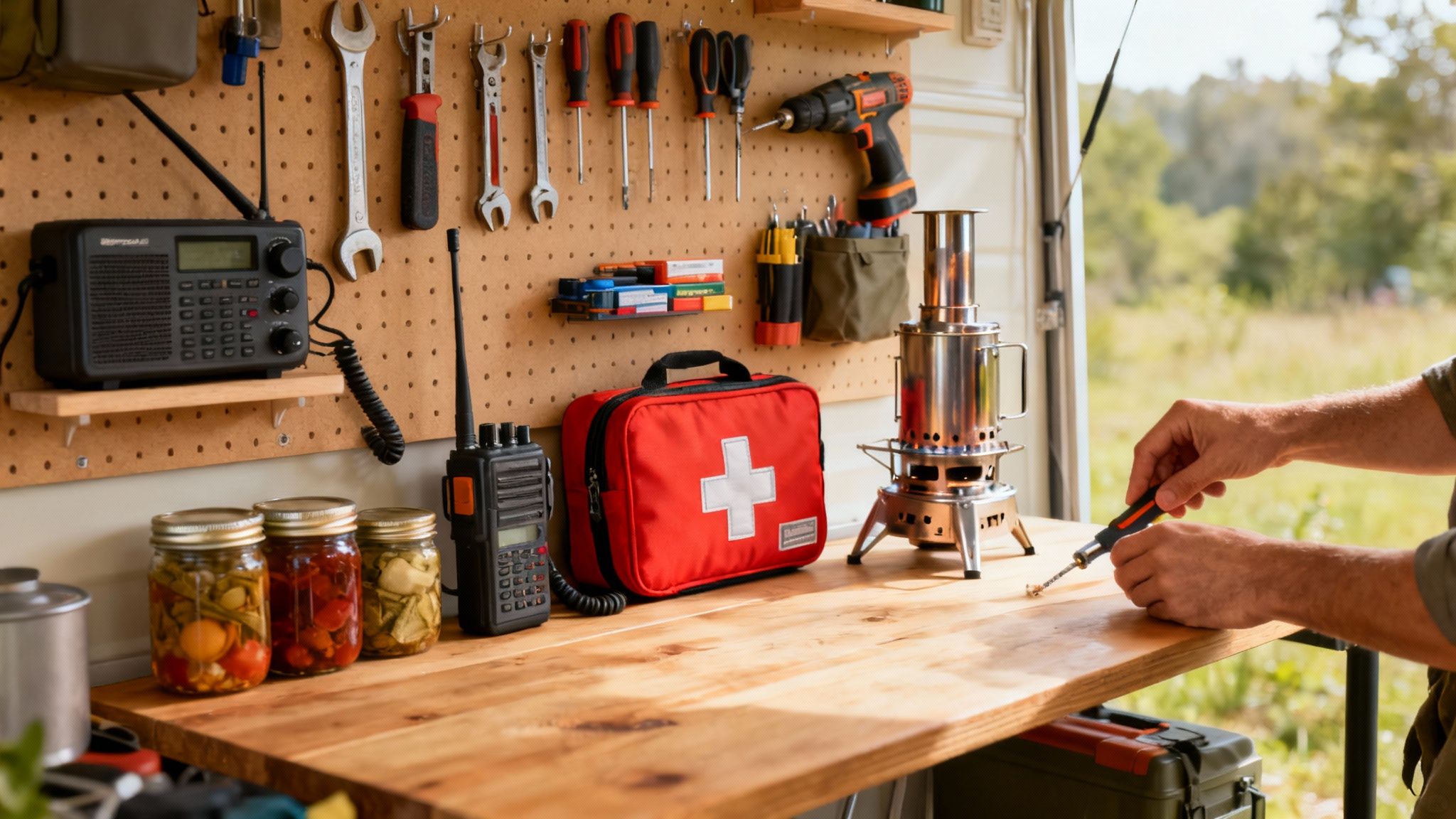
Think of this section as your checklist for the everyday off grid living essentials. We’re talking about the gear and the know-how that bridge the gap between just having equipment and actually knowing how to use it to keep your family safe and comfortable.
Food Preparation and Preservation Without Power
When the power cuts out, your refrigerator becomes a useless, insulated box. That’s why non-electric cooking and food preservation methods are non-negotiable. You need bulletproof ways to cook meals and store your harvest that don’t rely on an inverter or a noisy generator.
A simple rocket stove is a game-changer, blasting out intense heat from just a few twigs. On the other end of the spectrum, a solar oven can bake anything a regular oven can, powered by nothing but sunshine. Having both gives you options, rain or shine.
For keeping your pantry full year-round, traditional preservation skills are your lifeline. These aren’t just quaint hobbies; they’re the bedrock of food security.
- Canning: A pressure canner, such as the widely-used Presto Pressure Canner, is your best friend for safely storing low-acid foods like meat, fish, and most vegetables for years.
- Dehydrating: This is one of the easiest ways to create lightweight, nutrient-packed food. You can use a solar dehydrator or even just the air and sun to dry out fruits, veggies, and herbs.
- Fermenting: Making things like sauerkraut or kimchi doesn’t just preserve food—it actually makes it more nutritious by adding beneficial probiotics.
Layered Safety and Communication
Your security and your ability to call for help are just as vital as food and water. A layered security plan starts with the basics: solid locks, reinforced doors, and a clear line of sight around your property. But when it comes to communication, you have to think beyond your smartphone.
If the cell towers go down, a ham radio becomes your connection to the outside world. Reliable handheld models like the Baofeng UV-5R are an affordable entry point for beginners. It lets you talk to people over huge distances without needing any existing infrastructure. Getting your license is a pretty straightforward process, and the ability to get information when no one else can is priceless.
Medical readiness is the other critical layer. That little first-aid kit from the pharmacy won’t cut it. A serious trauma and medical kit, like the ones from companies such as MyMedic, gives you the tools to handle major injuries when an ambulance might be hours away.
For a comprehensive breakdown of what belongs in your emergency preparedness arsenal, our guide on building a disaster supply kit covers everything from medical supplies to communication tools.
Gear is the starting point, but skill is what ensures survival. Practicing fire-starting, basic repairs, and food preservation now turns theoretical knowledge into muscle memory long before you truly need it.
You can’t just read this and nod along. Owning a fire starter is pointless if you’ve never tried to get a flame going in the wind and rain. A well-stocked toolbox is just a heavy box if you don’t know how to track down a leaky pipe or fix a bad connection on your water pump.
The skills you build today are your most valuable asset. They don’t need batteries, they can’t be stolen, and they are the true foundation of being self-reliant. If you’re looking for where to begin, our guide on the top survival skills you must master is the perfect starting point. It’s time to turn your gear into an extension of what you know.
A Phased Plan for Your Off-Grid Transition
Going fully off-grid is a marathon, not a sprint. Anyone who tells you otherwise is selling something. Trying to tackle everything at once is the fastest way to burn through your savings, your motivation, and your sanity.
Instead, a deliberate, phased approach makes the whole thing manageable. It lets you build real skills, spread out the costs, and gain unshakable confidence one step at a time. This journey starts right where you are, not on some remote piece of land you haven’t bought yet.
Think of it as a three-stage rocket launch. Each stage builds on the last, pushing you closer to true independence without blowing up on the launchpad.
Phase 1: The Hybrid Living Stage
This is your foundation. You’re still connected to all the modern conveniences, but you start intentionally chipping away at your dependency. It’s all about building skills and stockpiling essentials right in your current home.
- Skill Building: This is where the real work begins. Get hands-on with the core skills we’ve covered. Start canning vegetables from the farmer’s market, practice starting a fire with a few different methods (when it’s not an emergency), and get certified in first aid.
- Essential Stockpiling: Begin methodically building a deep pantry with non-perishable foods your family will actually eat. This is also the time to acquire key tools, a good portable water filter, and a serious medical kit, like the ones from MyMedic.
- Small-Scale Systems: Don’t go big yet. Set up a simple rainwater barrel for your garden. Start a small container garden on your patio or balcony. The goal here is to learn from small, low-risk, low-cost systems before you ever think about scaling up.
If finances are tight, don’t let that stop you—our guide on prepping on a budget shows you how to build real resilience without breaking the bank.
Phase 2: The System Integration Stage
Now you start bringing in your first major off-grid components, but you keep the grid as your safety net. This is your personal training ground for managing the bigger, more complex systems.
Maybe you install a small solar setup just to power your workshop or a backup freezer. You could add a larger rainwater harvesting system to supplement your household water. This is the perfect time to learn how your gear actually performs through different seasons, make adjustments, and see what your real-world usage looks like without the risk of a catastrophic failure.
The transition to self-reliance is built on a series of small, intentional victories. Each skill learned and each small system successfully integrated becomes a building block for the final move to complete independence.
Phase 3: The Full Independence Stage
This is it—the final move. After mastering your skills and battle-testing your systems in the first two phases, you’re finally ready to scale up and cut the cord.
This is when you expand that solar array to power the entire home, drill a well for a permanent water source, and ensure you have redundant backups for every single critical system. You’ve already made your mistakes on a small scale, so you know exactly what to do.
By following this step-by-step approach, you learn from small, manageable failures. You build competence. By the time you go fully independent, you have the experience and resilience to not just survive, but thrive.
Frequently Asked Questions About Off-Grid Living
Diving into off-grid living always kicks up a lot of questions. Getting straight answers is the first step to building a plan that works and avoiding the kind of mistakes that cost you time and money. Here are a few of the most common things people ask when they’re just getting started.
What Is the First Essential You Should Focus On?
Water. Always start with water. You can go for weeks without food, but you’ll only last a few days without clean water. Your absolute first priority is locking down a reliable source and having more than one way to purify it.
A solid home gravity filter, like a Berkey, is a perfect starting point for your daily needs because it doesn’t need any power to work. You’ll also want a portable filter, like the Sawyer Squeeze, as a backup and for when you’re on the move. Once you know your water is handled, then you can start thinking about a small, scalable power system.
How Much Does It Realistically Cost to Start?
Honestly, the cost can be all over the map. It really depends on how far you want to go and how fast you want to get there. You can start building real resilience with just a few hundred dollars by grabbing core off grid living essentials like water filters, some emergency food, and basic tools.
A small, portable solar setup for a cabin or RV might run you a few thousand dollars. But if you’re dreaming of a completely independent homestead with a professionally drilled well and a big solar array, you could easily be looking at tens of thousands. The trick is to take it one step at a time. A phased approach spreads the cost out, making the whole thing much less overwhelming.
What Are the Biggest Mistakes Beginners Make?
The two biggest tripwires for newcomers are drastically underestimating how much power they use every day and completely forgetting about redundancy. You need backups for your backups—it’s that simple. Another huge mistake is buying a bunch of expensive gear without ever practicing the skills to use and maintain it.
Success comes from detailed planning, starting small, and prioritizing practical skills over fancy gadgets. A simple, well-understood system is always better than a complex one you can’t fix yourself.
Finally, a surprising number of people dive in without doing their homework on local zoning laws and building codes. That oversight can bring your whole project to a grinding halt down the road.